


- Project Essentials: Loudoun County states that all decks require zoning and building permits; HOA review is a separate community requirement when applicable.
- The new digital LandMARC system demands specific PDF plan formats.
- Permit records and approved plans help document the project for inspections, future alterations, and property transactions.
- We prepare projects around current code requirements and coordinate reviewer comments when they arise.
Do all decks need permits in Loudoun County?
Yes. Loudoun County's current deck guidance states that all decks require a building permit and a zoning permit. Projects inside incorporated towns may follow a different reviewing path, and HOA approval does not replace county permits. Confirm the jurisdiction and current filing instructions on the official county deck page before construction. For a homeowner overview, read do I need a building permit for a deck in Virginia?
Important Note:
Do not use general Virginia exemption summaries to override Loudoun County's published deck instructions. Confirm both building and zoning requirements with the authority that will review the property.
- Starting work before the required approvals can lead to corrections, delays, or enforcement action; confirm the current process with the county before construction.
- Keep approved plans, permit records, and inspection results with the property's project documents.
- If an older deck needs structural corrections before review, compare the scope with our deck repair service and deck replacement service.
How do I complete a LandMARC deck permit application?
The LandMARC deck permit application requires homeowners to digitally upload PDF architectural plans, a plat map showing Loudoun County setback requirements, and specific structural details directly to the county portal. The Loudoun County permit dashboard tracks progress; missing approvals or incomplete documents can delay review and trigger correction requests.

While many recommend DIY permitting to save money, there is a strong case for professional management when facing multi-departmental reviews. Handling Loudoun County HOA Deck Rules alone often results in mismatched specifications between the architectural review board and county engineers.
The 5-Step Approval Process:
- Obtain zoning clearance: Mark exact setbacks on your certified property plat.
- Secure written HOA approval: Use material samples and preliminary renderings.
- Upload engineered drawings: Include load paths, footing layout, joist span and spacing, beam and post spacing, stair geometry, ledger attachment, flashing, and other structural details. For early footing planning, use the Deck Footing Depth Calculator Virginia; for framing assumptions, use the Deck Joist Span Calculator Virginia and Deck Beam Span Calculator Virginia; if you want to understand the house connection before permit review, read our ledger board flashing guide; for stair dimensions, use the Virginia deck stair calculator and the Virginia deck stair code guide.
- Confirm and pay current fees: Use the county's published deck guidance for the applicable project type and jurisdiction.
- Monitor dashboard: Address reviewer comments or required corrections immediately.
How deep do deck footings need to be in Virginia?
Deck footings in Virginia must reach suitable bearing soil and be protected from frost. Loudoun County's typical deck guidance uses a 24-inch minimum footing depth, but hole diameter and final depth increase based on load, soil bearing capacity, slope, height and field conditions. Use the Deck Footing Depth Calculator Virginia for early planning, then confirm the actual detail through permit review and footing inspection.
| Tributary Load Area | Soil Bearing Capacity | Required Footing Diameter | Minimum Depth |
|---|---|---|---|
| 20 sq. ft. | 1,500 psf | 16 inches | 24 inches |
| 40 sq. ft. | 1,500 psf | 20 inches | 24 inches |
| 60 sq. ft. | 1,500 psf | 24 inches | 24 inches |
Do I need 2x8 or 2x10 joists for my deck?
The choice between 2x8 and 2x10 joists depends on your clear span; 2x8s typically support spans up to 10 feet, while 2x10s safely cover 12 to 14 feet. We specify premium framing for heavy composite decking like Trex and TimberTech, which often require 12-inch on-center spacing rather than the standard 16-inch spacing to prevent structural deflection. For a plain-English span breakdown, use the Deck Joist Span Calculator Virginia and then read 2x8 vs 2x10 deck joists.
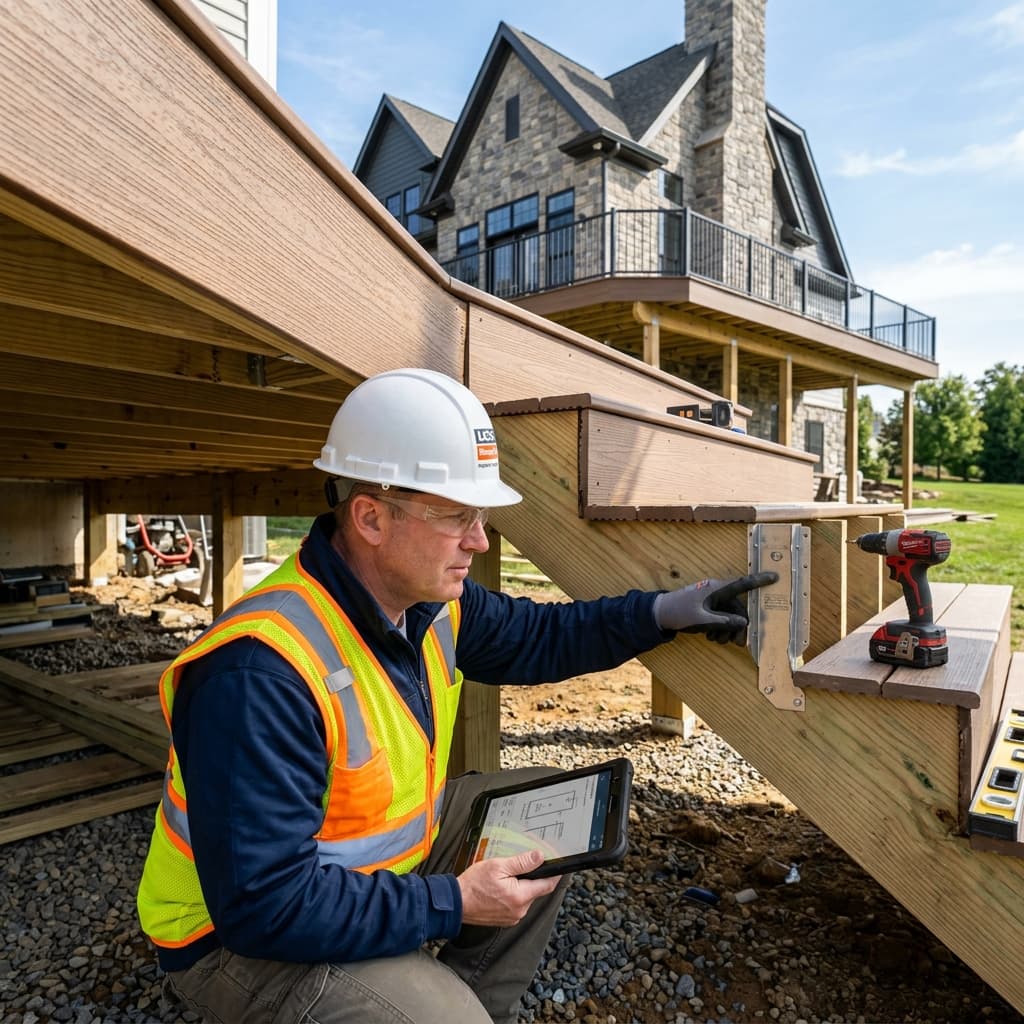
Stairs are reviewed as part of the full structural system, especially on elevated decks. Our Virginia deck stair calculator helps homeowners model rise, run, step count and stair angle, while the deck stair construction diagram shows how treads, risers, stringers, hangers, and landings fit together before the framing inspection. The stair code guide covers rise, run, handrail, guard, and landing requirements. Homeowners preparing for final inspection can also use the deck stair safety checklist and review common stair inspection failures before corrections become expensive.
| Joist Size (Southern Pine) | Spacing (On-Center) | Maximum Allowable Span |
|---|---|---|
| 2x8 | 16 inches | 10 feet, 6 inches |
| 2x8 | 12 inches | 11 feet, 4 inches |
| 2x10 | 16 inches | 13 feet, 4 inches |
| 2x10 | 12 inches | 14 feet, 6 inches |
Structural Ledger & Moisture Management
The biggest pitfall with ledger installation is improper moisture management. As of 2026, stringent flashing rules mandate continuous layers to prevent water intrusion and dry rot. You cannot attach a ledger board directly to brick veneer or stone siding.
- Install Z-flashing behind the exterior weather barrier.
- Stagger 1/2-inch hot-dipped galvanized bolts according to joist span length.
- Ensure solid wood blocking inside the house structure.
- Never use standard wood screws for structural ledger attachment.
Stair and Railing Height Codes
Virginia code requires guardrails to be at least 36 inches high for platforms over 30 inches above grade. Stairs require an 8 1/4-inch maximum riser and 9-inch minimum tread. Ensuring code compliance prevents falls and guarantees that rails can withstand a 200-pound concentrated load.
Loudoun Deck Permit FAQs
How much does a deck permit cost in Loudoun County?
Loudoun County's current deck guidance lists $265 for a typical deck under 1,000 square feet outside an incorporated town and $395 when the county's plan specifications are used. Fees can differ by project and jurisdiction, so verify the current amount on the official Loudoun County deck page before budgeting or filing.
Do all decks need a permit in Loudoun County?
Loudoun County states that all decks require both a building permit and a zoning permit. Requirements can differ inside incorporated towns, so confirm the reviewing jurisdiction and current instructions before submitting plans.
How deep do deck footings need to be in Loudoun County?
Deck footings must be a minimum of 24 inches deep to reach below the frost line and prevent seasonal shifting or frost heave.
Do I need 2x8 or 2x10 joists for my deck?
It depends on the span. 2x8s typically support up to 10 feet, while 2x10s safely cover 12 to 14 feet. We recommend 12-inch spacing for heavy composite decking like Trex.
Can I attach a deck ledger to brick veneer?
No. Virginia building code prohibits attaching a ledger board directly to brick veneer or stone siding. It must be attached to the structural rim joist of the house.
We Build for Permit Approval
Navigating LandMARC and Virginia USBC shouldn't be your full-time job. We prepare the drawings, submit the package, coordinate inspections, and explain any reviewer comments before they become change-order surprises.
Request Your Technical Consultation