

Deck Stair Code in Virginia: Rise, Run, Stringers & Handrails Explained
Deck stairs are one of the most heavily regulated parts of a deck — and the most common reason a deck fails its final inspection. Learn the Virginia code for riser height, tread depth, stringers, handrails, guards, and landings.
Quick Answer
In Virginia, deck stairs are judged on consistent rise and run, supported stringers, graspable handrails, stable guards, safe landings, lighting, and a secure stair-to-deck connection. The Virginia Residential Code stair geometry many Northern Virginia deck projects use is an 8 1/4-inch maximum riser, a 9-inch minimum tread depth, and a 3/8-inch maximum variation within the same flight.
For Northern Virginia homeowners, the practical next step is to model the layout with the deck stair calculator, compare the parts against the deck stair construction diagram, check Loudoun or Fairfax permit guidance, and request an inspection if stairs move, pull away, show rot, or failed a final inspection.
Source Context
Deck stairs look simple — a few boards stepping down to the yard — but they are one of the most heavily regulated parts of any deck, and they are the single most common reason a deck fails its final inspection. A staircase that is genuinely safe and comfortable is built to a precise geometry, and Virginia’s building code spells out nearly every dimension.
This guide explains the rules that govern deck stairs in Virginia — riser height, tread depth, stringer spacing, handrails, guards, and landings — so you understand what a code-compliant, inspection-ready staircase actually requires. If you want a parts-level breakdown first, start with our deck stair construction diagram guide. If you want to model the math before reading the code details, use the Virginia deck stair calculator to estimate rise, run, step count and stair angle.
Why Deck Stairs Get Their Own Code Section
Stairs concentrate risk. A deck surface is flat and forgiving; a staircase asks people to change elevation, often while carrying something or in low light. Inconsistent steps are a leading cause of household falls, so the Virginia Residential Code — the statewide code that governs deck construction — devotes detailed attention to stair geometry. Inspectors measure these dimensions on every permitted deck.
Riser Height: The 8 1/4-Inch Maximum
The riser is the vertical face of each step. Under Virginia residential stair geometry, the maximum riser height is 8 1/4 inches, measured vertically from one tread surface to the next. Lower risers are allowed — and often feel more comfortable — but you cannot exceed the maximum used by the local code authority.
The number of risers is simple division: the total height from the deck surface down to the landing, divided by your chosen riser height. A deck 48 inches off the ground, for example, needs at least six risers at the Virginia maximum, and many builders still choose seven lower risers for comfort.
Tread Depth: The 9-Inch Minimum
The tread is the horizontal surface you step on. Virginia residential stair geometry uses a 9-inch minimum tread depth, measured from the front nosing of one tread to the nosing of the next. Deeper treads are allowed and often feel safer outdoors; many deck designs still target 10 to 12 inches where the yard layout allows it.
The Uniformity Rule
This is the rule that DIY staircases break most often. Every riser in a flight must be close to the same height, and every tread close to the same depth. The code allows a difference of no more than 3/8 inch between the tallest and shortest riser — and between the deepest and shallowest tread — within the same run of stairs.
The reason is biomechanical. Your body memorizes the rhythm of a staircase after the first step or two. A single riser that is half an inch taller than the rest interrupts that rhythm and causes a stumble. Uniformity is not a formality; it is the core safety principle of stair design.
Stringers: The Backbone of the Stairs
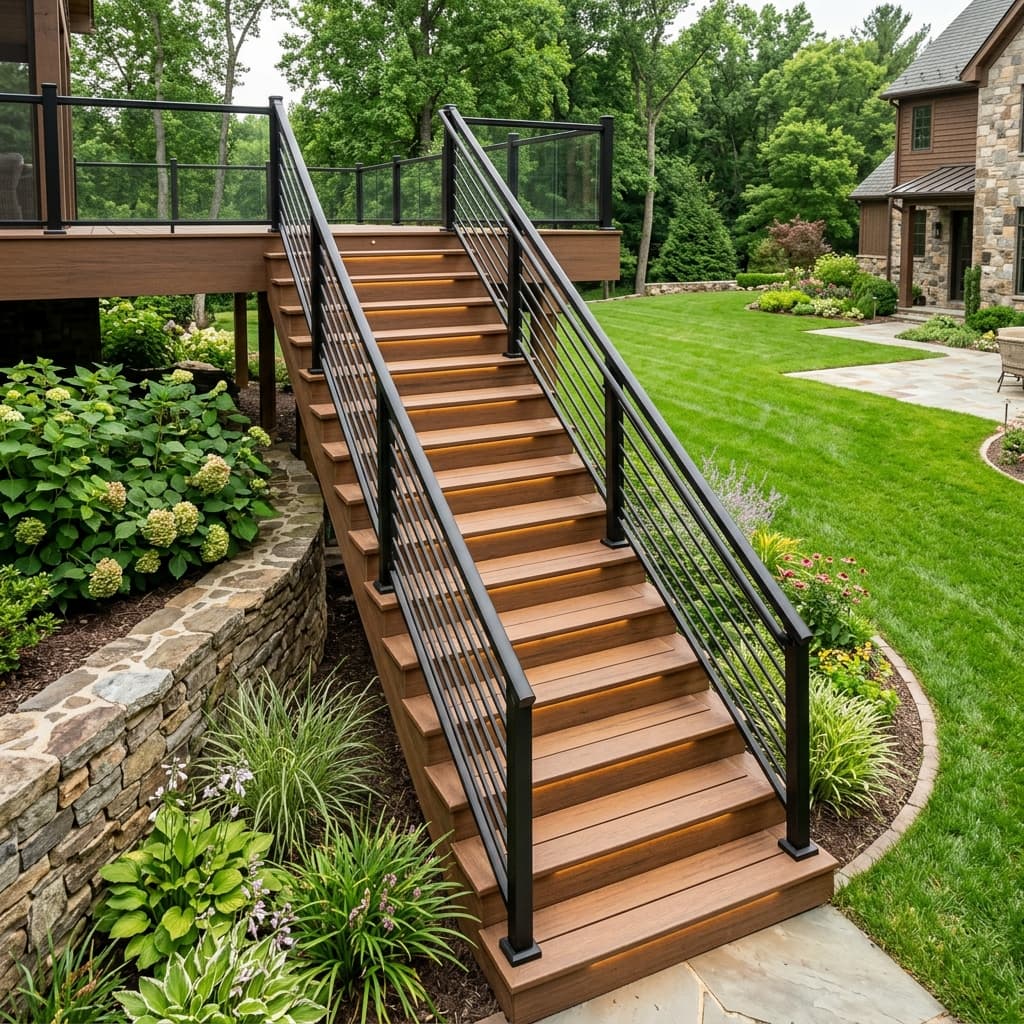
Stringers are the diagonal boards that carry the treads and transfer the weight of the staircase to the ground. Most deck stairs use 2x12 stringers, in one of two forms: cut stringers, notched in a sawtooth pattern, and solid stringers, which use metal or wood cleats to support the treads without notching.
Spacing matters. Stringers are typically installed no more than 16 inches apart, and composite treads usually call for tighter spacing — often 12 inches or less — because composite is more flexible than wood and will feel bouncy if it is under-supported. Always confirm the tread manufacturer’s spacing requirement. Cut stringers must also keep enough uncut material — a minimum 5-inch “throat” — so that notching does not weaken them. And like the deck itself, the bottom of the stairs must land on a proper footing or concrete pad, never on bare soil. The way that load reaches the ground follows the same load-path principles that govern the rest of the structure.
Handrails: Height and Graspability
Any stair flight with four or more risers requires a handrail on at least one side. The handrail must sit between 34 and 38 inches above the line connecting the tread nosings, and it must run continuously for the full length of the flight.
Height is only half the rule. A handrail must also be graspable — something a hand can actually close around during a fall. A wide, flat 2x6 laid on top of a guard does not qualify. Code-compliant handrails are either a round profile roughly 1¼ to 2 inches in diameter, or a shaped profile engineered to meet the same graspability intent. This is one of the most common DIY failures, because a homeowner-built rail often looks finished but cannot actually be gripped.
Guards on Open Stair Sides
Separate from the handrail, a guard is required along any open side of stairs where the walking surface is more than 30 inches above grade. Guards along the stairs must be at least 34 inches tall, measured vertically from the tread nosings.
The infill is governed by sphere rules. On the deck and along the stairs, a 4-inch sphere must not be able to pass through the balusters. On the open side of the staircase, the triangular gap formed by the tread, the riser, and the bottom rail must reject a 6-inch sphere. Inspectors check these openings at the final inspection.
Landings
A stairway needs a firm, level landing at both the top and the bottom. The landing must be at least as wide as the stairs and a minimum of 36 inches in the direction of travel — enough room to step off the last tread and stop safely instead of walking straight into an obstacle.
Stair Lighting
The code also requires deck stairs to be illuminated. The cleanest solution is low-voltage LED riser or post lights designed into the build. Beyond satisfying code, lit stairs are a genuine safety feature after dark — we cover the options in our guide to deck lighting automation and through our deck stair lighting service.
Built and Inspected to Code
Deck stairs reward precision. Get the riser height, tread depth, and uniformity right, support the stringers properly, and install a graspable handrail at the correct height, and the staircase will pass inspection and stay safe for decades. Get them wrong and the inspector will catch it — or worse, a guest will.
At Loudoun Decks, every staircase we build is laid out to the Virginia Residential Code and verified at inspection. To plan a deck with safe, comfortable, code-compliant stairs, call 571-655-7207 or visit ldndecks.com/get-estimate.
Related Resources
Frequently Asked Questions
What is the maximum riser height for deck stairs in Virginia?
The maximum riser height is 8 1/4 inches under Virginia residential stair geometry, measured vertically from one tread surface to the next. Lower risers are allowed and often feel more comfortable, but the height cannot exceed the maximum used by the local code authority, and every riser in the flight must be within 3/8 inch of the others.
What is the minimum tread depth for deck stairs in Virginia?
Virginia residential stair geometry uses a 9-inch minimum tread depth. Many outdoor deck stairs are still planned at 10 to 12 inches when space allows because a deeper tread usually feels more stable underfoot.
Do deck stairs need a handrail?
Yes. Any stair flight with four or more risers requires a graspable handrail on at least one side, mounted 34 to 38 inches above the tread nosings and running continuously the full length of the flight.
Why do all the steps on a deck staircase need to be the same height?
Your body memorizes the rhythm of a staircase within a step or two. A single riser even half an inch off interrupts that rhythm and causes stumbles, so the code limits the variation between the tallest and shortest riser to 3/8 inch.
Plan Your Northern Virginia Deck Project With Loudoun Decks
Get a free, no-pressure consultation from a licensed Northern Virginia deck builder. Call (571) 655-7207 or visit ldndecks.com/get-estimate.
Get a Free EstimateEverything Your Outdoor
Space Needs
From ground-up deck construction to full outdoor living spaces, every project is custom-designed for your home with permit planning, material guidance, and written workmanship terms.
Custom Deck Builder
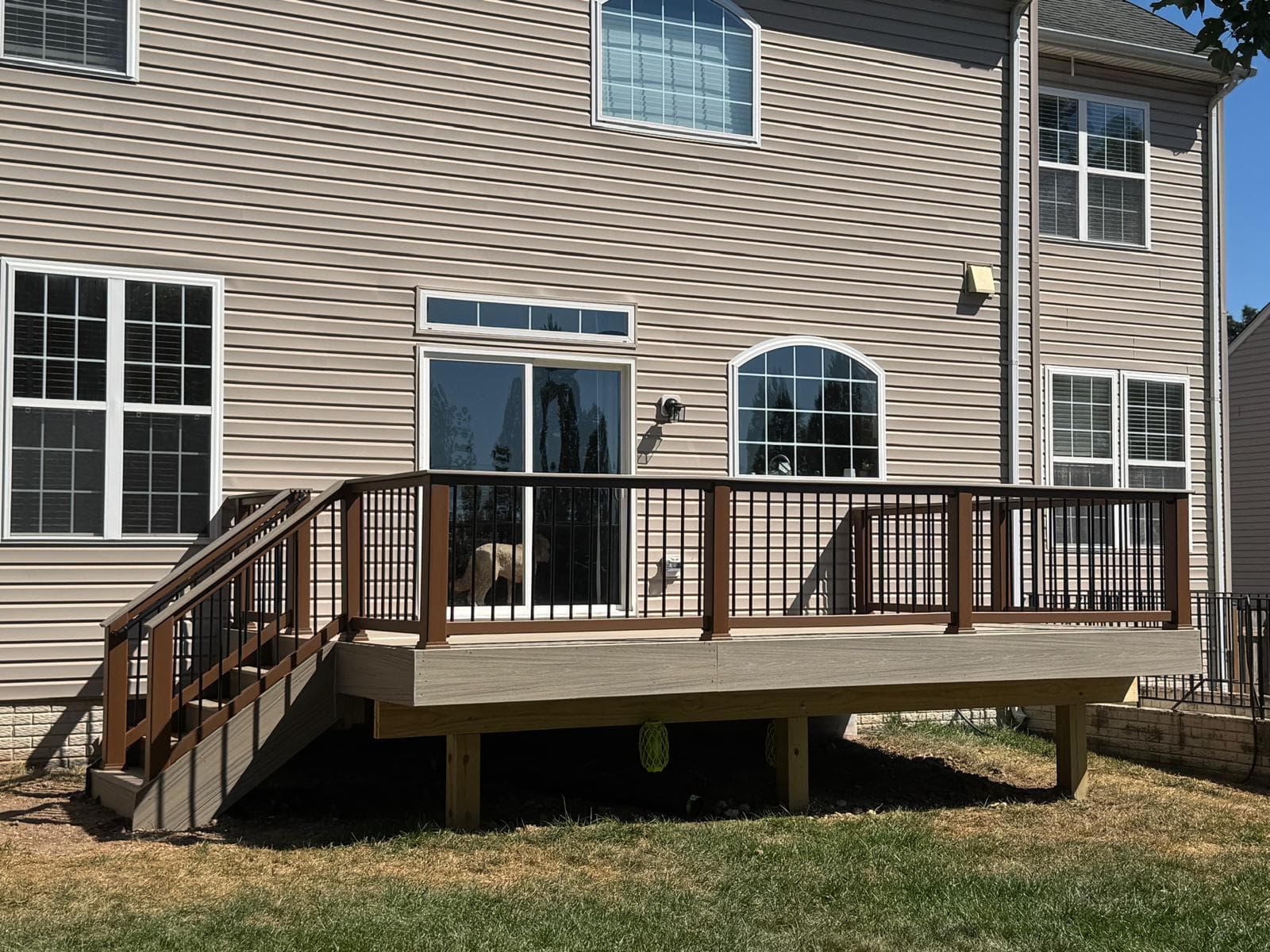
Transform your backyard with a custom-designed deck using Trex, TimberTech, wood, or PVC materials matched to your budget, HOA rules, and maintenance goals.
Deck Resurfacing
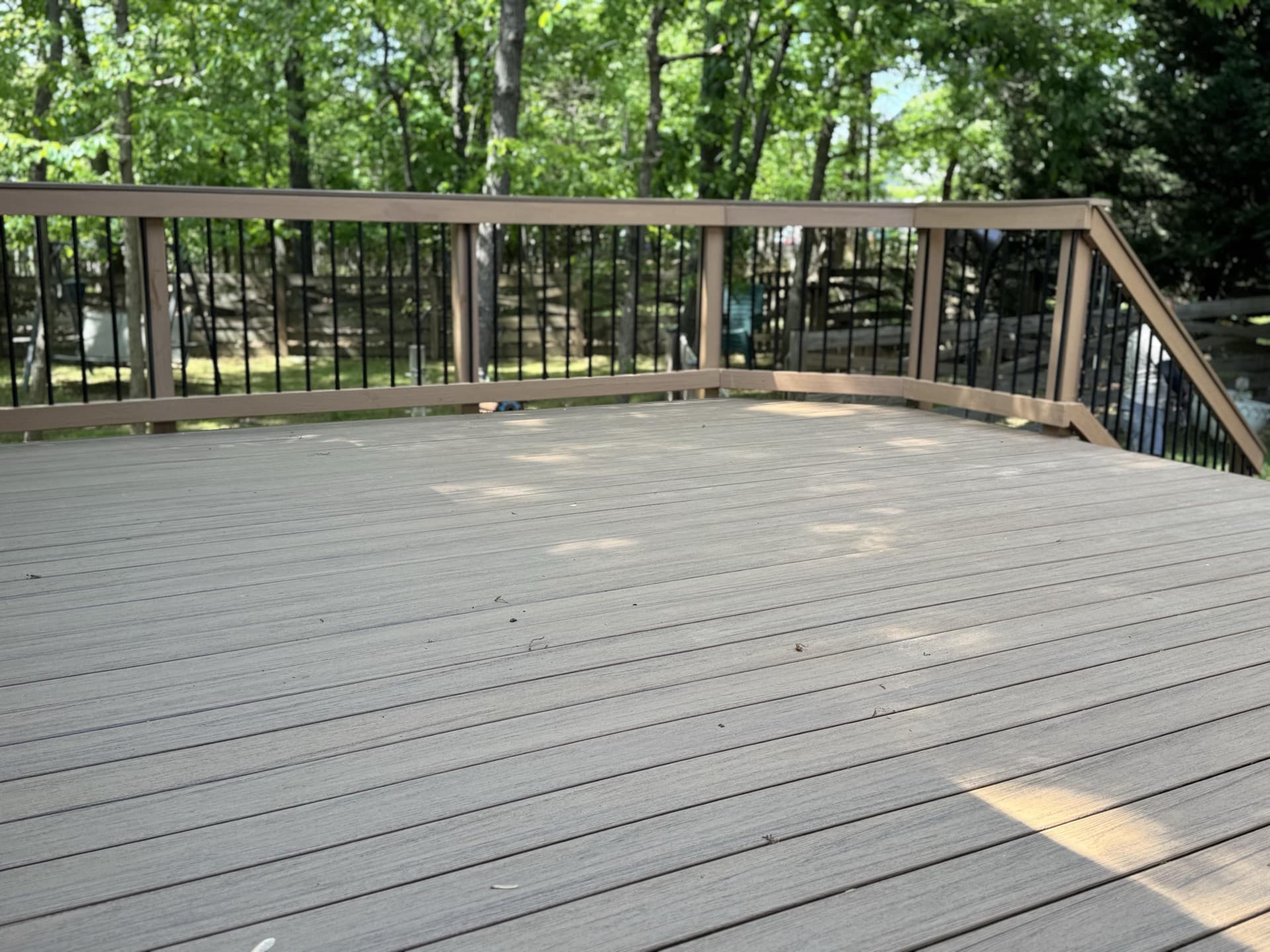
Premium wood-to-composite resurfacing for structurally sound frames. Full surface conversions start from $15k with boards, railings, fascia, and safety review.
Patio Contractor Services
Professional bluestone and paver patio installation. We create durable, beautiful ground-level outdoor living spaces that last a lifetime.
Local Expertise Across Northern Virginia
Loudoun Decks is a trusted deck builder serving Loudoun County, Fairfax County, Prince William County, Arlington, and Stafford.
Guides Northern Virginia Homeowners Are Reading
Before & After Deck Projects
Photo gallery with verification notes for deck replacements, composite upgrades and outdoor living work.
LDN Decks Reviews
Homeowner feedback and trust signals for Northern Virginia deck projects.
BBB Accredited Deck Builder
BBB profile, status context and third-party trust signals.
LDN Decks Reviews on Yelp
Yelp review profile and public reputation signals for homeowners.
Leave a Review for LDN Decks
Customer review destination and public profile links.
Free Deck Cost Calculator
Get an instant estimate by material, size, and add-ons.