


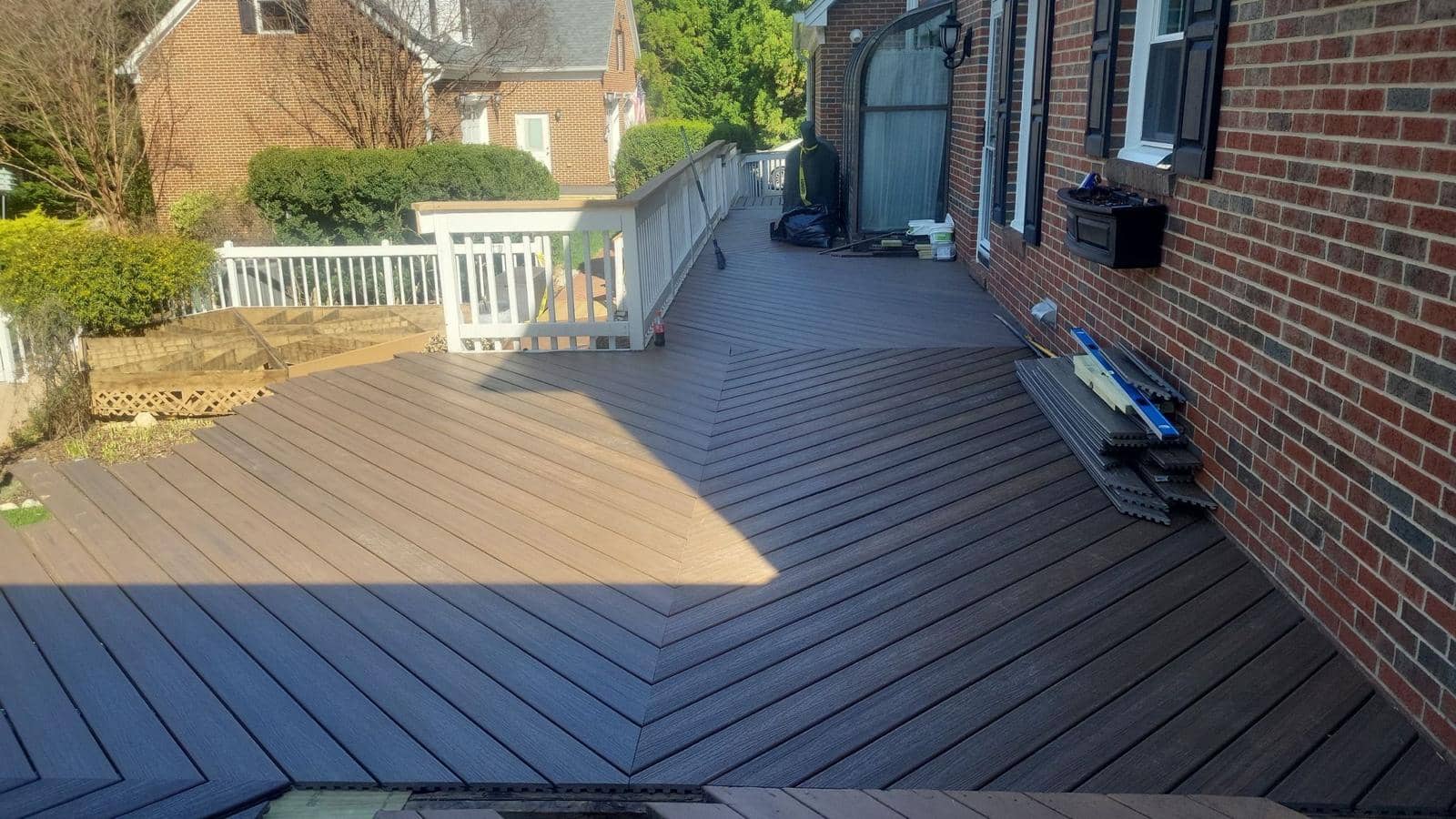
A new deck in Northern Virginia represents a $15,000–$60,000+ investment. At that price point, warranty coverage isn't an afterthought — it's a deciding factor. Yet most homeowners sign contracts without fully understanding what their warranty actually covers, what voids it, and who is responsible when something goes wrong five years down the road.
This guide breaks down every warranty layer that protects (or fails to protect) your deck: manufacturer product warranties, written installer workmanship terms, and the critical role that installer certification can play in keeping your coverage intact. We'll also cover how to file a claim, the difference between warranty and insurance, and the specific warranty pitfalls we see most often in Loudoun, Fairfax, and Prince William counties.
Whether you're comparing quotes, evaluating contractors, or dealing with a deck issue years after installation, this guide gives you the knowledge to protect your investment.
Manufacturer Warranty Comparison Table (2026)
Every major composite and PVC decking brand offers a different warranty structure. The differences are significant — a 25-year warranty and a 50-year warranty sound similar, but the coverage details vary dramatically. Here is a side-by-side breakdown:
| Brand / Line | Warranty Length | Fade Coverage | Stain Coverage | Structural | Transferable | Labor Included |
|---|---|---|---|---|---|---|
| Trex Enhance | 25 years | Yes | Yes | Yes | Yes | With Platinum installer |
| Trex Transcend | 25 years | Yes | Yes | Yes | Yes | With Platinum installer |
| Trex Lineage | 50 years | Yes | Yes | Yes | Yes | With Platinum installer |
| TimberTech Pro | 30 years | Yes | Yes | Yes | Yes | No |
| TimberTech AZEK | 50 years | Yes | Yes | Yes | Yes | No |
| Fiberon Good Life | 25 years | Yes | Yes | Limited | Yes | No |
| Fiberon Concordia | 25 years | Yes | Yes | Limited | Yes | No |
| Pressure-Treated Wood | None | No | No | No | N/A | N/A |
| Cedar / Redwood | None | No | No | No | N/A | N/A |
Wood decking carries zero manufacturer warranty on the finished product. Lumber yards may offer limited rot warranties on treatment, but these rarely cover real-world performance issues.
What Each Warranty Type Actually Covers
Deck warranties aren't one-size-fits-all. Understanding the different coverage categories prevents surprises when you need to make a claim.
Fade Resistance Warranty
Covers color change beyond a specified Delta-E threshold. Trex warrants that boards won't fade more than a defined level over 25 years (50 years for Lineage). In practice, this means the boards will maintain their color within a range that most homeowners would consider normal aging. Virginia's UV exposure is moderate-to-high — we see roughly 1,800–2,000 hours of direct sunlight annually in Northern Virginia, and modern composite shells handle this well.
Stain Resistance Warranty
Covers resistance to food, grease, and mold staining under normal residential use. This doesn't mean stains never occur — it means they should clean off with standard composite deck cleaner. Persistent staining that doesn't respond to approved cleaning methods is a valid warranty claim.
Structural Warranty
Covers the decking board's structural integrity — cracking, splitting, splintering, rotting, or termite damage. This is the most straightforward coverage: if a board physically fails under normal use, the manufacturer replaces it. Note that structural failure caused by improper installation (wrong joist spacing, no end support) is typically excluded.
Workmanship Warranty (Installer)
This is separate from the manufacturer warranty and comes from your contractor. It can cover defects in the installation itself — improper ledger attachment, flashing failures, inadequate drainage, loose railings, joist spacing errors, and structural settling. The exact term, scope, exclusions, and remedy should be written into the project paperwork instead of summarized verbally.
What Voids a Deck Warranty
This is where most homeowners get burned. Manufacturer warranties have specific conditions that, if violated, void the entire warranty. We see these violations regularly on decks built by unlicensed contractors:
1. Improper Installation
The number-one warranty voider. If joist spacing exceeds 16” on center (12” for diagonal installations), if end boards lack support within 1” of the end, or if gapping specifications aren't met, the warranty is void. Trex requires specific gapping (3/16” side-to-side, 1/8” end-to-end at 60°F) that expands or contracts based on installation temperature. Getting this wrong is the most common mistake we see from inexperienced installers.
2. No Building Permit
Trex and TimberTech both require that decks be built in compliance with local building codes. In Loudoun, Fairfax, and Prince William counties, that means a valid building permit. If your deck was built without a permit, you have a potential warranty exposure — and a code compliance issue. See our Loudoun County permit guide for the full process.
3. Wrong Fasteners
Each manufacturer specifies approved fastener systems. Trex recommends their proprietary hidden fastener clips or approved face screws. Using drywall screws, nails, or incompatible fastener brands can void coverage. We use exclusively manufacturer-approved fastener systems on every project.
4. Improper Cleaning Methods
Pressure washing above 3,100 PSI, using chlorine bleach, or applying unapproved chemical cleaners can damage the protective shell and void the stain/fade warranty. Trex recommends a maximum of 3,100 PSI at a 60-degree fan tip held 8+ inches from the surface. We recommend an even gentler approach: soft bristle brush with Trex-approved cleaner twice per year.
5. Inadequate Ventilation
Composite boards need airflow underneath to prevent moisture buildup. If your deck is too close to grade (under 6 inches of clearance for most brands), or if the underside is sealed without proper ventilation, moisture-related issues may not be covered. This is especially relevant in Northern Virginia's humid summers.
6. Unauthorized Modifications
Painting, staining, or coating composite decking voids the warranty. The surface shell is engineered to resist UV and moisture — adding a topcoat interferes with that system. We occasionally see homeowners paint their composite deck to change the color, not realizing they've voided 25+ years of coverage.
Why Installer Certification Matters for Your Warranty
Not all installations activate the same warranty tier. Trex, in particular, ties warranty coverage directly to the installer's certification level:
| Installer Level | Material Warranty | Labor Coverage | Claim Priority | Requirements |
|---|---|---|---|---|
| Trex product-line planning | Full 25-50 yr | Verify current program terms | Verify with Trex | Confirm current profile and warranty terms directly with Trex |
| Trex Gold Partner | Full 25-50 yr | Partial | Standard | High volume, basic training |
| Trex Registered | Full 25-50 yr | No | Standard | Online registration only |
| Unlicensed / Unregistered | Full 25-50 yr* | No | Standard | None — but installation errors can void warranty |
The critical distinction: When an installer makes errors (wrong gapping, inadequate support, improper flashing), those errors can void the manufacturer warranty. You may still technically have a manufacturer warranty, but the claim can be denied because the installation does not meet specifications. With a source-verifiable installer, you can confirm current manufacturer profile details and review written workmanship terms before signing.
This is one of the most important factors when choosing a deck builder in Northern Virginia. The cheapest quote can become a liability if the installer cannot document code compliance, manufacturer installation requirements, and clear service terms.
Written Workmanship Warranty Terms: What to Review
Beyond the manufacturer warranty, contractor workmanship terms should be documented in the signed project paperwork. Review the exact duration, scope, exclusions, service process, and whether structural, labor, resurfacing, or accessory coverage differs.
Covered
- Ledger board attachment failure
- Flashing or waterproofing defects
- Structural settling beyond normal tolerance
- Joist or beam connection failures
- Railing post loosening
- Stair stringer separation
- Fastener pop-out or failure
- Drainage or grading issues we created
- Loudoun Decks Reviews (Google reviews) →
- Free Deck Cost Calculator →
Not Covered
- Manufacturer product defects (covered by their warranty)
- Normal wear and aging
- Damage from misuse or negligence
- Modifications made by others after installation
- Acts of nature (fallen trees, flooding)
- Cosmetic preferences (color variation within spec)
- Issues caused by failure to maintain
- Third-party additions (hot tubs, planters)
Ask whether the workmanship warranty is prorated, whether labor and materials are handled differently, what documentation is required for a service request, and whether any maintenance responsibilities affect coverage.
How to File a Deck Warranty Claim (Step by Step)
If you notice an issue with your deck, here is the exact process to follow:
Step 1: Identify the Issue Type
Determine whether the issue is a product defect (fading, staining, cracking, splitting — manufacturer warranty) or an installation defect (loose boards, structural movement, water intrusion — workmanship warranty). This determines who you contact first.
Step 2: Document Everything
Take clear photos in daylight showing the defect from multiple angles. Note the location on the deck, when you first noticed it, and any relevant conditions (recent storm, seasonal change). The more documentation you provide, the faster the claim processes.
Step 3: Contact the Right Party
For product defects, contact the manufacturer directly: Trex at 1-800-289-8739, TimberTech at 1-800-307-7780, or Fiberon at 1-800-573-8841. For installation defects, contact us at (571) 655-7207. If you're unsure which category applies, call us first — we'll help you determine the right path and can often facilitate manufacturer claims on your behalf.
Step 4: Provide Required Documentation
Manufacturers will ask for: proof of purchase or installation contract, installation date, photos of the defect, your installer's name and certification level, and confirmation that the deck was built with permits. If we built your deck, we can provide all of this documentation from our records.
Step 5: Inspection and Resolution
The manufacturer may send an inspector or request additional photos. Approved claims typically result in replacement materials shipped to your address. Claim timing depends on the manufacturer, product line, documentation quality, and review workload, so homeowners should verify current process details directly with the brand.
Warranty vs. Homeowner's Insurance: What's the Difference?
Homeowners frequently confuse warranty coverage with insurance coverage. They protect against entirely different risks:
| Factor | Manufacturer Warranty | Workmanship Warranty | Homeowner's Insurance |
|---|---|---|---|
| Covers | Product defects (fade, stain, split) | Installation errors | Sudden/accidental damage |
| Examples | Board cracks without cause | Ledger pulls away from house | Tree falls on deck in storm |
| Who pays | Manufacturer | Installer (us) | Insurance company |
| Deductible | None | None | $500–$2,500 typical |
| Duration | 25–50 years | Written contractor term | Policy term (annual) |
| Claim effect | No premium increase | No cost to you | May increase premium |
Key takeaway: If a board fades excessively, that's a warranty claim. If a storm destroys your railing, that's an insurance claim. If your deck sags because the contractor skipped a footing, that's a workmanship warranty claim. Knowing which path to pursue saves weeks of back-and-forth.
Common Warranty Mistakes We See in Northern Virginia
After building hundreds of decks in Loudoun, Fairfax, and Prince William counties, we've seen recurring warranty issues that are entirely preventable:
No Permit = No Protection
We regularly inspect decks built without permits — especially in older Ashburn and Centreville neighborhoods. Beyond the code compliance risk, these homeowners discover at claim time that their warranty has a significant vulnerability. Every county in Northern Virginia requires a deck permit. There is no exception for “small decks” or “replacement decks.”
Keeping Your Paperwork
Store your installation contract, permit approval, product receipts, and any HOA approval letters together. Digital copies are fine. You may not need them for 10+ years, but when you do, having them readily available can mean the difference between an approved and denied claim.
Maintenance Matters
Composite decks are low-maintenance, not zero-maintenance. Trex recommends cleaning twice annually. Allowing organic debris to accumulate for years creates conditions (mold, staining) that may fall outside warranty coverage because they result from neglect rather than product failure. See our deck maintenance checklist for the recommended schedule.
How Warranty Coverage Affects Resale Value
In Northern Virginia's competitive real estate market, a transferable 25–50 year warranty is a genuine selling point. Buyers — especially in Brambleton, Broadlands, One Loudoun, and South Riding — specifically ask about deck warranties during home inspections.
A Trex or TimberTech warranty that transfers to the new owner effectively makes the deck a worry-free asset for the buyer. Combined with the fact that composite decks recoup 65–80% of their cost at resale in Northern Virginia, warranty coverage amplifies ROI. Conversely, a wood deck with no warranty (and visible maintenance needs) can actually reduce perceived home value.
We provide project paperwork designed to keep manufacturer warranty information, written workmanship terms, permit records, and maintenance guidelines organized for future resale conversations.
Choosing Deck Materials Based on Warranty Protection
If warranty coverage is a top priority, here is how to think about material selection:
- Best warranty protection: TimberTech AZEK (50-year, full PVC, most comprehensive coverage)
- Best warranty-to-cost ratio: Trex Transcend (25-year coverage at mid-range pricing; verify current installer-program terms directly with Trex)
- Best budget option with warranty: Trex Enhance (same 25-year warranty as Transcend at 20–30% lower cost)
- Best premium warranty: Trex Lineage (50-year warranty with ultra-realistic aesthetics)
- No warranty protection: Pressure-treated wood, cedar, redwood (zero manufacturer coverage on the finished product)
For a complete material breakdown including cost, lifespan, and performance factors, see our Trex vs TimberTech vs AZEK comparison.
Frequently Asked Questions
How long is the Trex decking warranty?
Trex offers a 25-year limited residential warranty on Enhance and Transcend lines covering fade and stain resistance. The Trex Lineage line carries a 50-year warranty. All Trex warranties are transferable to subsequent homeowners.
What voids a composite deck warranty?
Improper installation (wrong joist spacing, no gapping), non-approved fasteners, lack of building permits, harsh pressure washing above 3,100 PSI, chlorine bleach cleaning, painting or staining the surface, and inadequate ventilation underneath the deck.
Does a deck warranty cover labor costs?
Most manufacturer warranties cover material replacement only. Some manufacturer or installer programs may offer enhanced terms, but current coverage should be verified directly with the manufacturer and in the contractor's written paperwork.
Is a deck warranty transferable when I sell my home?
Yes. Trex requires notification within 60 days of transfer. TimberTech/AZEK warranties transfer automatically. This transferability adds real resale value — buyers in Northern Virginia specifically ask about deck warranty status.
What does a workmanship warranty cover?
Workmanship terms can cover installation defects such as ledger attachment, flashing, joist spacing, railing post connections, stair stringer separation, fastener failure, or structural settling. Exact coverage depends on the written term, scope, exclusions, and remedy in the signed paperwork.
How do I file a Trex warranty claim?
Contact Trex at 1-800-289-8739 or file at trex.com/warranty. Have your proof of purchase, installation date, photos, and installer information ready. Ask Trex directly whether installer-program status affects the current claim review process.