

Deck Railing Code Requirements in Northern Virginia 2026
Every deck railing system built or replaced in Northern Virginia must meet the Virginia Uniform Statewide Building Code, which adopts the International Residential Code with local amendments. Understanding what the code actually requires — railing height, baluster spacing, load capacity, and connection details — helps homeowners verify that contractor proposals are code-compliant and avoid failed inspections.
Deck railing code compliance is verified at the final inspection stage of every new deck permit in Northern Virginia. A failed railing inspection — which can require significant rework — is almost always caused by one of four issues: incorrect height, non-compliant baluster spacing, inadequate post anchoring, or a railing system that was not listed for the application. Understanding what the code actually requires prevents these failures.
This guide covers current Virginia deck railing code requirements as adopted from the IRC, with notes on how Loudoun, Fairfax, and Prince William counties apply them in practice.
When Is a Deck Railing Required?
Virginia Uniform Statewide Building Code (VUSBC), adopting IRC Section R507 and R312, requires guards (railing) on any deck surface more than 30 inches above grade at any point along the deck perimeter. The 30-inch measurement is taken from the deck surface to the grade below — not to the ground at the base of the house.
A deck that is 24 inches above grade at one end but 36 inches above grade at the opposite end requires railing for the portions that exceed 30 inches, and technically does not require railing for the portions below 30 inches — though most contractors and inspectors prefer consistent railing throughout for clarity and aesthetics.
Stairs require guardrails on both sides when the stairs have more than three risers (four steps) — the guardrail must be continuous from the top landing to the bottom landing.
Required Railing Height
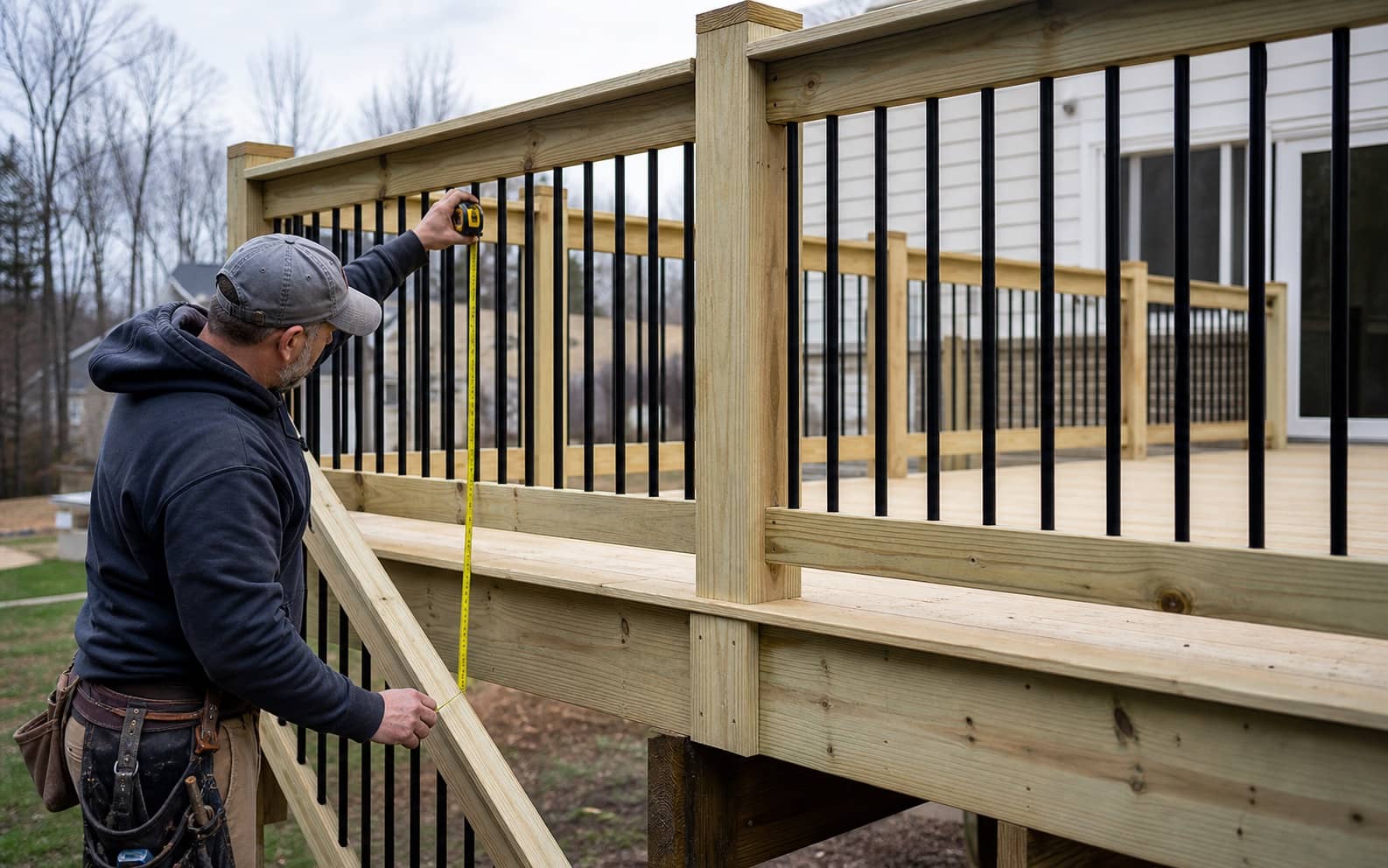
Railing height is measured from the top of the deck surface (or stair tread) to the top of the railing cap rail.
For deck surfaces less than 30 inches above grade: Minimum 36 inches.
For deck surfaces 30 inches or more above grade: Minimum 42 inches.
This distinction is important for elevated decks. A deck that is 48 inches above grade — common on split-level homes or walkout basement configurations in Northern Virginia — requires 42-inch railing, not 36-inch. Many composite railing systems are available in both 36-inch and 42-inch post heights — confirm the correct height for your specific deck elevation before ordering.
For stairs, the IRC requires handrail height between 34 and 38 inches measured vertically from the stair tread nosing to the top of the handrail.
Baluster Spacing: The 4-Inch Rule
Balusters (the vertical or horizontal infill elements between posts) must be spaced so that a 4-inch sphere cannot pass between them at any point. This requirement prevents young children from passing their heads through the railing.
For vertical balusters on composite railing, this is straightforward — manufacturers pre-space balusters at 3.5 to 3.875 inches on center, which satisfies the 4-inch sphere requirement.
For horizontal cable railing, the 4-inch sphere rule applies to the cable spacing — cables must be spaced so a 4-inch sphere cannot pass through when the cables are at maximum deflection. Most code-compliant cable railing systems space cables at 3 inches on center, which provides a margin at cable deflection.
For open-style balusters (horizontal flat bars or round bars), the 4-inch sphere rule applies in both directions — vertically between bars, and at the termination points near the post where a gap may be larger than the baluster spacing.
Post Spacing and Structural Requirements
The IRC does not specify a maximum post spacing for deck railing — but the structural requirement that a 200-pound concentrated load applied in any direction at the top of the railing must be resisted without failure effectively limits post spacing based on the railing system design.
For composite railing systems, most manufacturers specify maximum post spacing of 6 to 8 feet, and their systems are tested and listed for this spacing. Installers should not exceed the manufacturer-specified post spacing.
For cable railing, post spacing is significantly more constrained — typically 3 to 5 feet for mid-spans, with end post locations at every change of direction or cable run terminus. This is driven by both the deflection limit on the cables and the tension load on end posts.
Post anchorage is one of the most frequently failed items in deck railing inspections. Posts must be anchored per the railing system's installation manual — which typically means through-bolting to the rim joist or blocking, not surface-mounting to the decking with fasteners alone. Surface-mounted post bases that are simply screwed to deck boards do not meet the load requirement under most conditions.
For cable railing end posts specifically, blocking must be installed between the outer joist and the interior framing to distribute the cumulative cable tension load across the deck framing.
Top Rail Graspability (Stairs)
For stair handrails, the top rail must be graspable — the handrail profile must allow a person to grip it with a full hand grip. The IRC specifies that circular handrails must be 1.25 to 2 inches in diameter. Non-circular handrails must meet a perimeter requirement of 4 to 6.25 inches.
This matters because some composite deck cap rails — which are wide, flat, and designed for aesthetics — do not meet the graspability requirement for stair handrails. On stairs, a separate code-compliant graspable handrail must be provided, either as a secondary rail at the correct height or as the primary cap rail if the profile meets the graspability requirement.
What Inspectors Check
At the final inspection for a new deck in Loudoun or Fairfax County, the inspector will typically verify:
1. Railing height at the deck surface and at stairs 2. Baluster spacing with a 4-inch gauge 3. Post anchorage (visible through the deck structure or via documentation) 4. Stair handrail graspability and continuity 5. That the installed system is a listed product or has engineering documentation if non-standard
The most common inspection failures on deck railing are: (1) incorrect post height for the deck elevation, (2) balusters at a mid-run location that accidentally exceed 4 inches due to field adjustments, and (3) posts that are surface-mounted without proper anchorage into the framing.
Replacing Railing on an Existing Deck
Replacing railing on an existing deck requires a building permit in most Northern Virginia jurisdictions if the work is structural — which most railing replacements are. A permit triggers an inspection of the new railing system, which confirms the replacement meets current code.
Important: the current code that applies at time of permit is the current VUSBC — not the code that was in effect when the original deck was built. Many decks in Northern Virginia were built when 36-inch railing was acceptable at all heights. Railing replacement on those decks must meet current requirements, including 42-inch railing if the deck is 30 inches or more above grade.
LDN Decks handles railing permits, code-compliant installation, and inspection coordination for railing replacement projects across Loudoun, Fairfax, and Prince William counties.
Get a Free Railing Replacement Estimate
---
Related: Deck Railing Options Northern Virginia · Cable Railing Pros, Cons & Cost · Composite vs Aluminum Railing · Deck Permit Loudoun County · Deck Structural Safety Signs
Frequently Asked Questions
What height does deck railing need to be in Virginia?
Virginia code requires deck railing to be at least 36 inches high for deck surfaces less than 30 inches above grade, and at least 42 inches high for deck surfaces 30 inches or more above grade. Stair handrails must be between 34 and 38 inches measured from tread nosing to the top of the handrail.
What is the baluster spacing requirement for deck railing in Virginia?
Virginia code requires that baluster spacing not allow a 4-inch sphere to pass through at any point. For vertical balusters on composite railing, manufacturers pre-space balusters at approximately 3.5 to 3.875 inches to satisfy this requirement. For horizontal cable railing, cables must be spaced so a 4-inch sphere cannot pass through at maximum cable deflection — typically 3 inches on center.
Do I need a permit to replace deck railing in Northern Virginia?
Yes, in most cases. Railing replacement is a structural modification that requires a building permit in Loudoun, Fairfax, and Prince William counties. The permit triggers an inspection of the new railing system. Importantly, the new railing must meet current code — which may require 42-inch railing on older decks that were originally built with 36-inch railing.
What load must deck railing withstand in Virginia?
Virginia residential code (from the IRC) requires that deck railing be capable of withstanding a 200-pound concentrated load applied in any direction at the top of the railing without failure. This requirement effectively governs post spacing and post anchorage — posts must be anchored into the deck framing, not surface-mounted, to meet this load requirement.
Why do composite cap rails fail stair handrail code?
Standard composite deck cap rails are wide, flat profiles designed for aesthetics. The IRC requires that stair handrails be graspable — circular profiles 1.25 to 2 inches in diameter, or non-circular profiles with a perimeter of 4 to 6.25 inches. Most wide composite cap rails do not meet the graspability dimension requirement. On stairs, a separate graspable handrail must be provided, either as a secondary rail or as the primary cap if the profile qualifies.
Code requirements cited in this guide reflect the Virginia Uniform Statewide Building Code as adopted from the IRC and are for informational purposes. Local amendments may apply in specific jurisdictions. Always verify current requirements with your county Department of Building and Development and confirm code compliance with a licensed contractor before beginning any railing work.
Plan Your Northern Virginia Deck Project With Loudoun Decks
Get a free, no-pressure consultation from a licensed Northern Virginia deck builder. Call (571) 655-7207 or visit ldndecks.com/get-estimate.
Get a Free EstimateEverything Your Outdoor
Space Needs
From ground-up deck construction to full outdoor living spaces, every project is custom-designed for your home with permit planning, material guidance, and written workmanship terms.
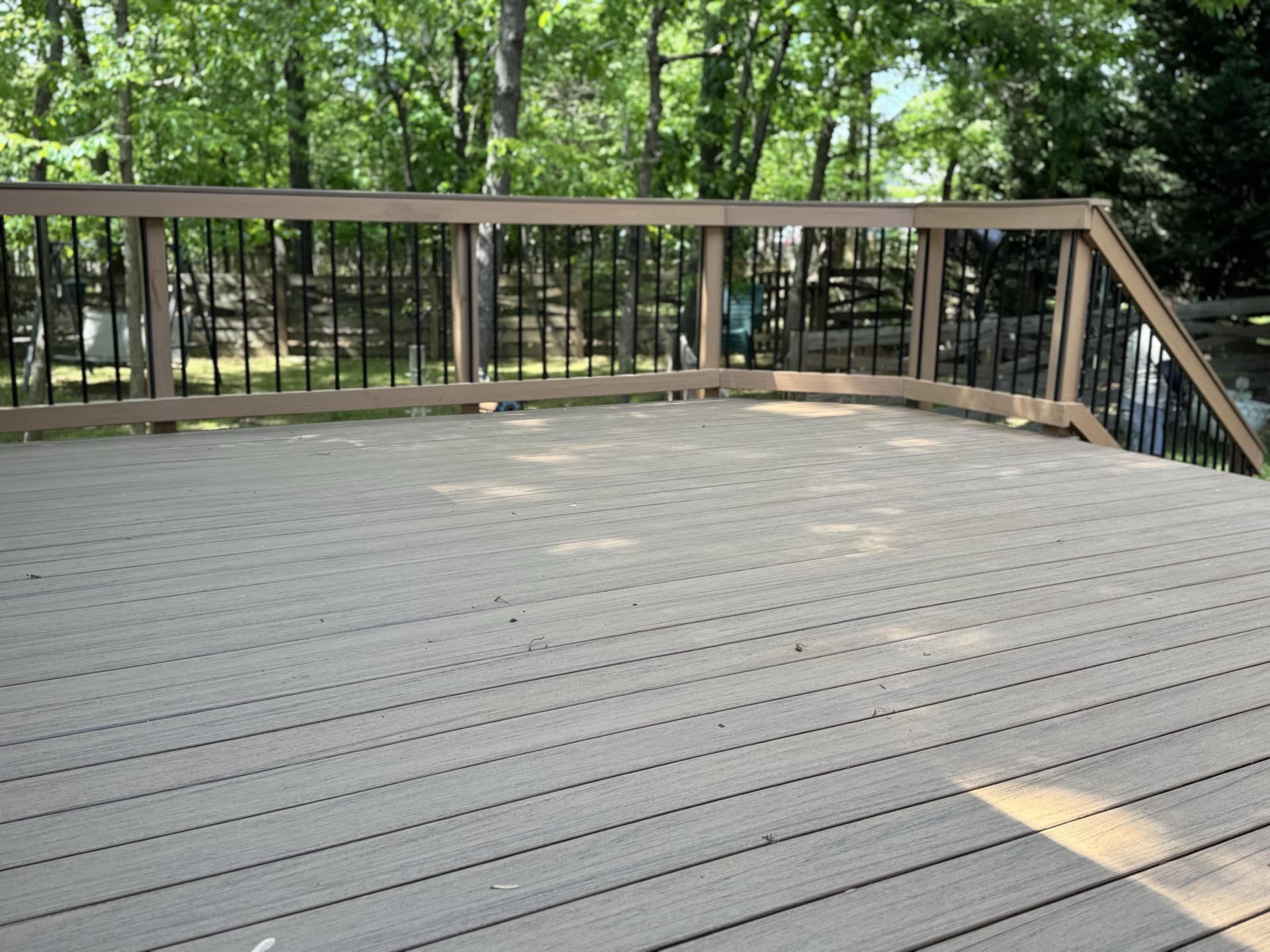
Custom Deck Builder
Transform your backyard with a custom-designed deck using Trex, TimberTech, wood, or PVC materials matched to your budget, HOA rules, and maintenance goals.
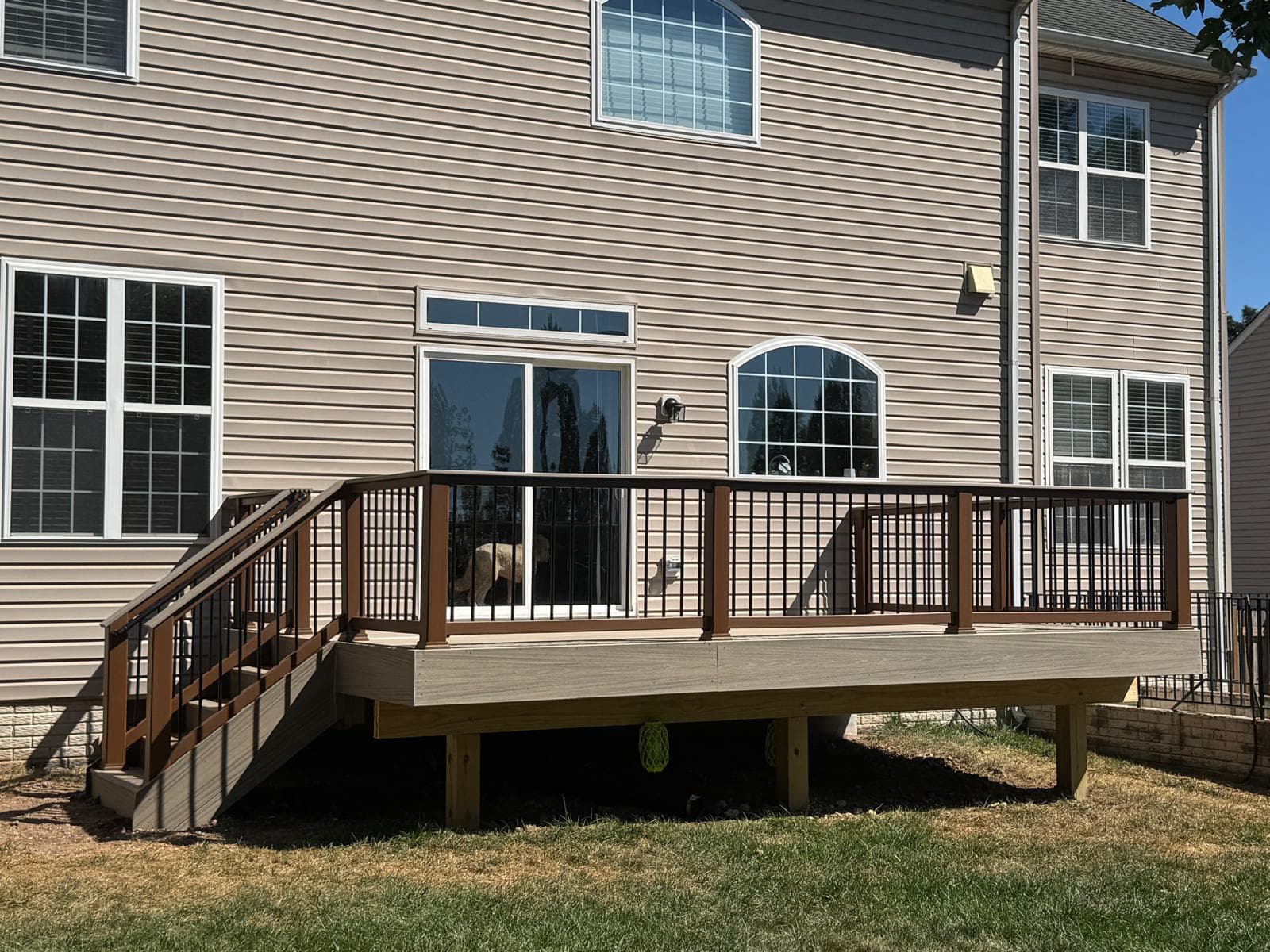
Deck Resurfacing
Premium wood-to-composite resurfacing for structurally sound frames. Full surface conversions start from $15k with boards, railings, fascia, and safety review.

Patio Contractor Services
Professional bluestone and paver patio installation. We create durable, beautiful ground-level outdoor living spaces that last a lifetime.
Local Expertise Across Northern Virginia
Loudoun Decks is a trusted deck builder serving Loudoun County, Fairfax County, Prince William County, Arlington, and Stafford.
Guides Northern Virginia Homeowners Are Reading
Deck Permits in Fairfax County
Requirements, timeline, fees, and inspection process.
Deck Builder in Northern Virginia
Custom decks, permits, HOA support and local service areas.
Covered Deck Builder
Covered deck planning, outdoor living upgrades and shade structure decisions.
Trex vs TimberTech vs AZEK
Side-by-side brand comparison for Virginia climate.
Composite Deck Cost in Northern Virginia
Material pricing, verified source references, planning examples and what drives the price.
Free Deck Cost Calculator
Get an instant estimate by material, size, and add-ons.