
Multi-Level Deck Design in Northern Virginia: What to Know Before You Build
A multi-level deck solves design challenges that a single-level platform cannot: sloped lots, large yard areas that benefit from functional zones, and the desire to separate dining, cooking, and lounge areas in a way that feels intentional. But multi-level decks also cost more, require more complex permitting, and introduce design decisions that affect how the space functions for years.
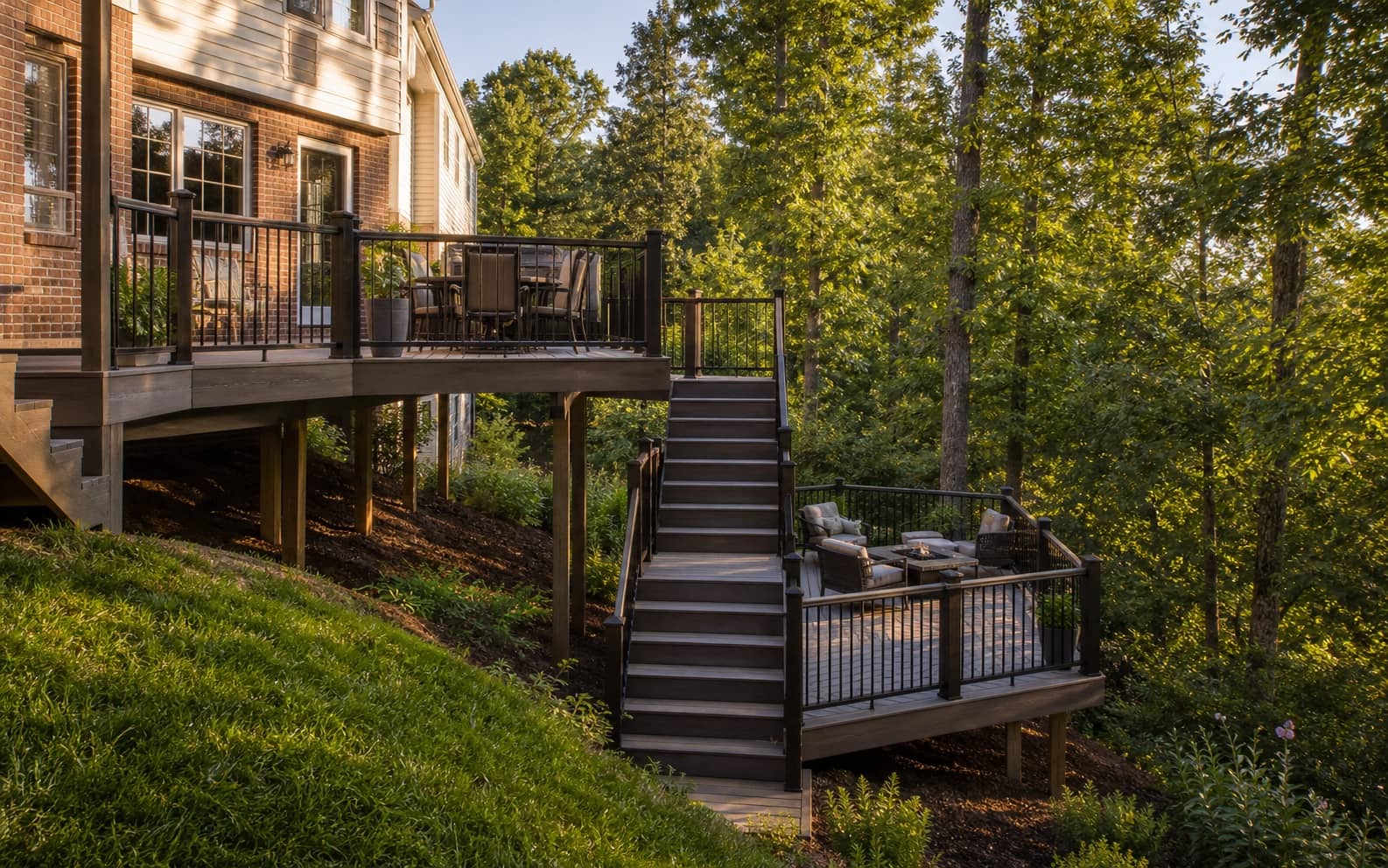
Multi-level decks are one of the most requested deck configurations in Northern Virginia — and for good reason. A well-designed two or three-level deck takes what would otherwise be a large flat platform and turns it into an outdoor living system with distinct zones for cooking, dining, lounging, and yard access.
But multi-level decks also involve more structural complexity, higher cost per square foot than single-level decks, and design decisions that are difficult to reverse after construction. This guide covers what Northern Virginia homeowners need to understand before committing to a multi-level design.
When a Multi-Level Deck Makes Sense
Sloped lots. The most practical justification for a multi-level deck is a sloped backyard. When your lot drops 4 to 10 feet from the house to the back of the yard, a single-level deck at door height either sits very high above grade at the far end (requiring tall posts and complex framing) or cuts into the slope (requiring grading and a potentially awkward grade relationship at the house). A two-level deck that follows the slope creates a more natural grade relationship and brings both levels closer to the ground.
Large footprint that benefits from zone separation. A 600-square-foot single-level deck is a large, undifferentiated platform. The same square footage in two levels — a 400-square-foot upper level for dining and cooking, a 200-square-foot lower level as a lounge or firepit zone — creates two outdoor rooms that feel distinct and more purposeful than one large open area.
Multiple door access points. Some Northern Virginia homes have both a sliding door at the dining level and a walkout door from a finished basement. A deck that serves both access points naturally becomes multi-level, with each level connecting to its respective interior space.
The Design Decisions That Matter Most
Level height differential. The most common multi-level configuration in Northern Virginia is a 2 to 4-foot drop between levels. This creates a comfortable visual separation without requiring a long stair run. A larger differential — 6 feet or more — begins to feel like two separate decks rather than a unified design and can create awkward sightlines from the upper level to the lower.
Stair placement. Where the stair run connects the two levels determines traffic flow on both levels. A stair at one end of the upper level sends traffic around the perimeter; a stair in the center creates two zones on the upper level naturally separated by the stair landing. Think about how you actually move through the space and where stair traffic will interrupt or enhance the layout.
Railing continuity. On a multi-level deck, railing runs along both the upper level perimeter and the step-down transition. Keeping the same railing system throughout — same material, same cap rail, same baluster or cable configuration — is essential to a visually cohesive design. Mixing railing types between levels creates a fragmented look.
Integration vs. separation. Multi-level decks can be designed so the two levels are visually open to each other — no wall between them, just a change in elevation — or with a partial privacy screen or planter box at the step-down that creates more defined separation. The open configuration feels larger; the separated configuration gives each zone more private character.
Structural Considerations
A multi-level deck is structurally more complex than a single-level deck of the same total square footage. The upper level is typically attached to the house via a ledger. The lower level may be either freestanding (supported on its own posts and footings) or connected to the upper level structure.
The step-down transition — where the upper level framing steps down to the lower level — requires careful structural detailing. The posts that support the outer edge of the upper level in the transition zone must be designed to carry both the upper deck load and transfer it correctly to footings.
Every multi-level deck in Northern Virginia requires a building permit, and the structural drawings must show both levels with all framing dimensions, post and footing locations, and the connection detail at the transition.
Cost of Multi-Level Decks vs. Single-Level
A multi-level deck costs 20 to 35 percent more per square foot than a single-level deck of equivalent total area, reflecting the additional framing at the transition zone, more complex permit drawings, additional stair costs, and longer railing runs.
For a 500-square-foot composite deck in Northern Virginia: - Single-level: approximately $55,000 to $85,000 - Two-level (same total sq ft): approximately $68,000 to $105,000
The cost premium is worth it when the lot conditions (slope) or the functional goal (distinct zones) genuinely call for multi-level design. It is not worth the premium simply for visual complexity — a beautifully designed single-level deck with a pergola, built-in seating, and lighting achieves a high-end result at lower cost.
HOA Considerations for Multi-Level Decks
In Loudoun and Fairfax County HOA communities, multi-level decks require the same ARC approval as any deck — but the review may be more involved. Multi-level structures that are taller at their upper level, or that have a more prominent visual presence from neighboring lots or the street, receive more scrutiny on material, color, and overall scale.
Brambleton, One Loudoun, and Reston in particular have guidelines that address deck height visibility and the relationship of deck structures to neighboring properties. Submit accurate elevation drawings to the ARC — not just a top-down plan — so the committee can properly assess the visual impact.
Getting the Design Right the First Time
Multi-level deck design decisions are expensive to reverse after construction. The stair placement, level differential, railing type, and zone configuration should be worked out in design before a permit is submitted.
LDN Decks does full design development for multi-level projects — 3D visualization, permit drawing package, and HOA submittal documentation. We build multi-level composite decks across Ashburn, Leesburg, Fairfax, Herndon, Burke, and surrounding communities.
Schedule a Multi-Level Deck Consultation
---
Related: Deck Design Ideas for Small Backyards · Covered Deck vs Open Deck · What Affects Deck Cost · Deck Cost 2026 · New Deck Services
Frequently Asked Questions
How much does a multi-level deck cost in Northern Virginia?
A multi-level composite deck in Northern Virginia costs 20 to 35 percent more per square foot than a single-level deck of equivalent total area. For a 500-square-foot two-level composite deck, expect $68,000 to $105,000 depending on complexity, height differential, and site conditions. The premium reflects additional framing at the transition zone, longer railing runs, and more complex permit drawings.
Is a multi-level deck worth it?
A multi-level deck is worth the cost premium when your lot conditions genuinely call for it — particularly on sloped lots where a two-level design manages grade more naturally than a single-level platform — or when a large footprint benefits from distinct functional zones. It is not worth the premium purely for visual complexity if a single-level deck with design elements achieves a similarly high-end result.
Do multi-level decks require a permit in Northern Virginia?
Yes. Every attached deck in Northern Virginia requires a building permit, and multi-level decks require more detailed structural drawings — including both level plans, the transition zone framing detail, and footing design for all post locations. Permit review for multi-level decks may take slightly longer than for simple single-level structures.
What is the best height differential between deck levels?
The most common and functional height differential in Northern Virginia multi-level decks is 2 to 4 feet between levels. This creates clear visual zone separation and a comfortable stair run of 4 to 6 steps. Differentials of 6 feet or more begin to feel like two separate structures and create awkward sightlines from the upper level to the lower.
Can I add a second level to an existing deck?
It depends on the structural capacity of the existing framing. Adding a second level to an existing deck is a significant structural modification — the existing ledger, posts, beams, and footings must be assessed for their ability to carry additional load. A licensed contractor must evaluate the existing structure before any design is proposed, and the modification requires a building permit.
Design recommendations and cost ranges in this guide are general guidance based on Northern Virginia market conditions. Actual design feasibility, permit requirements, and costs depend on site-specific conditions, structural assessment, and HOA guidelines. Always consult a licensed contractor for project-specific advice.
Plan Your Northern Virginia Deck Project With Loudoun Decks
Get a free, no-pressure consultation from a licensed Northern Virginia deck builder. Call (571) 655-7207 or visit ldndecks.com/get-estimate.
Get a Free EstimateEverything Your Outdoor
Space Needs
From ground-up deck construction to full outdoor living spaces, every project is custom-designed for your home with permit planning, material guidance, and written workmanship terms.
Custom Deck Builder
Transform your backyard with a custom-designed deck using Trex, TimberTech, wood, or PVC materials matched to your budget, HOA rules, and maintenance goals.
Deck Resurfacing
Premium wood-to-composite resurfacing for structurally sound frames. Full surface conversions start from $15k with boards, railings, fascia, and safety review.

Patio Contractor Services
Professional bluestone and paver patio installation. We create durable, beautiful ground-level outdoor living spaces that last a lifetime.
Local Expertise Across Northern Virginia
Loudoun Decks is a trusted deck builder serving Loudoun County, Fairfax County, Prince William County, Arlington, and Stafford.
Guides Northern Virginia Homeowners Are Reading
Deck Builder in Northern Virginia
Custom decks, permits, HOA support and local service areas.
Covered Deck Builder
Covered deck planning, outdoor living upgrades and shade structure decisions.
Trex vs TimberTech vs AZEK
Side-by-side brand comparison for Virginia climate.
Composite Deck Cost in Northern Virginia
Material pricing, verified source references, planning examples and what drives the price.
Free Deck Cost Calculator
Get an instant estimate by material, size, and add-ons.
TimberTech & AZEK Decks
Premium PVC and composite deck options for Northern Virginia.