
What Affects Deck Cost the Most? 8 Factors That Move the Price
Homeowners comparing deck quotes are often surprised to find that two bids for a similarly sized deck can differ by $10,000 or more. The difference is almost never profit margin — it is scope. Eight specific factors drive deck cost, and understanding each one lets you read bids accurately and make design decisions that align with your budget.
Two neighbors in the same Northern Virginia subdivision can get quotes for decks of the same size and find that the prices differ by $15,000 or more. Without understanding what drives deck cost, the lower quote looks like a bargain and the higher one looks like a rip-off. In reality, both quotes may be accurate — they just reflect different project scope, site conditions, or specification levels.
These eight factors explain most of the price variation you will see in Northern Virginia deck bids.
Factor 1: Material Selection
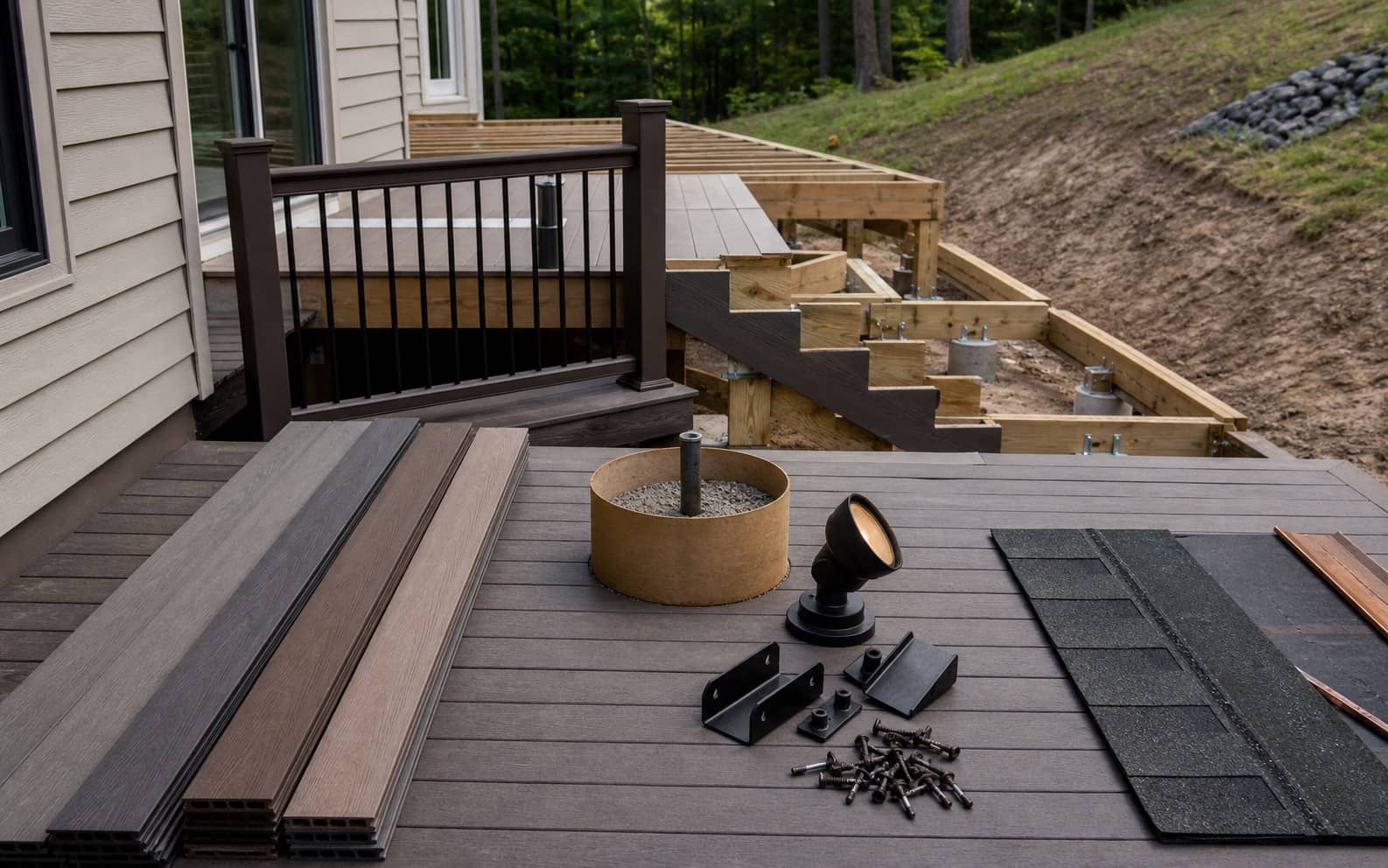
The single biggest lever on deck cost is the surface material. Composite decking costs 30 to 60 percent more than pressure-treated pine per linear foot of installed board. Within composite, entry-level products (single-capped, basic color range) cost $5 to $8 per linear foot less than premium products (fully-capped, dual-tone, realistic wood grain). A full upgrade from pressure-treated to premium composite on a 300-square-foot deck adds $8,000 to $15,000 to the project cost.
Railing material is a secondary but significant cost driver. Standard composite railing runs $80 to $120 per linear foot installed. Aluminum cable railing runs $150 to $250. Low-iron glass panel railing exceeds $300. On a deck with 80 linear feet of railing perimeter, the difference between standard composite and cable railing is $5,600 to $10,400.
Factor 2: Deck Height
A grade-level deck — one that sits less than 24 to 30 inches above the ground — uses short posts and minimal framing beyond what structural code requires. An elevated deck, or one that steps down a significant slope, requires longer posts, larger beams, additional lateral bracing, and more complex footing design.
The structural framing cost per square foot increases progressively as deck height increases. A 10-foot-high deck can cost 30 to 45 percent more per square foot than a grade-level deck of identical footprint and material. Second-story decks with complex stair systems can approach 50 percent premium.
Factor 3: Shape and Layout Complexity
A simple rectangle is the most cost-efficient deck shape. Every deviation from a rectangle adds cost: angled corners require material cuts and waste; multi-level changes require additional framing, stair landings, and transitions; curved edges require bent or cut material and more labor time.
A 300-square-foot L-shaped deck costs more than a 300-square-foot rectangle with equal surface area. A 300-square-foot two-level deck costs more than a 300-square-foot single-level deck. Contractors are not padding — they are reflecting real additional material and labor hours.
Factor 4: Stairs
Stairs are disproportionately expensive relative to square footage. A single code-compliant stair run of 6 to 8 steps — with composite treads, composite risers, and code-compliant railing on both sides — costs $2,000 to $4,500. Wide stairs, curved stairs, or stairs with multiple intermediate landings run higher.
Projects with multiple stair access points (common on L-shaped decks or decks that access both a lower patio and an upper door) can see $6,000 to $10,000 in stair costs alone. When comparing quotes, verify what stair configuration each quote includes.
Factor 5: Site Conditions and Access
A deck on a flat lot with open access — where a crew can bring in a truck and work freely around the perimeter — costs less to build than the same deck on a sloped lot with limited side-yard access and a fence that has to be temporarily removed.
Specific site conditions that add cost: significant slope (more framing, more complex footing layout), tight side-yard access that requires hand-carrying materials, existing structures that must be worked around, rocky or hard soil that slows footing excavation, and distance from the street that increases material staging time.
Some sites in Northern Virginia — particularly older subdivisions in McLean, Great Falls, and Vienna with mature landscaping and tight lot coverage — have access conditions that add meaningful cost.
Factor 6: Permit and Engineering Requirements
Every attached deck requires a building permit in Northern Virginia, and permits have cost implications beyond the permit fee itself. Drawing preparation for permit submission is typically included in contractor overhead — but for elevated decks, complex framing, or projects that require engineering review, drawing preparation can be a separately priced line item.
Decks that exceed standard IRC span tables for joists or beams may require a stamped engineering letter — an additional $300 to $800 cost. Decks in HOA communities with specific submittal requirements add administrative time. Permits that require multiple correction rounds add time cost that some contractors pass through.
Factor 7: Lighting, Electrical, and Add-Ons
The structural deck quote rarely includes lighting, electrical, or accessory structures. These are common add-ons that significantly affect total project cost.
Low-voltage deck lighting (post cap lights, stair riser lights, under-rail lights): $1,500 to $4,000 for a typical installation, depending on fixture count and wiring complexity.
Line-voltage electrical (outlet boxes, code-compliant wiring in conduit): requires a licensed electrician, typically adds $1,500 to $3,500 depending on distance from the panel.
Pergola or shade structure: $8,000 to $25,000 depending on size and material.
Built-in seating or planters: $1,500 to $5,000 depending on configuration.
Outdoor kitchen rough-in: $3,000 to $8,000 for structural supports, gas stub, and electrical — kitchen equipment itself is additional.
When comparing quotes, confirm whether these items are included or excluded.
Factor 8: Labor Market and Scheduling Timing
Labor cost in Northern Virginia reflects one of the highest costs-of-living markets on the East Coast. Skilled deck carpenters in Loudoun and Fairfax counties command higher hourly rates than national averages, and a licensed Class A contractor carries the overhead of licensing, insurance, warranty support, and permit management that lower-priced operators do not.
Seasonal timing also affects pricing. Spring and early summer (March through June) represent peak demand for deck construction in Northern Virginia. Contractors with full schedules have less incentive to compete aggressively on price. Projects scheduled for fall construction or winter project planning (with spring build) often receive more competitive bids.
Reading Bids Accurately
When you receive multiple bids, the lowest number is not always the lowest cost — it may simply be a less complete proposal. Before comparing bids:
- Verify material specification is identical (brand, product line, color) - Confirm permit and HOA submission is included - Confirm railing linear footage and type is identical - Verify stair configuration and location - Confirm what add-ons are included or excluded - Check that warranty and cleanup are addressed
A $5,000 difference between two bids on the same project is worth investigating. A $15,000 difference almost always reflects a difference in scope.
LDN Decks provides detailed line-item proposals so you can see exactly what each cost element reflects — no hidden variables.
Get a Detailed Estimate for Your Deck Project
---
Related: How Much Does a Deck Cost in Northern Virginia? · Composite vs Pressure-Treated Cost · Deck Financing Options · Deck Cost Calculator · New Deck Services
Frequently Asked Questions
Why do deck quotes vary so much in Northern Virginia?
Most price variation between deck bids reflects differences in project scope, not profit margin. Material specification (composite grade, railing type), deck height, shape complexity, stair count, site conditions, and what add-ons are included all affect price significantly. Before comparing quotes, verify that each bid covers identical scope — material brand and product tier, railing type, stair configuration, and permit handling.
What is the most expensive part of building a deck?
For most projects, the decking surface material and railing system together account for 40 to 55 percent of total cost. On elevated or complex decks, structural framing becomes a larger portion. Stairs are disproportionately expensive relative to the square footage they add — each stair run can add $2,000 to $4,500 to a project.
How much does deck height affect cost?
Deck height is a significant cost driver. An elevated deck 8 to 12 feet off the ground can cost 30 to 45 percent more per square foot than a grade-level deck of the same size and material, due to the additional structural framing, longer posts, and more complex footing requirements.
Does the time of year I build affect deck cost?
Yes, timing affects price in the Northern Virginia market. Spring (March through June) is peak demand season and contractors with full books have less incentive to offer competitive pricing. Projects planned in fall or winter for spring construction, or built in fall, often receive better pricing as contractors fill schedule gaps.
Are permits included in deck contractor quotes?
In most cases, permit fees and drawing preparation are included in Northern Virginia contractor bids — but always confirm. Some contractors list permit fees separately; others absorb them. For complex projects or elevated decks, engineering review may be an additional cost not included in standard quotes.
Cost information in this guide reflects general Northern Virginia market conditions as of 2026. Actual pricing varies by contractor, specific project scope, site conditions, and market timing. Always obtain itemized bids from at least three licensed contractors before making project decisions.
Plan Your Northern Virginia Deck Project With Loudoun Decks
Get a free, no-pressure consultation from a licensed Northern Virginia deck builder. Call (571) 655-7207 or visit ldndecks.com/get-estimate.
Get a Free EstimateEverything Your Outdoor
Space Needs
From ground-up deck construction to full outdoor living spaces, every project is custom-designed for your home with permit planning, material guidance, and written workmanship terms.
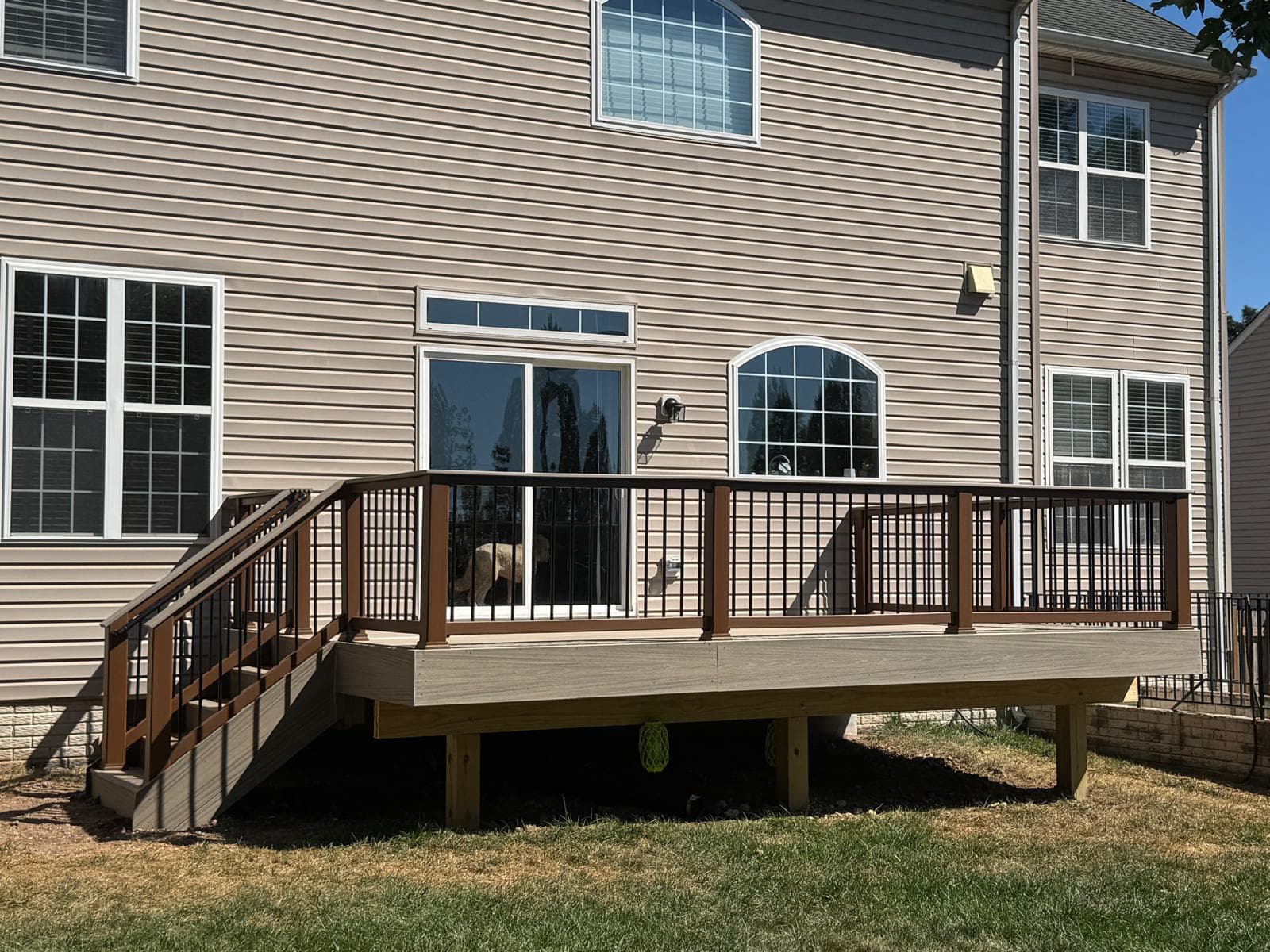
Custom Deck Builder
Transform your backyard with a custom-designed deck using Trex, TimberTech, wood, or PVC materials matched to your budget, HOA rules, and maintenance goals.
Deck Resurfacing
Premium wood-to-composite resurfacing for structurally sound frames. Full surface conversions start from $15k with boards, railings, fascia, and safety review.

Patio Contractor Services
Professional bluestone and paver patio installation. We create durable, beautiful ground-level outdoor living spaces that last a lifetime.
Local Expertise Across Northern Virginia
Loudoun Decks is a trusted deck builder serving Loudoun County, Fairfax County, Prince William County, Arlington, and Stafford.
Guides Northern Virginia Homeowners Are Reading
Free Deck Cost Calculator
Get an instant estimate by material, size, and add-ons.
TimberTech & AZEK Decks
Premium PVC and composite deck options for Northern Virginia.
Deck Permits in Loudoun County
Permit requirements, review steps and inspection context for Loudoun homeowners.
Deck Permits in Fairfax County
Requirements, timeline, fees, and inspection process.
Deck Builder in Northern Virginia
Custom decks, permits, HOA support and local service areas.
Covered Deck Builder
Covered deck planning, outdoor living upgrades and shade structure decisions.