


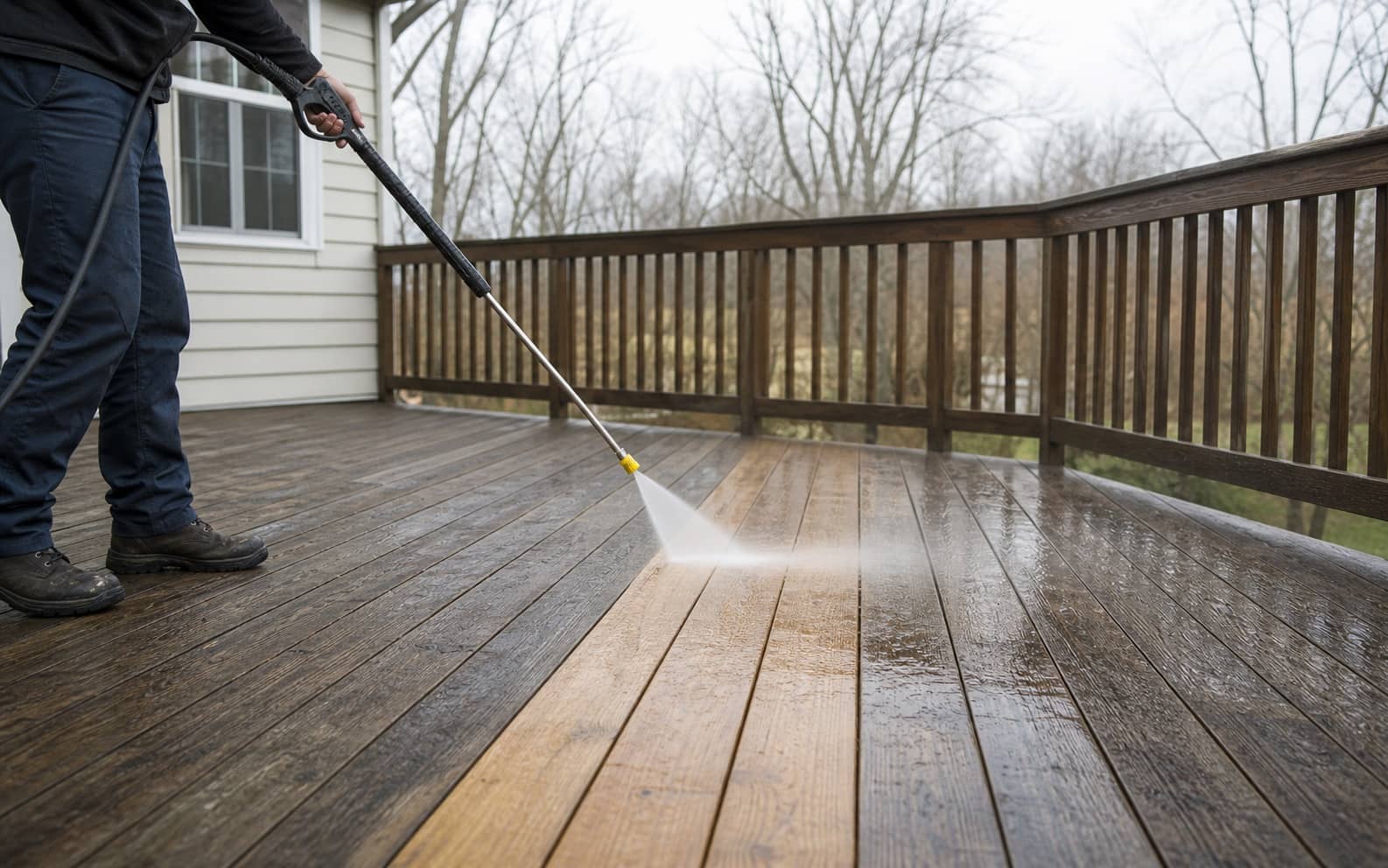
How to Power Wash a Deck Without Causing Damage
Power washing is the fastest and most effective way to clean a deck — and one of the easiest ways to permanently damage one. Too much pressure, the wrong nozzle tip, or the wrong technique leaves marks, raises grain, and damages composite caps. This guide covers exactly how to power wash both wood and composite decks without causing damage.
Power washing a deck correctly takes about 45 minutes and produces a clean, uniform surface ready for staining or seasonal use. Power washing it incorrectly leaves permanent stripe marks, raised wood grain, damaged composite cap surfaces, and — in severe cases — etched board texture that cannot be repaired without replacement.
The difference between a good result and a damaged deck comes down to four variables: PSI, nozzle tip, distance, and technique. Get all four right and power washing is straightforward.
The Four Variables
PSI (pounds per square inch): This is the pressure at the pump, not at the nozzle. Most residential power washers are rated 1,500 to 3,000 PSI.
- Composite decking (Trex, TimberTech, AZEK): 1,500 PSI maximum. Most manufacturers specify 1,500 PSI; some AZEK documentation permits up to 2,000 PSI. When in doubt, use the lower number. - Pressure-treated wood: 1,500 to 2,000 PSI. Higher pressures raise wood grain and can drive water deep into the wood fiber. - Hardwood (ipe, cumaru, teak): 1,200 to 1,500 PSI. Hardwoods are dense but can still be surface-damaged by high-pressure direct streams.
Nozzle tip (measured in degrees): The tip controls how wide the water fan is. Narrower fans concentrate more force; wider fans spread it.
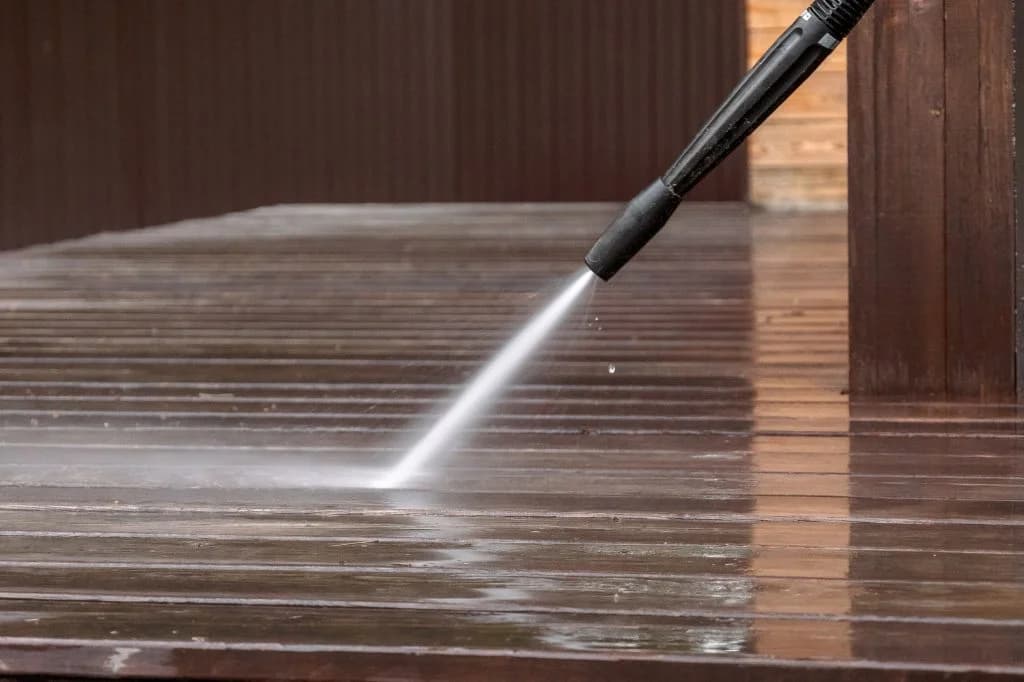
- Never use 0° (red) tip on any deck surface. A 0° tip concentrates the full pump pressure into a single point — it will cut grooves in wood and punch through composite cap. - 25° (green) tip is the standard for deck cleaning on wood surfaces. - 40° (white) tip is appropriate for composite decking — lower impact, broader coverage. - Turbo/rotating nozzle: Produces high force in a rotating pattern. Not recommended for composite; use with caution on wood at 18+ inch distance.
Distance from the surface: Closer distance = more force delivered to the surface, regardless of PSI setting. The minimum safe distances: - Composite decking: 12 inches minimum, 18 inches recommended - Pressure-treated wood: 8 inches minimum - Never hold the nozzle stationary — a moving nozzle at 6 inches is less damaging than a stationary nozzle at 12 inches
Technique: This is where most damage occurs. - Always move the wand in the direction of the board grain, not across it. Cross-grain movement creates stripe marks on wood and scratches composite texture channels - Keep the wand moving at a consistent pace — pausing creates dark stripes at the pause point - Work from the house outward so dirty water flows away from cleaned sections - On composite decking, keep the fan angle low (nearly parallel to the surface) to avoid lifting debris under the nozzle
Step-by-Step Process for Composite Decking
1. Remove all furniture, plants, and rugs. Move anything that can be damaged by water overspray. 2. Sweep loose debris and clear between-board gaps. 3. Connect power washer, attach 40° white tip. 4. Test on an inconspicuous area first — a board end near the house or under where a planter sits. 5. Hold nozzle 18 inches from the surface, angle nearly parallel to the boards. 6. Work in 4-foot sections, moving continuously in the grain direction. 7. Rinse from the house outward. 8. Allow 24 to 48 hours to dry before replacing furniture or applying any cleaner.
Step-by-Step Process for Wood Decking
1. Remove furniture and sweep loose debris. 2. Mix deck cleaner (with mildewcide if mildew is present) in a pump sprayer or bucket. Apply to the deck surface and allow to dwell per product instructions before power washing. 3. Attach 25° green tip to power washer. 4. Hold nozzle 8 to 12 inches from the surface. 5. Work in continuous strokes in the grain direction. Do not stop mid-board. 6. Work from the house outward. 7. For stair treads: wash with the grain, not across the nosing edge. 8. After washing, inspect for raised grain — lightly sand with 60 to 80-grit if the surface feels splintery. 9. Apply wood brightener (optional) to restore pH and open grain for staining. 10. Allow 48 to 72 hours minimum before staining.
What Happens When Power Washing Goes Wrong
Stripe marks on composite: Caused by holding the nozzle too close or moving across the grain. Composite cap surfaces that have been pressure-damaged show lighter or darker stripes that run perpendicular to the boards. Mild cases sometimes reduce with cleaning and UV weathering; severe cases may require board replacement.
Raised grain on wood: Caused by excessive PSI, too-close nozzle distance, or 0° tip. The wood fibers are lifted and the surface becomes rough and splinter-prone. Sanding with 60-grit can reduce raised grain; severe raising may require planing.
Fuzzing on composite: Composite boards that have been power-washed with excessive pressure or a turbo tip develop a fuzzy, light-colored surface appearance. This is damage to the cap layer — the cap has been abraded and the underlying core fiber is partially exposed. This is permanent without board replacement.
Graying without brightening: Freshly power-washed wood that is not brightened with a wood brightener (oxalic acid) turns gray quickly as the tannins oxidize at the surface. This is cosmetic — the wood is clean — but applying a wood brightener before staining gives a better result.
Renting vs. Buying a Power Washer
A residential power washer capable of 1,500 PSI with variable tips rents for $50 to $80 per day at Northern Virginia tool rental locations. For once-per-year deck cleaning, rental is cost-effective for most homeowners. Electric pressure washers in the 1,200 to 1,800 PSI range are also widely available for purchase at $150 to $350 — appropriate for composite decks where lower PSI is required anyway.
For wood decks where the full 2,000 PSI capacity is useful, a gas-powered rental unit is more effective than most consumer electric washers.
LDN Decks includes professional power washing as part of deck staining and annual maintenance services across Northern Virginia.
Get a Deck Cleaning or Maintenance Estimate
---
Related: How to Clean a Composite Deck · Deck Staining Guide Northern Virginia · Deck Winterization Checklist · Deck Structural Safety Signs · Deck Repair Services
Frequently Asked Questions
What PSI should I use to power wash a composite deck?
Maximum 1,500 PSI for composite decking (Trex, TimberTech, AZEK). Use a 40-degree (white) nozzle tip, hold the nozzle at least 12 to 18 inches from the surface, and keep the wand moving in the board grain direction. Higher pressure, a narrower tip, or holding the nozzle too close damages the composite cap surface — this damage is permanent.
What PSI should I use to power wash a wood deck?
1,500 to 2,000 PSI for pressure-treated wood decking, using a 25-degree (green) nozzle tip held 8 to 12 inches from the surface. Keep the wand moving continuously in the grain direction — stopping mid-board creates stripe marks. For hardwoods (ipe, cumaru), use 1,200 to 1,500 PSI with the same technique.
Can I use a 0-degree nozzle tip on my deck?
No. A 0-degree (red) tip concentrates the full pump pressure into a single point and will cut grooves in wood and punch through composite cap surfaces, causing permanent damage. Never use a 0-degree tip on any deck surface. Use a 25-degree (green) tip for wood and a 40-degree (white) tip for composite.
Why does my deck look gray after power washing?
Freshly power-washed wood turns gray quickly as surface tannins oxidize when exposed to air. This is cosmetic, not structural damage — the wood is clean. Applying a wood brightener (oxalic acid solution) after power washing and before staining removes the gray oxidation and restores the natural wood color. Wood brightener also opens the grain for better stain penetration.
How long after power washing can I stain a deck?
Wait 48 to 72 hours minimum after power washing before staining. The wood must be fully dry throughout its depth, not just surface-dry. In Northern Virginia's humid spring and fall conditions, 72 hours is safer. The water-bead test confirms readiness: if water sprinkled on the surface absorbs immediately (no beading), the wood is dry enough to accept stain.
Power washing technique guidance reflects general best practice as of 2026. Always check the manufacturer's specific cleaning instructions for your composite decking product before power washing. Using pressure or nozzle configurations outside manufacturer specifications may void the product warranty.
Plan Your Northern Virginia Deck Project With Loudoun Decks
Get a free, no-pressure consultation from a licensed Northern Virginia deck builder. Call (571) 655-7207 or visit ldndecks.com/get-estimate.
Get a Free EstimateEverything Your Outdoor
Space Needs
From ground-up deck construction to full outdoor living spaces, every project is custom-designed for your home with permit planning, material guidance, and written workmanship terms.
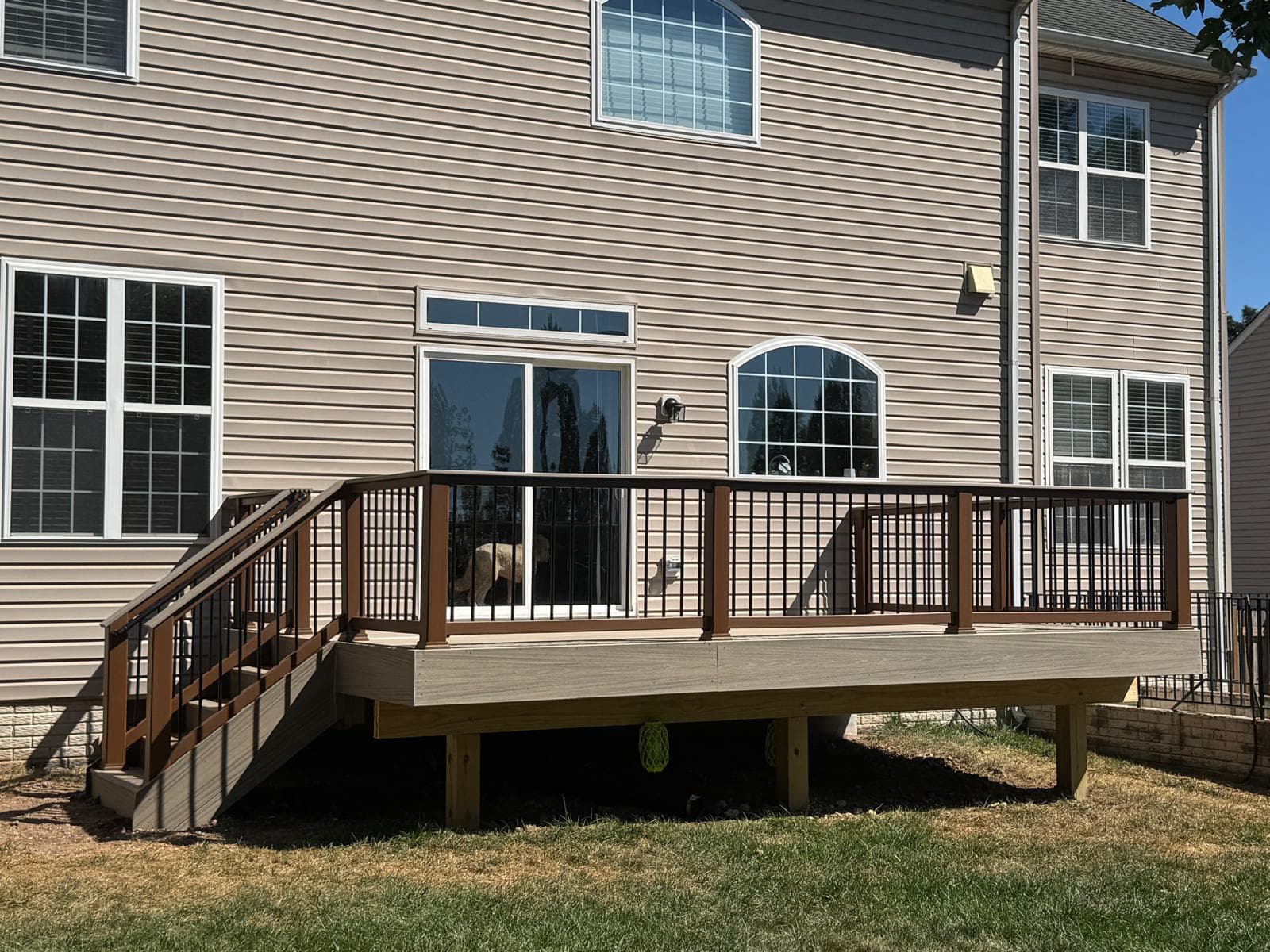
Custom Deck Builder
Transform your backyard with a custom-designed deck using Trex, TimberTech, wood, or PVC materials matched to your budget, HOA rules, and maintenance goals.
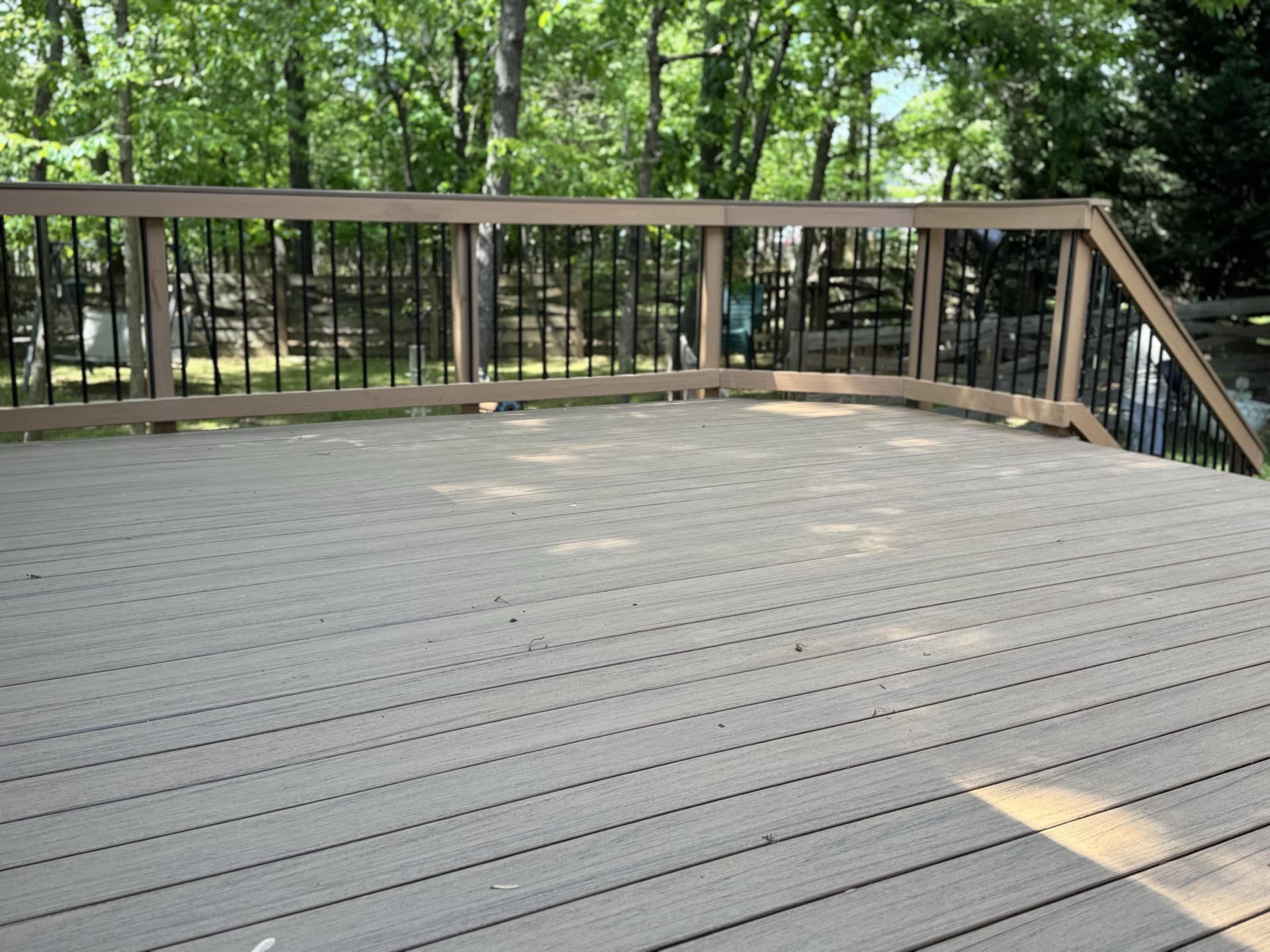
Deck Resurfacing
Premium wood-to-composite resurfacing for structurally sound frames. Full surface conversions start from $15k with boards, railings, fascia, and safety review.
Patio Contractor Services
Professional bluestone and paver patio installation. We create durable, beautiful ground-level outdoor living spaces that last a lifetime.
Local Expertise Across Northern Virginia
Loudoun Decks is a trusted deck builder serving Loudoun County, Fairfax County, Prince William County, Arlington, and Stafford.
Guides Northern Virginia Homeowners Are Reading
Composite Deck Cost in Northern Virginia
Material pricing, verified source references, planning examples and what drives the price.
Free Deck Cost Calculator
Get an instant estimate by material, size, and add-ons.
TimberTech & AZEK Decks
Premium PVC and composite deck options for Northern Virginia.
Deck Permits in Loudoun County
Permit requirements, review steps and inspection context for Loudoun homeowners.
Deck Permits in Fairfax County
Requirements, timeline, fees, and inspection process.
Deck Builder in Northern Virginia
Custom decks, permits, HOA support and local service areas.