
Deck Lighting Ideas for Northern Virginia Homes: A Practical 2026 Guide
Deck lighting is one of the highest-return additions you can make to an outdoor space — it extends usable hours into the evening, adds safety on stairs and edges, and transforms the appearance of the deck after dark. This guide covers the practical options for Northern Virginia homeowners in 2026, from low-voltage systems to line-voltage circuits.
A deck without lighting is unusable after sunset — and in Northern Virginia's climate, the most comfortable outdoor hours are often in the evening, after the intense summer heat breaks. Deck lighting transforms the outdoor space from a daytime amenity to a year-round evening destination.
Beyond aesthetics, lighting is a safety feature. Stairs, step-downs, and deck edges in darkness are fall hazards. Code-compliant deck stair lighting is required in some jurisdictions, and it is good practice in all of them.
This guide covers the primary deck lighting categories, how they integrate with composite decking, and what to expect for installation cost in the Northern Virginia market in 2026.
Category 1: Post Cap Lights
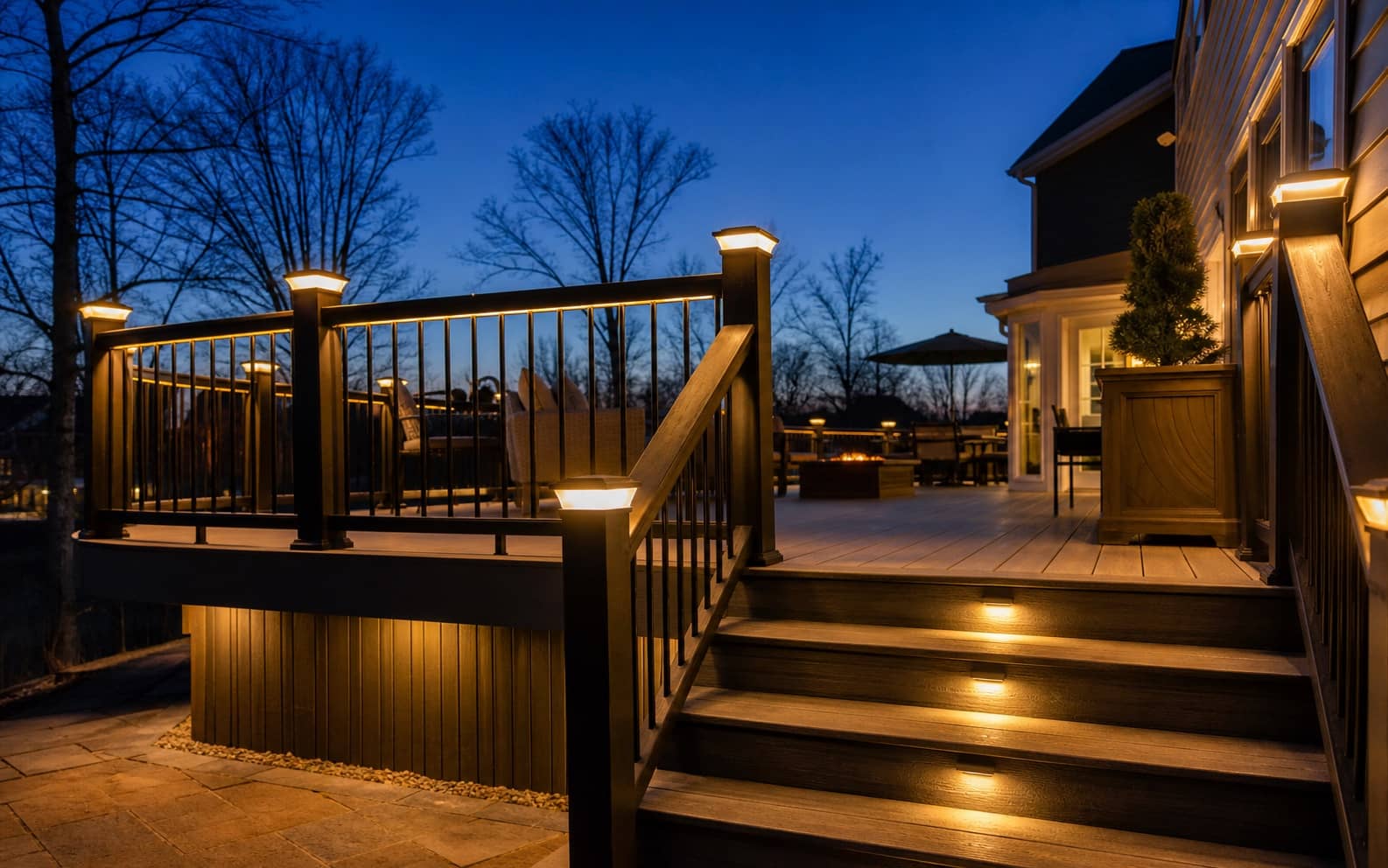
Post cap lights sit on top of the railing posts and provide ambient illumination at railing height. They are the most visible lighting element from both inside the house and from the yard, and they define the perimeter of the deck visually at night.
Low-voltage LED post caps (most common): Run on a 12V transformer connected to a standard outdoor outlet. Individual fixtures consume 1 to 3 watts each. A deck with 8 railing posts requires 8 fixtures plus a transformer and wire run. Cost installed: $800 to $2,000 depending on fixture count and wire routing.
Solar post caps: Self-contained — no wiring required. Charge during daylight and illuminate at night. Convenient but inconsistent — output degrades on cloudy days or in shaded post locations, and solar post caps in Northern Virginia's tree-heavy suburban lots often underperform in spring before full leaf-out provides clear sky access. Best suited to fully exposed southern-facing decks.
Integrated composite post cap lights: Several composite railing systems (Trex Transcend, TimberTech RadianceRail) offer post caps designed to integrate with the railing system aesthetically. These are low-voltage LED and require the same transformer and wiring as standard low-voltage systems.
Category 2: Deck Stair Lights
Stair riser lights mount under each tread, illuminating the step surface below. They are the most safety-critical lighting element on a deck — a well-lit stair run eliminates one of the most common deck-related fall hazards.
Code requires that stairs on residential decks have adequate illumination for safe egress — the specific lux level is not always defined in residential code, but a standard riser light installation satisfies the intent. Low-voltage riser lights are the standard approach: one or two fixtures per tread riser, wired in series on the same transformer circuit as post cap lights.
Cost for a standard stair run of 6 to 8 steps: $400 to $900 installed.
Category 3: Under-Rail and Deck Board Lighting
Under-rail strip lights: LED strip or puck lights mounted under the cap rail or bottom rail, washing light downward onto the deck surface. Creates a dramatic effect at night and reduces the need for other ambient light sources. Works particularly well when combined with lighter-colored composite boards that reflect the light effectively.
Deck board insert lights: Small LED lenses that insert into holes drilled through the deck surface, providing points of light across the floor. Dramatic but installation-intensive — each light requires a hole, a wire chase, and a connection point. Common on premium projects; less common on standard decks due to cost.
Cost: Under-rail strip lighting for a 12-foot rail section runs $600 to $1,400 installed. Deck board inserts run $50 to $120 per individual fixture installed, making them expensive at scale.
Category 4: Overhead and Pergola Lighting
For decks with a pergola or overhead structure, ceiling fans with integrated lights, pendant fixtures, or string lights are the primary options.
Line-voltage ceiling fans with light kits (requires a dedicated electrical circuit): A ceiling fan with a damp-rated light kit mounted to a pergola beam is one of the most functional additions for Northern Virginia summer decks — it combines shade structure lighting with air movement that makes the space comfortable on humid July evenings. Cost: $400 to $900 for the fixture, plus $500 to $1,200 for a licensed electrician to run the circuit.
String lights on a pergola frame: The most popular aesthetic deck lighting choice. Café-style string lights strung across a pergola frame create an inviting evening ambiance at relatively low cost. Plug-in versions run $80 to $200 for the lights themselves plus an outdoor outlet — no electrician required for plug-in versions. Hard-wired versions require an electrician.
Pendant lights on a pergola: Decorative pendant fixtures hung from pergola rafters require weatherproof housings (damp-rated minimum, wet-rated for exposed positions) and dedicated circuits. Higher design impact but more installation cost.
Integrating Lighting With Your Deck Build vs. Retrofitting
Wiring is significantly less expensive to install during initial deck construction than to retrofit afterward. During construction, wire chases can be integrated into the framing before surface boards go down, and transformer locations can be planned with finish carpentry in mind.
Retrofitting low-voltage lighting onto an existing composite deck is possible — wire can often be run along the underside of the framing or through the railing system — but it is more labor-intensive and the wire runs may be more visible.
If you are building a new deck and think you may want lighting in the future, ask your contractor to install the wire infrastructure (conduit runs, transformer location, outlet placement) during construction even if you defer the fixture purchase. This costs a few hundred dollars during construction and saves $1,000 to $2,000 in retrofit labor.
Line Voltage vs. Low Voltage: Which Is Right?
Low-voltage (12V) systems are appropriate for post cap lights, stair lights, and under-rail accent lighting. They are safe for DIY installation in many jurisdictions, use minimal energy, and provide warm ambient light. The transformer plugs into a standard outdoor GFCI outlet.
Line-voltage (120V) systems are required for ceiling fans, line-voltage pendant lights, and outdoor outlets that will serve appliances. Line-voltage electrical work on a deck must be performed by a licensed electrician in Virginia and requires an electrical permit. Plan for $1,500 to $3,500 for a basic deck electrical circuit with one or two outlets and a fan-rated junction box.
What Lighting Costs in Northern Virginia in 2026
A typical deck lighting package — post cap lights on all railing posts, stair riser lights, and a transformer — runs $1,500 to $3,500 installed by a deck contractor during initial construction.
Adding under-rail strip lighting and a string light-ready overhead outlet adds another $800 to $1,800.
A full lighting package including ceiling fan circuit, post caps, stair lights, and under-rail accents runs $3,500 to $6,500 for a typical 300 to 400-square-foot deck.
LDN Decks integrates lighting into deck builds across Northern Virginia and coordinates with licensed electricians for line-voltage work. We design lighting plans that look intentional — not like an afterthought.
Get a Deck Estimate Including Lighting
---
Related: Covered Deck vs Open Deck Northern Virginia · Multi-Level Deck Design · Deck Design for Small Backyards · New Deck Services · Deck Cost 2026
Frequently Asked Questions
What is the best deck lighting for Northern Virginia homes?
Low-voltage LED systems are the best overall choice for most Northern Virginia decks — they are energy efficient, safe for DIY installation, and provide warm ambient light on post caps and stair risers. For overhead lighting on a pergola, a line-voltage ceiling fan with an integrated light kit adds both light and air movement for summer comfort. String lights on a pergola frame are the most popular low-cost option for evening ambiance.
How much does deck lighting cost to install in Northern Virginia?
A standard deck lighting package — post cap lights on all railing posts, stair riser lights, and a transformer — runs $1,500 to $3,500 installed during initial deck construction. A full lighting package including ceiling fan circuit, post caps, stair lights, and under-rail accents runs $3,500 to $6,500 for a 300 to 400-square-foot deck.
Do deck lights require an electrician in Virginia?
Low-voltage (12V) deck lighting systems — post cap lights, stair riser lights, under-rail strips — typically do not require a licensed electrician and can be installed by a deck contractor or experienced homeowner. They plug into a standard outdoor GFCI outlet via a transformer. Line-voltage (120V) work — ceiling fan circuits, outdoor outlets for appliances — requires a licensed electrician and an electrical permit in Virginia.
Should I add lighting when building a new deck or later?
During initial construction is significantly more cost-effective. Wire chases can be integrated into the framing before deck boards are installed, and transformer and outlet locations can be planned with the finish carpentry. Retrofitting lighting onto an existing composite deck is possible but adds $500 to $1,500 in labor compared to new construction installation.
Are solar deck lights good in Northern Virginia?
Solar deck lights perform inconsistently in Northern Virginia's suburban lots, where mature trees, HOA landscaping, and neighboring structures reduce direct sun exposure at post cap level. They work well on fully exposed south-facing decks in spring and summer but underperform during cloudy periods and in shaded positions. Low-voltage wired LED systems provide more consistent and reliable performance for most Northern Virginia deck configurations.
Cost estimates and product recommendations reflect Northern Virginia market conditions as of 2026. Electrical work requirements vary by jurisdiction — consult a licensed electrician for line-voltage deck electrical projects. Verify HOA requirements for exterior lighting before purchasing or installing deck lighting fixtures.
Plan Your Northern Virginia Deck Project With Loudoun Decks
Get a free, no-pressure consultation from a licensed Northern Virginia deck builder. Call (571) 655-7207 or visit ldndecks.com/get-estimate.
Get a Free EstimateEverything Your Outdoor
Space Needs
From ground-up deck construction to full outdoor living spaces, every project is custom-designed for your home with permit planning, material guidance, and written workmanship terms.
Custom Deck Builder
Transform your backyard with a custom-designed deck using Trex, TimberTech, wood, or PVC materials matched to your budget, HOA rules, and maintenance goals.
Deck Resurfacing
Premium wood-to-composite resurfacing for structurally sound frames. Full surface conversions start from $15k with boards, railings, fascia, and safety review.

Patio Contractor Services
Professional bluestone and paver patio installation. We create durable, beautiful ground-level outdoor living spaces that last a lifetime.
Local Expertise Across Northern Virginia
Loudoun Decks is a trusted deck builder serving Loudoun County, Fairfax County, Prince William County, Arlington, and Stafford.
Guides Northern Virginia Homeowners Are Reading
Covered Deck Builder
Covered deck planning, outdoor living upgrades and shade structure decisions.
Trex vs TimberTech vs AZEK
Side-by-side brand comparison for Virginia climate.
Composite Deck Cost in Northern Virginia
Material pricing, verified source references, planning examples and what drives the price.
Free Deck Cost Calculator
Get an instant estimate by material, size, and add-ons.
TimberTech & AZEK Decks
Premium PVC and composite deck options for Northern Virginia.
Deck Permits in Loudoun County
Permit requirements, review steps and inspection context for Loudoun homeowners.