
Understanding Structural Deck Cantilevers: VRC Code Limits, Backspan Ratios, and Beam Overhangs
A structural cantilever allows a deck to extend past its support beams for a clean, floating aesthetic. Learn the safety rules, backspan ratios, and VRC building code limits for joist and beam overhangs in Northern Virginia.
Quick Answer
A deck cantilever is an overhang where joists or beams extend past their support, but the safe distance depends on backspan, joist size, beam size, species, spacing, load, blocking, guardrail attachment, and local permit review.
For Northern Virginia homeowners, cantilevers should be treated as structural design details, not cosmetic overhangs, because poor backspan ratios, weak ledgers, missing blocking, or guard posts on cantilevered edges can create bounce, sag, or failed inspections.
Source Context
A structural cantilever is one of the most powerful design features in custom deck building, offering a clean, floating aesthetic and practical layout benefits. A cantilever allows your deck’s floor joists to extend past the main support beam, or the beam to extend past the outer posts, creating an overhang that moves the posts and footings inward, away from the perimeter.
Moving support posts inward can help you avoid underground obstacles like utility lines, tree roots, or patio edges, and softens the structural footprint of the deck when viewed from the yard. However, cantilevers are subject to intense gravity forces. The overhanging section acts as a lever, creating upward bending tension on the framing behind the beam.
To ensure structural safety, the Virginia Residential Code (VRC)—which regulates residential deck construction in Loudoun, Fairfax, and Prince William counties—enforces strict mathematical limits on how far joists and beams can cantilever. This guide details those limits, explains the critical backspan ratio, and outlines the engineering standards for safe cantilevers.
1. The Critical L/4 Joist Cantilever Rule
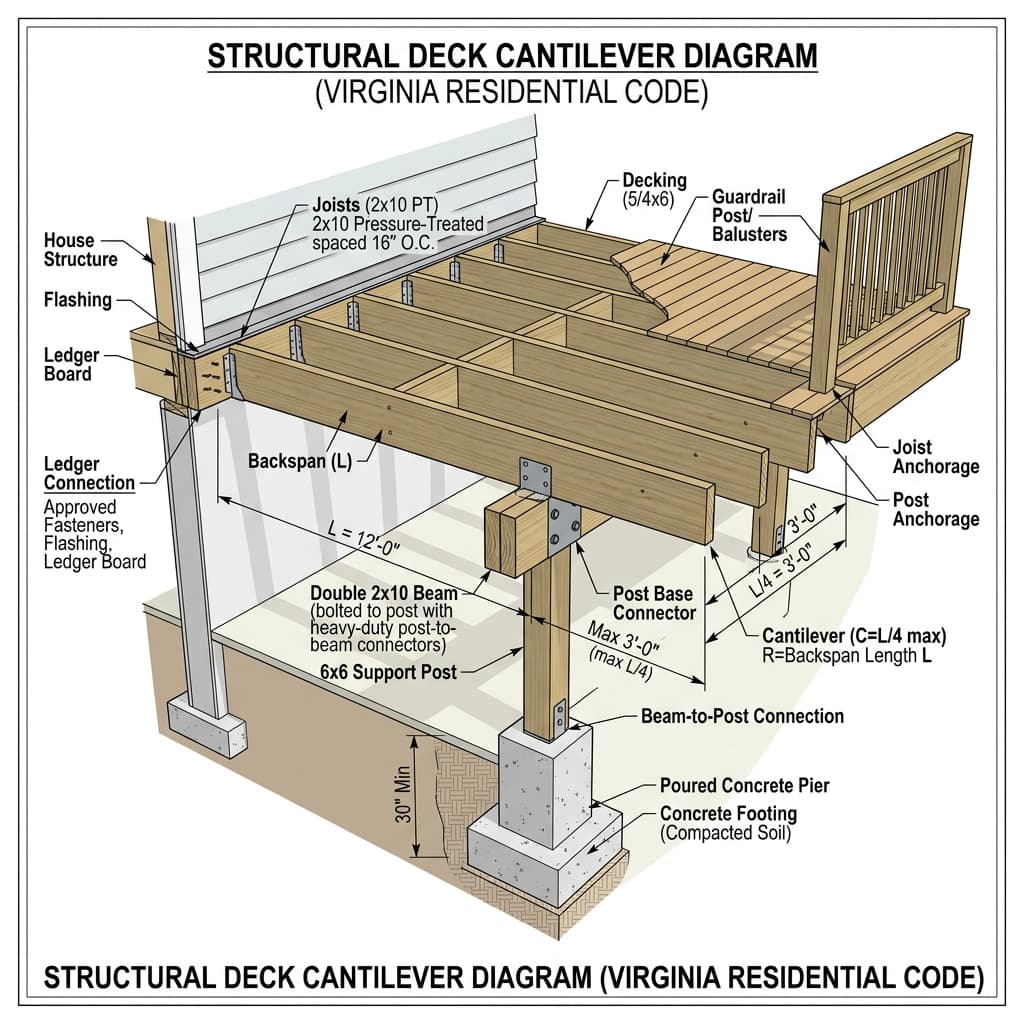
The primary code rule governing joist cantilevers is the L/4 backspan ratio. This rule states that the maximum distance a joist can cantilever past a beam must not exceed one-fourth (1/4) of the joist's actual backspan (the distance between the house ledger and the beam, or between two beams).
$$\text{Maximum Cantilever} \le \frac{\text{Backspan Length (L)}}{4}$$
real-world Sizing Examples - **12-Foot Backspan:** If your deck joists span 12 feet from the house ledger to the main support beam, the maximum allowable joist cantilever overhang is **3 feet** ($12 \div 4 = 3$). - **16-Foot Backspan:** If the joists span 16 feet between supports, the maximum cantilever is **4 feet** ($16 \div 4 = 4$).
It is important to remember that L/4 is the absolute maximum code limit under ideal conditions. Joist species, size, spacing, and structural load all play a major role. For example, if you are installing a heavy perimeter feature like a built-in stone outdoor kitchen or thick brick planters on the cantilevered edge, a structural engineer or local building department may require a reduced cantilever or larger joist sizes to handle the concentrated weight.
2. Joist Span Table Adjustments for Overhangs
Under the VRC, when joists cantilever past a beam, the allowable total span of the joist (from the ledger to the cantilevered edge) is often reduced. This is because the cantilever imposes extra bending stress on the wood fibers directly above the support beam.
For a standard Southern Pine 2x10 joist spaced 16 inches on-center: - Without a cantilever, the joist can span roughly 14 feet from the ledger to the center of the beam. - With a maximum cantilever, the allowable backspan span can drop to ensure the joist has enough strength to resist the combined downward force of the deck field and the overhang.
Always cross-reference your joist spans against the prescriptive span tables in VRC Table R507.5 before cutting your framing lumber.
3. Beam Cantilevers: Post-to-Beam Overhangs
Joists are not the only members that can cantilever; the main support beams can also extend past the outer support posts. This is called a beam cantilever or beam overhang.
Beam cantilevers are highly useful for wrapping a deck around a corner of the house or creating a wider deck surface without needing additional posts and concrete footings. The VRC limits beam cantilevers to a maximum of one-fourth (1/4) of the beam's span between posts, or a flat limit based on the size of the beam.
Under standard VRC rules for multi-ply wood beams (such as double or triple 2x10s or 2x12s), the beam cantilever overhang is generally limited to a maximum of 24 inches (2 feet) past the outer support post. Exceeding 2 feet requires structural engineering calculations and stamped drawings for your permit application.
4. Why Cantilevers Sag: Common Framing Mistakes
When a deck develops a noticeable sag or bounce along its outer edge, an improperly constructed cantilever is almost always the cause. Common framing mistakes include:
- Undersized Joists: Using 2x8 joists for a long span with a cantilever. We default to 2x10 or 2x12 pressure-treated joists under composite decking to eliminate bounce.
- Inadequate Fasteners at the Ledger: Because the cantilever acts as a lever, it pulls *upward* on the ledger connection at the house. If the ledger is not bolted to the home's rim joist with code-approved structural lag screws (like LedgerLOKs) spaced correctly, the lever force can pull the deck away from the house.
- Lack of Blocking: Failing to install solid wood blocking between the joists directly over the support beam. Without blocking, the joists can twist or roll under the heavy rotational torque of the cantilever.
5. Guardrail Post Mounting on Cantilevered Edges
Mounting guardrail posts to a cantilevered edge is one of the most inspected details on a deck. Because the railing posts sit at the absolute end of the overhanging joist, leaning against the railing creates massive leverage that can split the joist ends.
To pass VRC inspection: - Railing posts must be bolted to the joists using two 1/2-inch hot-dipped galvanized carriage bolts with heavy-duty steel washers. - You must install lateral tension brackets (such as Simpson Strong-Tie DTT2Z connectors) that tie the railing post structurally back into the inner deck framing, preventing the joist from splitting under lateral force.
Summary: Build Solid, Span Safe
Cantilevers are a fantastic architectural tool when engineered correctly, but they leave zero room for guesswork. By adhering strictly to the VRC’s L/4 backspan rules, installing solid blocking, and utilizing heavy-duty galvanized structural connectors, you ensure that your floating deck remains completely stable and safe for decades.
Planning a custom deck build in Loudoun, Fairfax, or Prince William county? Call Loudoun Decks at 571-655-7207 or visit ldndecks.com/contact to schedule a consultation with our structural design team.
Related Resources
Frequently Asked Questions
What is the maximum distance a deck joist can cantilever?
Under the Virginia Residential Code, a joist cantilever cannot exceed one-fourth (1/4) of the joist's backspan. For example, if the joist spans 12 feet from the house ledger to the beam, it can cantilever a maximum of 3 feet past the beam.
Do beam cantilevers follow the same L/4 rule?
Yes. Beams can cantilever past their support posts up to one-fourth (1/4) of their span between posts. However, prescriptive building codes in Virginia generally cap this at a maximum of 24 inches for standard multi-ply lumber beams unless custom engineered.
Why is solid blocking required over the beam on a cantilever?
Because a cantilevered joist experiences intense rotational forces, solid wood blocking must be installed between the joists directly above the beam. Blocking prevents the joists from twisting, rolling, or buckling under load.
Can I put a hot tub on a cantilevered deck section?
No. A hot tub concentrates thousands of pounds onto a small area and must sit on a reinforced concrete pad at grade level or on a heavily reinforced, post-supported frame. A cantilevered overhang should never support a hot tub.
Plan Your Northern Virginia Deck Project With Loudoun Decks
Get a free, no-pressure consultation from a licensed Northern Virginia deck builder. Call (571) 655-7207 or visit ldndecks.com/get-estimate.
Get a Free EstimateEverything Your Outdoor
Space Needs
From ground-up deck construction to full outdoor living spaces, every project is custom-designed for your home with permit planning, material guidance, and written workmanship terms.
Custom Deck Builder
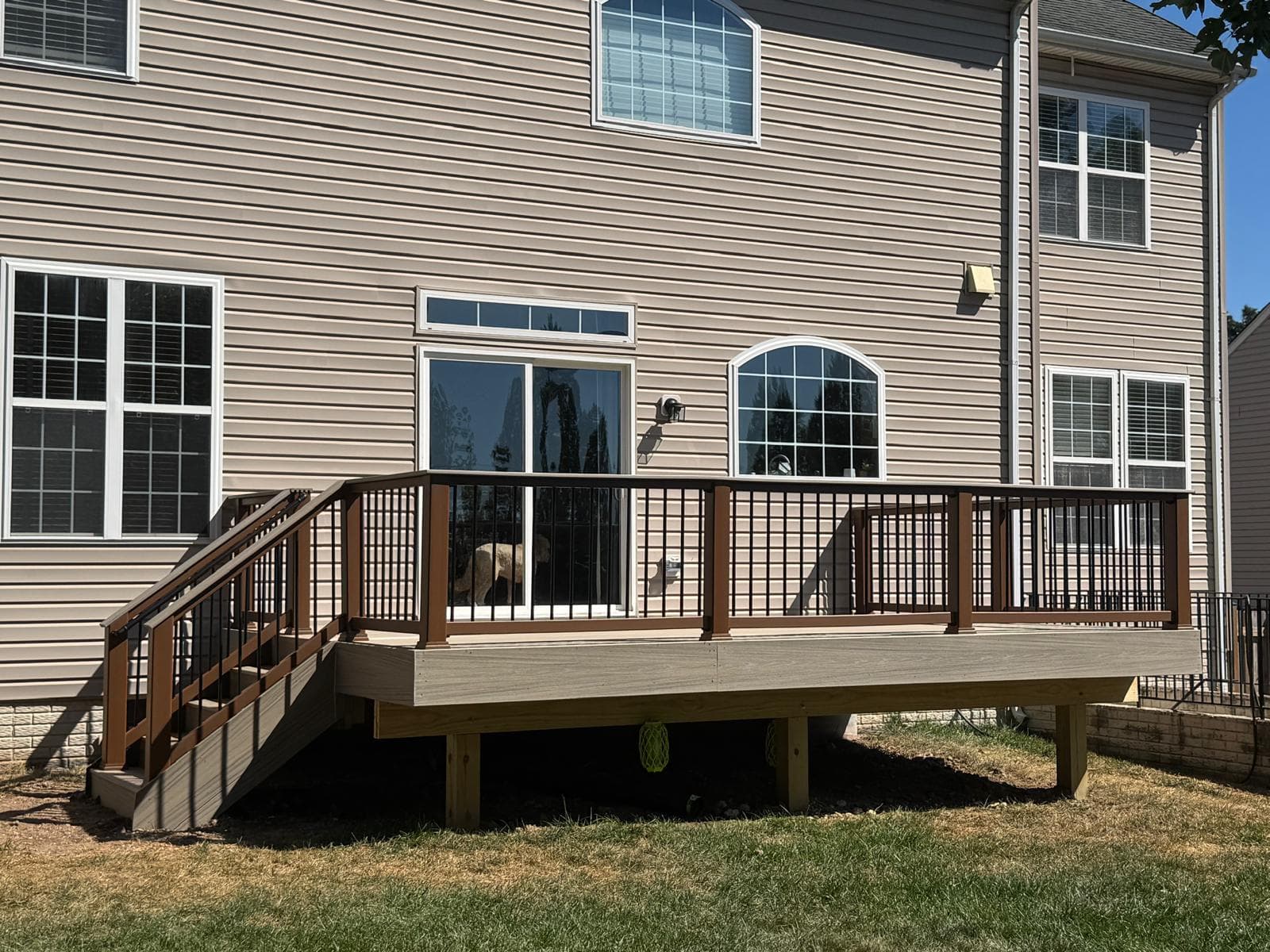
Transform your backyard with a custom-designed deck using Trex, TimberTech, wood, or PVC materials matched to your budget, HOA rules, and maintenance goals.
Deck Resurfacing
Premium wood-to-composite resurfacing for structurally sound frames. Full surface conversions start from $15k with boards, railings, fascia, and safety review.

Patio Contractor Services
Professional bluestone and paver patio installation. We create durable, beautiful ground-level outdoor living spaces that last a lifetime.
Local Expertise Across Northern Virginia
Loudoun Decks is a trusted deck builder serving Loudoun County, Fairfax County, Prince William County, Arlington, and Stafford.
Loudoun County
- Ashburn, VA
- Leesburg, VA
- Sterling, VA
- Aldie, VA
- South Riding, VA
- Broadlands, VA
- Brambleton, VA
- Purcellville, VA
- Hamilton, VA
- Lovettsville, VA
- Round Hill, VA
- Middleburg, VA
- Dulles, VA
- Arcola, VA
- Belmont, VA
- Cascades, VA
- Countryside, VA
- Lowes Island, VA
- Potomac Falls, VA
- Lansdowne, VA
- One Loudoun, VA
- Stone Ridge, VA
Fairfax County
- Fairfax, VA
- Fairfax Station, VA
- Burke, VA
- Springfield, VA
- West Springfield, VA
- Annandale, VA
- Centreville, VA
- Chantilly, VA
- Clifton, VA
- Herndon, VA
- Reston, VA
- Great Falls, VA
- McLean, VA
- Vienna, VA
- Oakton, VA
- Falls Church, VA
- Tysons, VA
- Dunn Loring, VA
- Merrifield, VA
- Alexandria, VA
- Lorton, VA
- Mount Vernon, VA
Prince William County
- Gainesville, VA
- Haymarket, VA
- Bristow, VA
- Manassas, VA
- Manassas Park, VA
- Woodbridge, VA
- Lake Ridge, VA
- Dumfries, VA
- Occoquan, VA
- Nokesville, VA
- Independent Hill, VA
- Montclair, VA
- Dale City, VA
- Triangle, VA
Arlington County
- Arlington, VA
- Rosslyn, VA
- Ballston, VA
- Clarendon, VA
- Pentagon City, VA
- Crystal City, VA
- Shirlington, VA
Stafford County
- Stafford, VA
- Falmouth, VA
- Garrisonville, VA
- Aquia Harbour, VA
Guides Northern Virginia Homeowners Are Reading
Deck Permits in Fairfax County
Requirements, timeline, fees, and inspection process.
Deck Permits in Arlington County
Permit, setback, inspection and urban-lot planning context for Arlington decks.
HOA Deck Rules in NoVA
Approval process, common restrictions, and tips.
Loudoun County Deck Builder Hub
Service-area guide for Ashburn, Leesburg, Sterling and western Loudoun projects.
Fairfax County Deck Builder Hub
Service-area guide for Fairfax, Reston, McLean, Vienna and nearby communities.
Trex vs TimberTech vs AZEK
Side-by-side brand comparison for Virginia climate.