


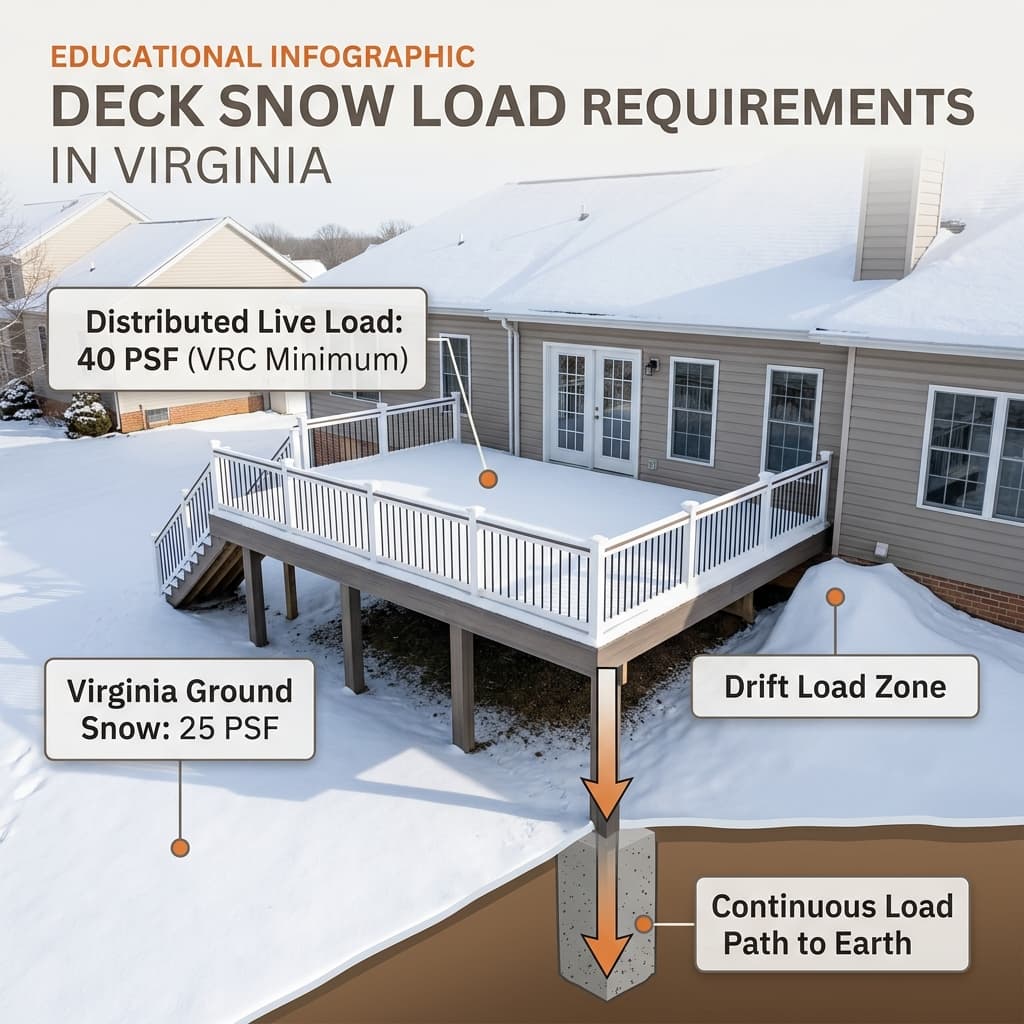
Deck Snow Load Requirements in Virginia: Live Load, Ground Snow, and Drift
Northern Virginia winters look mild on paper, but a single nor’easter can drop 20 inches of wet snow on a deck — and a deck that was not engineered for the load will fail. Here is how Virginia code calculates deck snow load, the ground snow values for NoVA counties, and how drift and concentrated loads change the math.
Quick Answer
Virginia residential decks are designed around a minimum live-load standard, with snow load, drift risk, and concentrated features like hot tubs or outdoor kitchens checked against the full load path.
In Northern Virginia, the practical red flags after heavy snow are ledger separation, new deck bounce, visible joist deflection, shifted posts, tilted or cracked footings, and any out-of-level movement that was not present before the storm.
Source Context
Northern Virginia winters look mild compared to New England, but the historical record tells a different story. A single nor’easter in 2010 dropped over 30 inches of wet snow on the region in 48 hours. Wet snow weighs roughly 20 pounds per cubic foot, and on a typical 400 square foot back deck that adds up to over 10,000 pounds of additional load — on top of the snow that may already have accumulated and on top of the live load the deck was designed to carry day-to-day.
A deck that is not engineered for that load can fail. The cleanest failures are at the footings or at the ledger; the worst-case failures take the whole structure down. Virginia residential code addresses exactly this scenario through a layered load model: a baseline live load that every deck must support, a ground snow load specific to your location, and additional rules for drifts and concentrated heavy loads.
This guide explains exactly how snow load is calculated for residential decks in Virginia, what the numbers actually are in Northern Virginia counties, why drift loads change the equation on multi-level builds, and how hot tubs and outdoor kitchens add concentrated loads that snow alone never produces. The same load-path principles described in our guide to how decks distribute load apply throughout.
The 40 PSF Live Load Standard
The Virginia Residential Code (VRC), adopted statewide and enforced by every county building department in Northern Virginia, requires that every residential deck be designed for a minimum live load of 40 pounds per square foot (psf).
Live load is the variable, non-structural weight a deck must support: people, furniture, planters, snow, a grill, a small gathering. The 40 psf number is the floor; an inspector will not approve a deck designed for less. On a 400 square foot deck, 40 psf adds up to 16,000 pounds of live load capacity — enough to hold roughly 100 adults at average weight, plus a normal furnishing load.
The 40 psf standard also has to absorb a normal snow event. For most of Virginia, the ground snow load value is below 40 psf, which means a properly designed deck handles typical snowfall as part of the same live load envelope. The 40 psf is not snow-plus-people; it is the total live capacity, and snow simply occupies part of it.
Ground Snow Load Values for Northern Virginia
Virginia uses ground snow load values published in ASCE 7 and reflected in the VRC to size structural members. Ground snow load is the weight of snow on the ground at a specific geographic point, used by engineers as the baseline for calculating roof and deck snow loads.
For Northern Virginia counties in 2026, the relevant values are:
- Loudoun County: 25 psf ground snow load
- Fairfax County: 25 psf ground snow load
- Prince William County: 25 psf ground snow load
- Arlington County: 25 psf ground snow load
- Stafford County: 25-30 psf depending on elevation
Western portions of Loudoun County near the Blue Ridge — areas above ~600 ft elevation around Hillsboro, Lovettsville, and the Loudoun Heights — can require higher ground snow values. Building departments determine the local value at plan review.
The ground snow value is below the 40 psf live load standard, which means a code-compliant Virginia deck designed to 40 psf already has the structural envelope to absorb a maximum-recorded snow event on flat ground. The exceptions are drift and concentrated loads, which we cover next.
How Drift Loads Change the Math
Drift load is the additional accumulation of snow that forms when wind blows snow off one surface and deposits it against an obstruction. For decks, the relevant scenario is a deck that sits below a roofline — wind drives snow off the higher roof and piles it against the wall of the house, on top of the deck below.
The drift depth depends on the geometry: the height difference between the roof and the deck, the length of the upper roof, the local wind exposure. On a deck tucked under a tall roof on a multi-story Northern Virginia colonial, a single nor’easter can pile drift snow two to four feet deep along the deck-to-house wall. That snow, especially wet snow, can briefly impose a load several times higher than the design live load.
The practical implications:
- Decks built directly below a tall roofline need extra attention at the ledger. The drift load concentrates exactly at the ledger connection, which is also the most failure-prone joint on the deck. Proper ledger flashing and fastener spacing per code is essential — see our ledger board flashing guide.
- Joist spans nearest the house carry the heaviest snow loads. A code-compliant design accounts for this through joist sizing and spacing.
- Roof slope matters. A steep roof above the deck releases sliding snow that can briefly impact the deck below at much higher than its design load. Snow guards or snow fences on the roof can prevent the worst impacts.
In practice, drift loads are why a deck that is structurally fine on its own can still fail after a major storm — the wind concentrates the snow where the deck was not designed to take it.
Concentrated Loads: Hot Tubs, Outdoor Kitchens, and Heavy Furniture
The 40 psf live load is a distributed load — it assumes the weight is spread evenly across the deck surface. A hot tub, a brick outdoor kitchen, or a massive sectional with built-in fire feature concentrates the load in one small area, and the math changes completely.
A filled six-person hot tub weighs about 5,000 pounds, sitting on a roughly 64 square foot footprint. That works out to roughly 80 psf — twice the live load standard — across a fraction of the deck area. The framing under that one section has to be specifically engineered to carry it.
The typical reinforcement strategy:
- Doubled or tripled joists under the load. Joist spacing might drop from 16 inches on-center to 12 inches, with paired joists at the perimeter of the load.
- Oversized beams to consolidate the load.
- Additional posts and footings directly under the heavy zone, often 24-30 inches in diameter where standard footings are 16 inches.
- Engineered drawings stamped by a structural engineer, which the building department typically requires for any deck supporting a hot tub or significant outdoor kitchen.
More detail on the framing requirements for spas is in our blog post on hot tubs and decks structural requirements.
The key principle: snow load is one piece of the live load envelope. A concentrated heavy feature adds load on top of whatever snow happens to be on the deck at the time. A deck that is rated for 40 psf with a hot tub on it must be engineered for the combined load, not the average.
The Load Path From Snow to Footing
A properly engineered deck channels snow load along the same path that carries people and furniture. The boards transfer the load to the joists. The joists transfer it to the beams (and to the ledger, if attached). The beams transfer it to the posts. The posts transfer it to the concrete footings. The footings spread the load over enough soil area that the deck stays stable.
Each link in that path has to be sized for the load it will see. A deck designed for 40 psf live load needs:
- Decking boards rated to span the joist spacing under the live load. Composite boards typically require 12-inch on-center spacing rather than 16-inch because composite is more flexible than wood — see our understructure guide for how joist spacing is chosen.
- Joists sized to span between supports under the load. Standard 2x10 joists at 16-inch on-center span roughly 14 feet at 40 psf live load; longer spans require deeper joists or tighter spacing.
- Beams sized to consolidate the joist loads and carry them to the posts. A typical beam is built from two or three 2x10 or 2x12 boards laminated together.
- Posts of at least 6x6 pressure-treated lumber, properly connected to beam above and footing below with galvanized metal hardware.
- Footings large enough to spread the load into Virginia clay soils without sinking. See our guide on soil bearing capacity and deck footings for the math behind footing sizing.
A failure at any single link breaks the load path and threatens the whole structure. Snow does not pick which link to load — it loads them all, simultaneously, for the duration of the storm.
Red Flags on an Existing Deck After Heavy Snow
If a major snow event passes through Northern Virginia and your deck is more than ten years old, walk it as soon as conditions allow and look for these warning signs.
At the ledger connection (where the deck meets the house):
- Visible separation between the ledger board and the siding.
- Soft, punky wood at the rim joist of the house, especially if probed gently with a screwdriver.
- Dark vertical staining running down the siding below the ledger.
- Cracking or splintering in the ledger lag screws or bolts.
On the deck surface:
- Boards that have developed new sag or bounce that was not there before.
- Visible deflection in the middle of joist spans.
- New gaps or separations between boards.
- Out-of-level surfaces that were level before the storm.
At the footings and posts (underneath the deck):
- Posts that have shifted off their footings or are no longer plumb.
- Concrete footings that have visibly tilted or sunk into the soil.
- New cracking in concrete footings.
- Frost-heaved footings that have lifted as wet soil froze around them.
Any of these is reason to schedule a professional inspection before using the deck again. Our deck safety inspection service covers each of these elements with structural probes, level checks, and load-path verification.
How Loudoun Decks Engineers for Snow Load
Every deck we build in Northern Virginia is designed and permitted to the 40 psf live load standard at minimum, with additional structural margin where the geometry of the home creates drift loading or where the homeowner is adding a hot tub or outdoor kitchen. For builds on western Loudoun’s higher-elevation parcels, we coordinate with the county on adjusted ground snow values during plan review.
If you are planning a new deck in Loudoun, Fairfax, Prince William, Arlington, or Stafford County — or if a recent storm has put a question mark over an existing deck — call 571-655-7207 or visit ldndecks.com/get-estimate. We engineer for the worst snow event you will see in 30 years, not just the average winter.
Related Resources
Frequently Asked Questions
What is the minimum snow load a deck must support in Virginia?
Virginia residential code requires every residential deck to be designed for a minimum live load of 40 pounds per square foot (psf). That figure is the total live load envelope and includes snow as part of it, not in addition to it. For most of Northern Virginia, the ground snow load is below 40 psf, so a code-compliant deck handles typical snowfall within its design capacity.
What is the ground snow load value for Loudoun County?
25 psf for most of Loudoun County in 2026. Western portions of the county at higher elevations near the Blue Ridge — around Hillsboro, Lovettsville, and Loudoun Heights — can require higher values, which the building department confirms at plan review.
What is drift load and why does it matter for decks?
Drift load is the extra accumulation of snow that forms when wind blows snow off a higher surface and deposits it against an obstruction. For decks, drift typically piles against the deck-to-house wall under a tall roofline, concentrating the load at the ledger connection — the most failure-prone joint on the deck. A drift can briefly impose a load several times higher than the deck’s design live load.
How does a hot tub change deck load requirements?
A hot tub concentrates roughly 5,000 pounds onto a 64 square foot footprint — about 80 psf, twice the standard 40 psf live load, across only a fraction of the deck. The framing under a hot tub must be specifically engineered with doubled or tripled joists at tighter spacing, oversized beams, additional posts and footings directly below the load, and usually stamped engineered drawings for the permit submission.
Can heavy snow collapse a deck in Northern Virginia?
Yes, especially on decks built without code compliance or where ledger flashing has allowed long-term rot in the rim joist of the house. A properly engineered and maintained deck designed to the 40 psf standard handles maximum-recorded NoVA snow events comfortably. The failures we see in practice are almost always on decks where pre-existing structural compromise — rotted ledger, failing footings, undersized framing — meets a major storm.
How do I know if my existing deck is rated for snow load?
Decks permitted and inspected to current Virginia code are designed for 40 psf live load by default. Pre-permit decks, DIY builds, and decks older than roughly 20 years may not meet current standards, especially on the ledger connection and footings. A professional deck safety inspection is the only reliable way to verify the structural envelope of an existing deck.
Plan Your Northern Virginia Deck Project With Loudoun Decks
Get a free, no-pressure consultation from a licensed Northern Virginia deck builder. Call (571) 655-7207 or visit ldndecks.com/get-estimate.
Get a Free EstimateEverything Your Outdoor
Space Needs
From ground-up deck construction to full outdoor living spaces, every project is custom-designed for your home with permit planning, material guidance, and written workmanship terms.
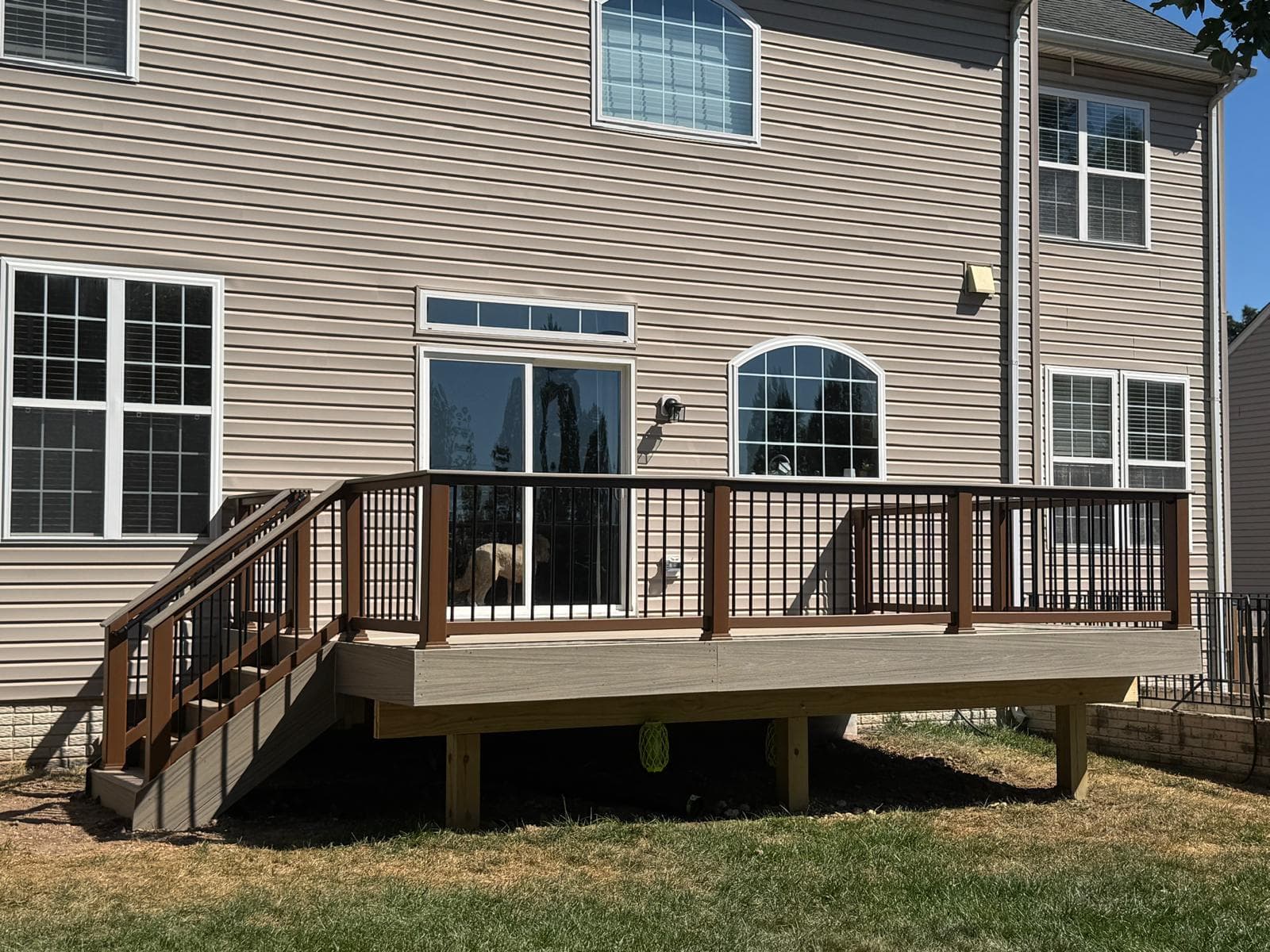
Custom Deck Builder
Transform your backyard with a custom-designed deck using Trex, TimberTech, wood, or PVC materials matched to your budget, HOA rules, and maintenance goals.
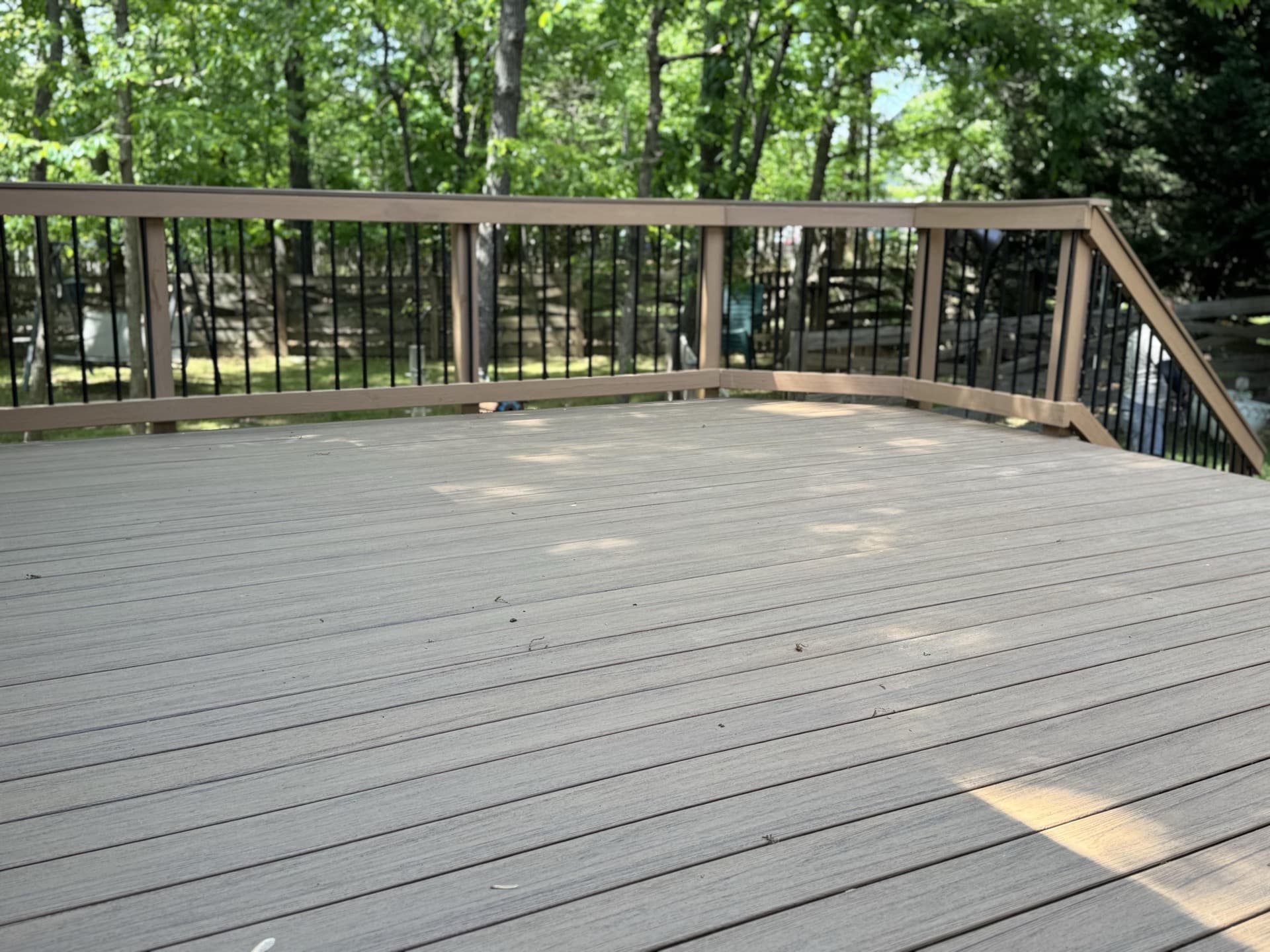
Deck Resurfacing
Premium wood-to-composite resurfacing for structurally sound frames. Full surface conversions start from $15k with boards, railings, fascia, and safety review.

Patio Contractor Services
Professional bluestone and paver patio installation. We create durable, beautiful ground-level outdoor living spaces that last a lifetime.
Local Expertise Across Northern Virginia
Loudoun Decks is a trusted deck builder serving Loudoun County, Fairfax County, Prince William County, Arlington, and Stafford.
Loudoun County
- Ashburn, VA
- Leesburg, VA
- Sterling, VA
- Aldie, VA
- South Riding, VA
- Broadlands, VA
- Brambleton, VA
- Purcellville, VA
- Hamilton, VA
- Lovettsville, VA
- Round Hill, VA
- Middleburg, VA
- Dulles, VA
- Arcola, VA
- Belmont, VA
- Cascades, VA
- Countryside, VA
- Lowes Island, VA
- Potomac Falls, VA
- Lansdowne, VA
- One Loudoun, VA
- Stone Ridge, VA
Fairfax County
- Fairfax, VA
- Fairfax Station, VA
- Burke, VA
- Springfield, VA
- West Springfield, VA
- Annandale, VA
- Centreville, VA
- Chantilly, VA
- Clifton, VA
- Herndon, VA
- Reston, VA
- Great Falls, VA
- McLean, VA
- Vienna, VA
- Oakton, VA
- Falls Church, VA
- Tysons, VA
- Dunn Loring, VA
- Merrifield, VA
- Alexandria, VA
- Lorton, VA
- Mount Vernon, VA
Prince William County
- Gainesville, VA
- Haymarket, VA
- Bristow, VA
- Manassas, VA
- Manassas Park, VA
- Woodbridge, VA
- Lake Ridge, VA
- Dumfries, VA
- Occoquan, VA
- Nokesville, VA
- Independent Hill, VA
- Montclair, VA
- Dale City, VA
- Triangle, VA
Arlington County
- Arlington, VA
- Rosslyn, VA
- Ballston, VA
- Clarendon, VA
- Pentagon City, VA
- Crystal City, VA
- Shirlington, VA
Stafford County
- Stafford, VA
- Falmouth, VA
- Garrisonville, VA
- Aquia Harbour, VA
Guides Northern Virginia Homeowners Are Reading
Free Deck Cost Calculator
Get an instant estimate by material, size, and add-ons.
Composite Deck Cost in Northern Virginia
Material pricing, verified source references, planning examples and what drives the price.
Composite Deck Cost by Size
300, 400, 500 and 600 sqft pricing examples with monthly payment ranges.
Deck Financing Options
Financing options may be available for eligible deck, resurfacing, repair and composite upgrade projects.
Deck Payment Estimator
Plan payment ranges and project scope before requesting a consultation.
Deck Builder in Northern Virginia
Custom decks, permits, HOA support and local service areas.