


Repair vs. Replace a Deck in Northern Virginia: How to Decide
The repair-versus-replace decision is the most consequential choice a Northern Virginia homeowner faces when their deck begins to show age. The wrong decision in either direction is expensive: repairing a deck that needs replacement means spending money on a structure that will need replacement in a few years anyway; replacing a deck that could be repaired means an unnecessary $25,000 to $50,000 spend.
The repair-versus-replace question does not have a universal answer. It depends on the age and condition of the framing, the surface material, the extent of the deterioration, what the homeowner wants the deck to be after the work is complete, and the relative economics of the two options. This guide provides a framework for working through the decision with facts rather than assumptions.
Start With the Framing, Not the Surface
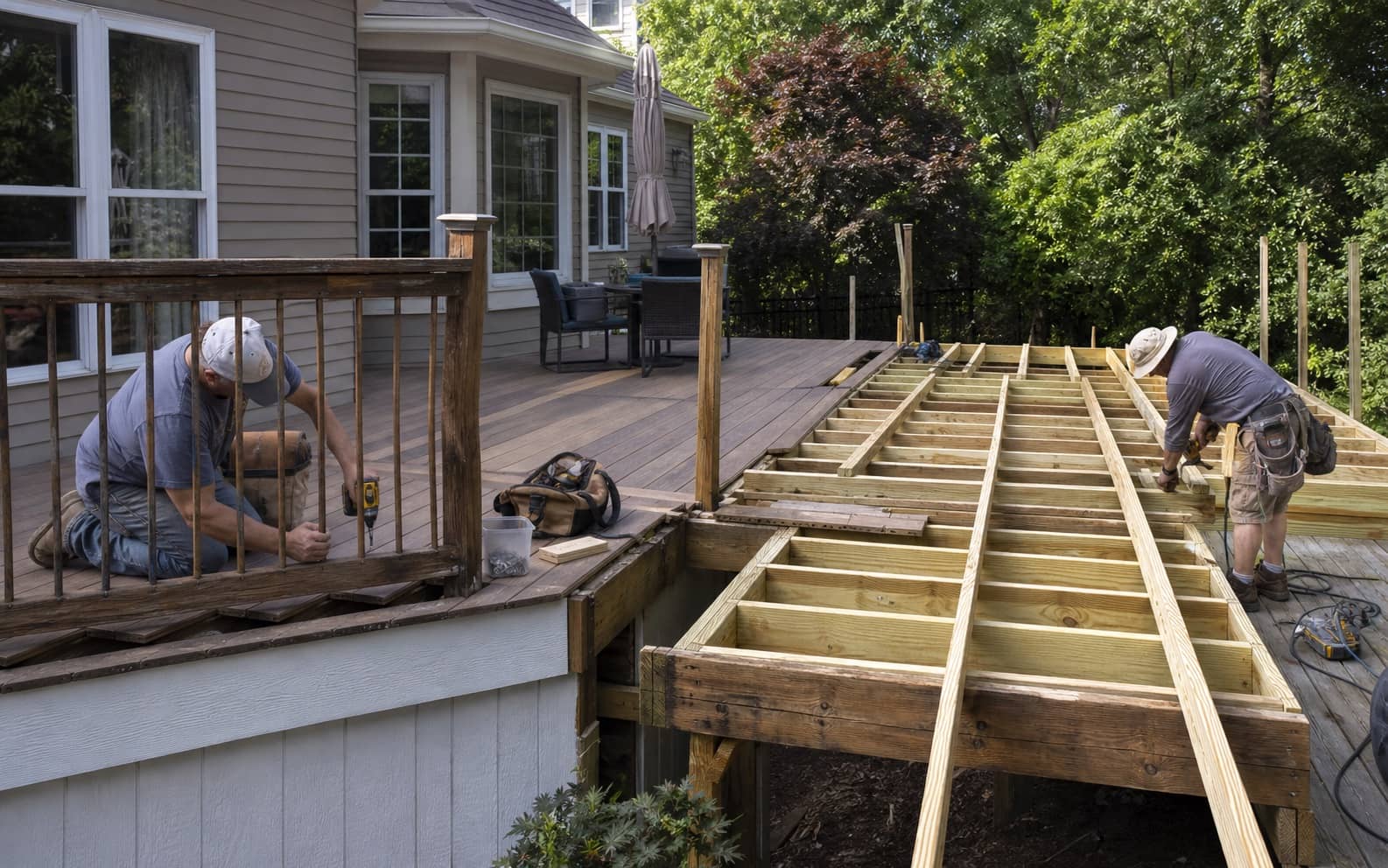
The most common mistake in the repair-versus-replace evaluation is focusing on the deck surface — the boards that are visible and that look bad — rather than the framing. Replacing decking boards on failing framing is the most expensive error a homeowner can make: the new surface fails prematurely, and the homeowner ends up doing the framing work they should have done the first time.
The correct evaluation sequence: 1. Assess the framing condition (posts, beams, joists, ledger) 2. Assess the surface condition (decking boards, railing) 3. Determine what would remain after repair vs. what a full replacement provides 4. Compare the 10-year total cost of each option
Framing Assessment: What Can Be Repaired
Isolated joist rot: Individual joists or pairs of joists with end rot can typically be sistered — new PT lumber installed alongside the rotted member — without rebuilding the deck. This is repair territory if the majority of joists are sound.
Post replacement: Posts that are rotted at the base can be replaced. Post replacement requires temporarily supporting the beam while the post is removed, installing a new post, and verifying the footing is still adequate. One to three posts — repair. More than half the posts — evaluate replacement.
Ledger repair: Ledger boards with limited rot in isolated sections can sometimes be repaired with sistered members. If the rot is widespread along the ledger, or if the house rim joist behind the ledger has been significantly compromised, full ledger replacement is required. This is an expensive repair that — if the rest of the framing is also compromised — may tip the analysis toward replacement.
Beam issues: A single-span beam with end rot where it bears on a post can be repaired with sistering. A beam with mid-span deterioration or significant sag is a major repair and may indicate broader framing compromise.
What cannot be economically repaired: When more than 40 to 50 percent of the framing members show rot or significant deterioration, the labor cost of selective repair approaches or exceeds the cost of full framing replacement. At that threshold, replacement is almost always the better value.
Surface Assessment: Decking and Railing
Pressure-treated decking boards: Individual boards with splits, significant checking, or rot can be replaced selectively. If more than 30 percent of the board count needs replacement, a full surface replacement is typically more cost-effective than piecemeal replacement — and has the added benefit of a uniform appearance.
Composite decking upgrade: If the current deck has PT decking on sound framing, replacing only the surface material with composite decking is a high-value repair option. The framing is reused, new composite decking is installed over it, and the homeowner gets 25 years of maintenance-free surface at approximately 40 to 60 percent of the cost of a full deck replacement.
Railing replacement: Railing can almost always be replaced independently of the decking or framing, provided the post attachment points in the framing are sound. Railing replacement is a repair — not a replacement trigger — in most cases.
Key Signals That Point to Full Replacement
Replace rather than repair when:
The framing is more than 25 years old with multiple failure points. The first repair sets the clock for the next. Repairing posts on a 25-year-old deck with compromised ledger and soft joist ends is spending $4,000 to $8,000 to extend a structure that will need full replacement in 5 to 7 years anyway.
The ledger and rim joist are significantly compromised. Ledger and rim joist repair is expensive and — if the house siding and exterior finishes must also be disturbed — the incremental cost of full replacement is often modest relative to the repair.
The deck does not meet current code and significant work is required anyway. Decks built before 2000 may have undersized footings, non-code ledger connections, or insufficient post sizing. Triggering a permit for repair also triggers a code compliance review — required upgrades may make repair close to full replacement in cost.
The homeowner wants to change the size, layout, or material. If the goal is a different deck than the current structure, repair is not the right frame. A replacement opens all design options.
The deck is less than 400 square feet and more than 20 years old with widespread surface and framing issues. On a small, old deck with multiple issues, the economics of full replacement vs. comprehensive repair are very close. Replacement guarantees a code-compliant structure with a fresh warranty horizon.
Cost Comparison Framework
For a 300-square-foot deck in Northern Virginia:
Repair scenario — selective framing + surface replacement: - Ledger repair: $1,500 to $3,000 - 2 to 3 post replacements: $800 to $2,000 - Joist sistering (6 to 8 joists): $1,500 to $3,000 - Full surface replacement (composite): $8,000 to $14,000 - Railing replacement: $4,500 to $7,200 - Total: $16,300 to $29,200 — and the repaired framing is still 20+ years old
Full replacement scenario: - Full deck removal and replacement with composite surface on new PT framing: $28,000 to $50,000 - Guaranteed code-compliant framing with 25-year surface warranty
The gap between comprehensive repair and full replacement is often $10,000 to $20,000 — but the replacement delivers a fresh structural horizon vs. a repaired aging one. When the framing is already 20+ years old and multiple elements have failed, the value of that fresh horizon is real.
Getting an Honest Assessment
The most important step in the repair-versus-replace decision is getting an honest assessment from a contractor who builds decks, not just repairs them. A contractor whose business is repair work has a natural inclination toward repair recommendations. A contractor who builds new decks and also does repair has the range to give you an honest read on when repair makes sense and when it doesn't.
LDN Decks builds new decks and performs repairs across Northern Virginia. We provide written repair-versus-replace assessments with itemized cost comparisons so homeowners can make the decision with full information.
Get a Repair vs. Replace Assessment
---
Related: Deck Collapse Warning Signs · DIY Deck Safety Checklist · Ledger Board Failure · Deck Cost 2026 · Deck Repair Services
Frequently Asked Questions
When should I replace a deck instead of repairing it?
Replace rather than repair when: more than 40 to 50 percent of the framing members show rot or deterioration; the ledger and house rim joist are significantly compromised; the deck is more than 20 to 25 years old with multiple failure points; the deck does not meet current code and required upgrades approach replacement cost; or when the homeowner wants to change the size, layout, or material. Comprehensive repair on aged framing is often poor value compared to full replacement.
Can I replace just the decking boards and keep the framing?
Yes, and this is often the right answer when the framing is structurally sound and in good condition. Replacing PT decking with composite on existing sound framing costs approximately 40 to 60 percent of a full deck replacement — the homeowner gets a maintenance-free surface and the framing investment is reused. The key is verifying framing condition first, since new composite over failing framing is an expensive mistake.
How much does deck repair cost in Northern Virginia?
Individual deck repairs in Northern Virginia typically run: ledger repair $1,500 to $3,000; post replacement $400 to $800 each; joist sistering $200 to $400 per joist; full surface replacement (composite) on existing framing $8,000 to $14,000 for a 300-square-foot deck; railing replacement $4,500 to $7,200 for 60 linear feet. Comprehensive repair addressing multiple elements frequently totals $15,000 to $30,000 — often within $10,000 to $20,000 of full replacement.
Does repairing a deck require a permit in Northern Virginia?
Structural repairs — ledger replacement, post replacement, joist sistering, footing replacement — require a building permit in Loudoun, Fairfax, and Prince William counties. Cosmetic repairs (replacing individual decking boards, re-fastening loose boards) typically do not. When a structural repair permit is pulled, the inspector may review the full deck structure for code compliance — which can require additional upgrades if the deck was built to older code standards.
How long does a repaired deck last?
A repaired deck lasts as long as the oldest remaining components. If framing from 2000 has been selectively repaired, the remaining 2000-era joists, beam, and ledger set the remaining service life — likely 5 to 15 years depending on their current condition. A full replacement resets the clock with code-compliant framing and a 25-year composite surface warranty. The economics favor repair when the framing is relatively young; they favor replacement when the framing is old and multiple components have failed.
Cost ranges and service life estimates reflect Northern Virginia market conditions as of 2026. Specific repair vs. replacement economics vary significantly by deck condition, size, and scope. Always obtain a professional structural assessment and itemized cost comparison before making repair or replacement decisions.
Plan Your Northern Virginia Deck Project With Loudoun Decks
Get a free, no-pressure consultation from a licensed Northern Virginia deck builder. Call (571) 655-7207 or visit ldndecks.com/get-estimate.
Get a Free EstimateEverything Your Outdoor
Space Needs
From ground-up deck construction to full outdoor living spaces, every project is custom-designed for your home with permit planning, material guidance, and written workmanship terms.
Custom Deck Builder
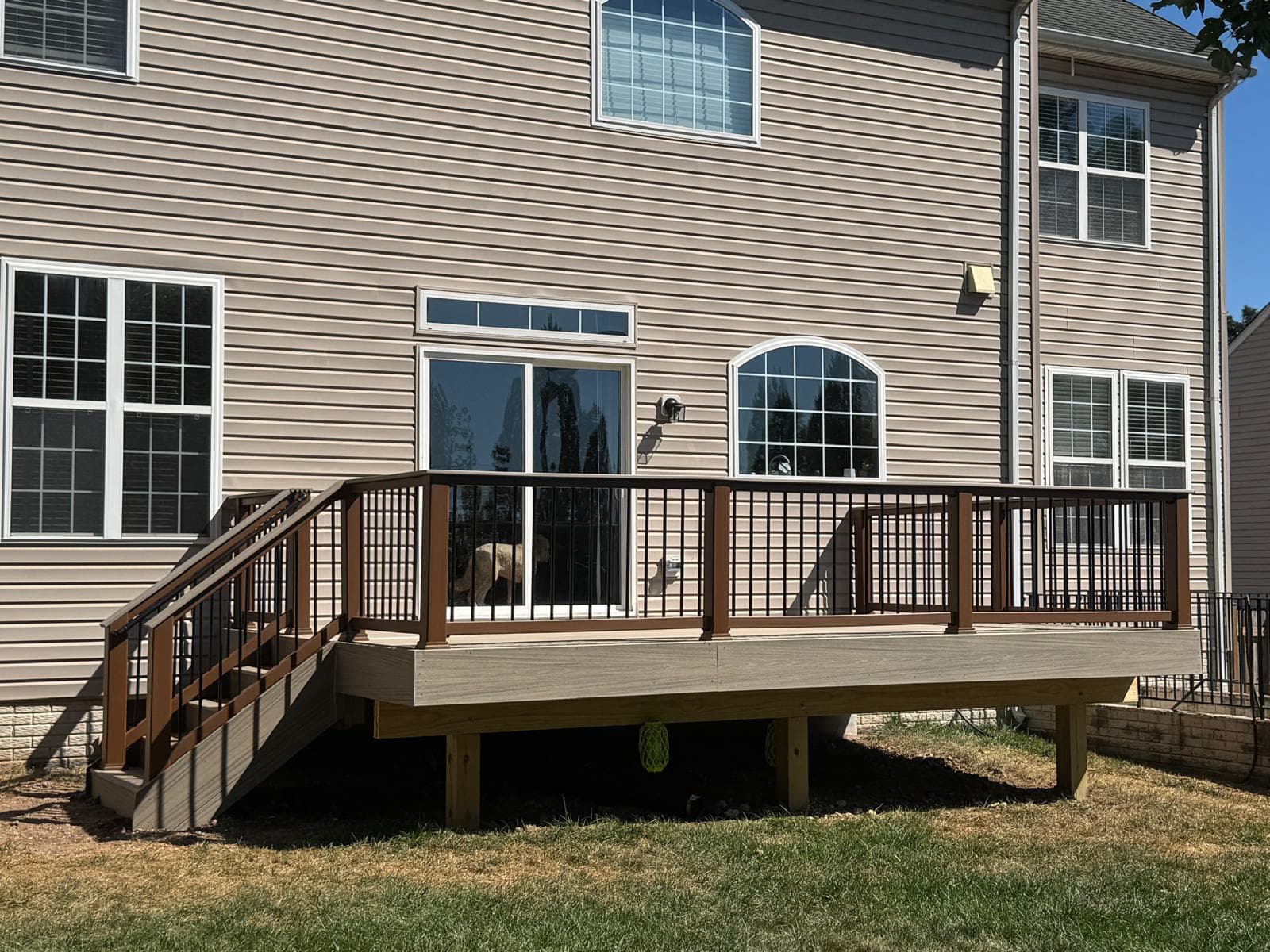
Transform your backyard with a custom-designed deck using Trex, TimberTech, wood, or PVC materials matched to your budget, HOA rules, and maintenance goals.
Deck Resurfacing
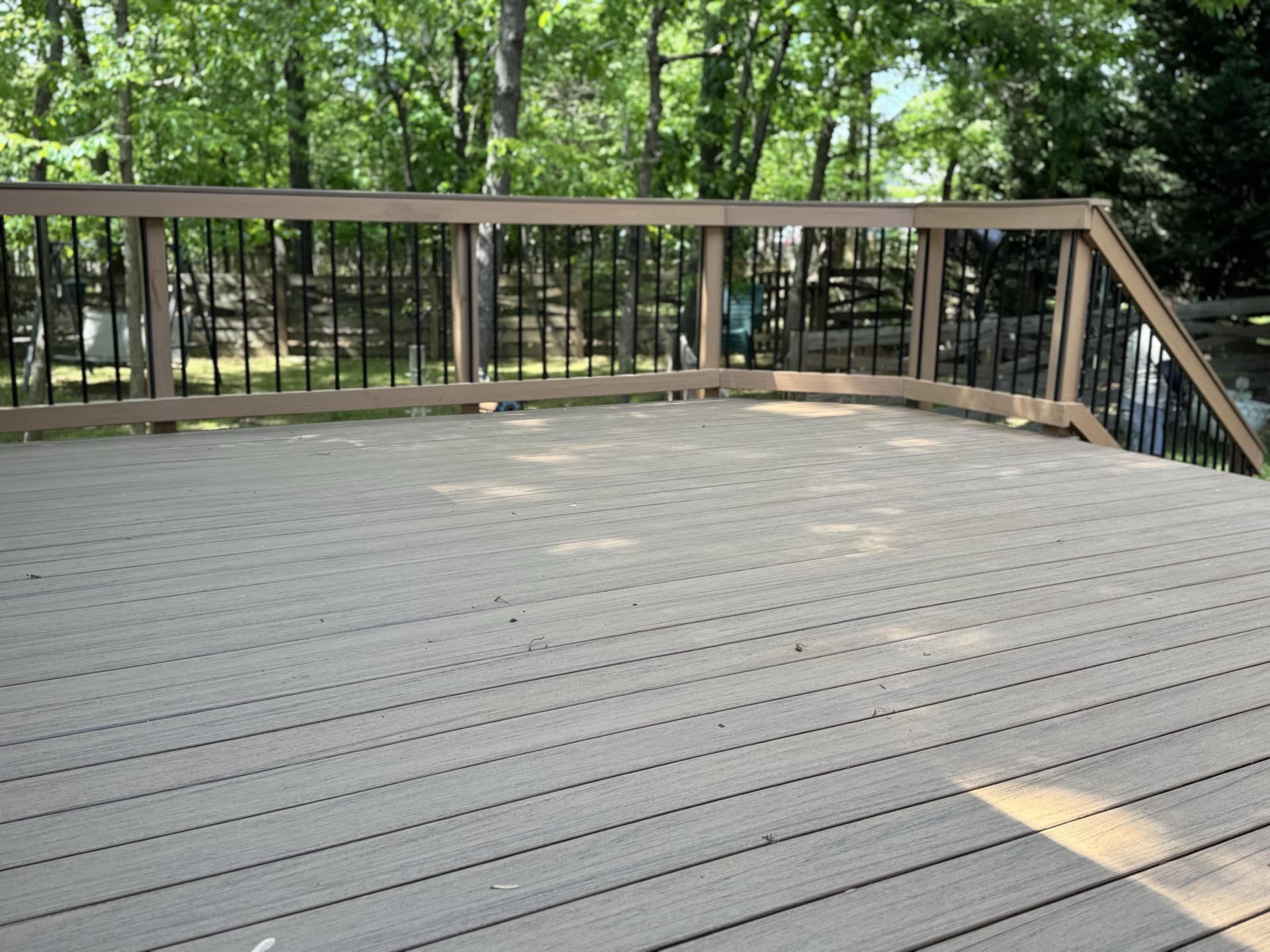
Premium wood-to-composite resurfacing for structurally sound frames. Full surface conversions start from $15k with boards, railings, fascia, and safety review.

Patio Contractor Services
Professional bluestone and paver patio installation. We create durable, beautiful ground-level outdoor living spaces that last a lifetime.
Local Expertise Across Northern Virginia
Loudoun Decks is a trusted deck builder serving Loudoun County, Fairfax County, Prince William County, Arlington, and Stafford.
Guides Northern Virginia Homeowners Are Reading
Composite Deck Cost in Northern Virginia
Material pricing, verified source references, planning examples and what drives the price.
Free Deck Cost Calculator
Get an instant estimate by material, size, and add-ons.
TimberTech & AZEK Decks
Premium PVC and composite deck options for Northern Virginia.
Deck Permits in Loudoun County
Permit requirements, review steps and inspection context for Loudoun homeowners.
Deck Permits in Fairfax County
Requirements, timeline, fees, and inspection process.
Deck Builder in Northern Virginia
Custom decks, permits, HOA support and local service areas.