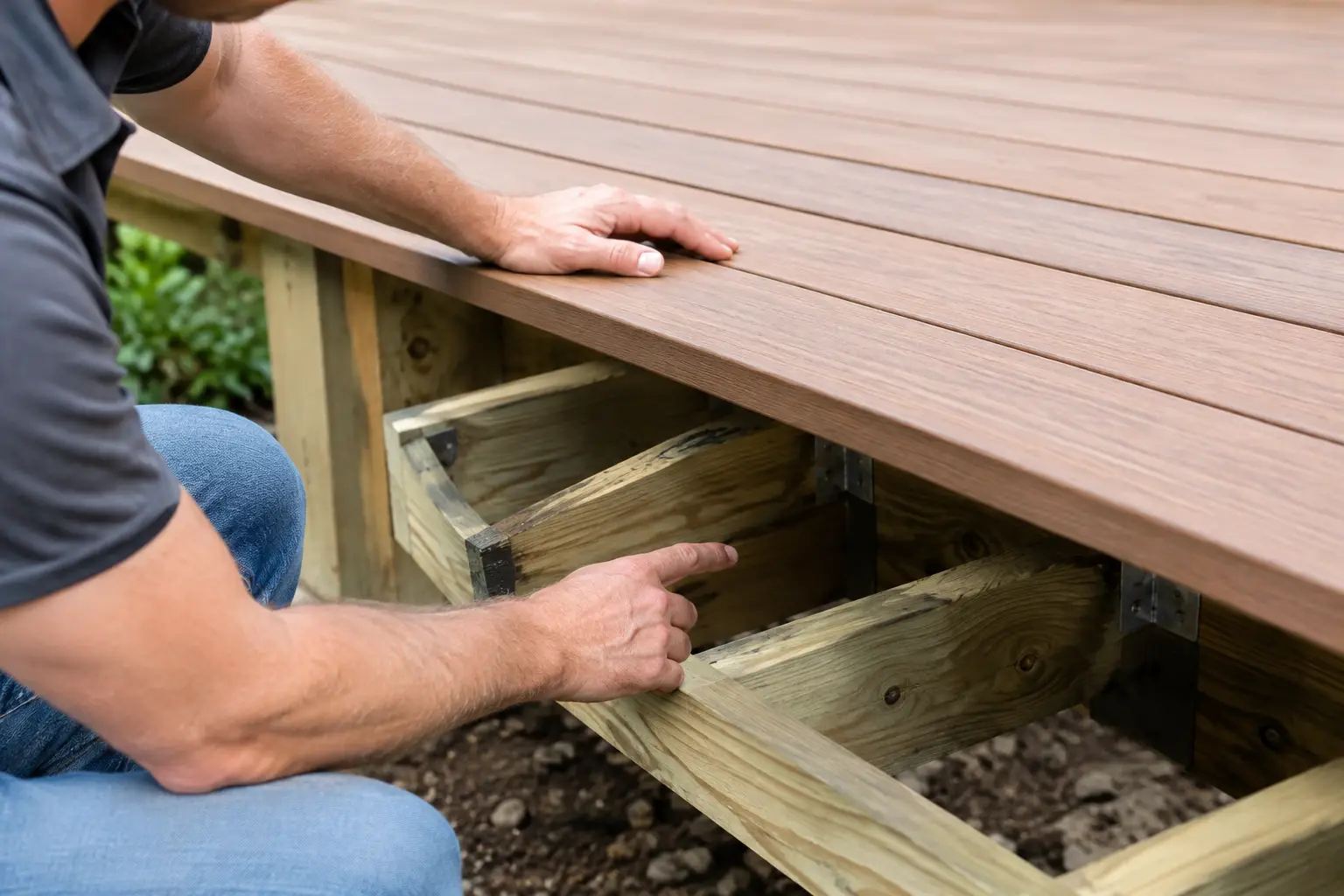
Can decking cover damaged framing? Learn when a deck can be resurfaced, when replacement is safer, and what a professional structural review should cover.
A new composite or PVC deck surface can make an aging deck look completely different. But can decking cover damaged framing? No. New boards may conceal a structural problem for a while, but they do not correct weakened joists, deteriorated posts, failing connections, or an unstable ledger. For a deck replacement project, the condition of the framing has to guide the scope before material colors, railing styles, or lighting options are selected.
For Northern Virginia homeowners, this question often comes up when the existing deck boards are worn, splintered, faded, or beginning to fail. The framing underneath may still be suitable for a resurfacing project, or it may signal that a more substantial replacement is the responsible choice. The difference is not cosmetic. It affects safety, design flexibility, permitting, and the long-term value of the investment.
Why New Decking Cannot Solve a Framing Problem
Deck boards are the walking surface. They are not the structure that carries the deck's load. That work is handled by the framing system: footings, posts, beams, joists, hardware, connections to the home, and, where applicable, stairs and guardrail framing.
Composite and PVC decking can be a strong fit for a replacement project because it offers a durable finished surface and a broad range of design options. It can also be heavier than some older wood decking products, and its installation requirements must be followed carefully. Installing premium decking over compromised framing creates the wrong foundation for the material and can complicate future repairs.
A surface-only update may hide rot, corrosion, movement, or inadequate framing spacing. It can also make an underlying issue harder to inspect later. A deck should be evaluated as a system, not as a collection of boards.
When Deck Resurfacing May Be Worth Considering
Resurfacing means replacing the deck boards and often the railings while keeping much of the existing structure. It can be appropriate when the framing is demonstrably sound and the homeowner's goals fit the existing deck footprint and layout.
A professional evaluation should look beyond whether the frame appears acceptable from the top. Accessible areas beneath the deck and at critical connections need attention. The review may consider whether the wood has significant deterioration, whether joists are straight and adequately supported, whether fasteners and connectors remain in serviceable condition, and whether the structure can support the selected decking and railing system.
Resurfacing tends to make more sense when the deck's size, stair location, elevation, and general function already work for the household. If the goal is simply to replace an aging walking surface with composite or PVC decking and update the railing appearance, retaining sound framing may limit unnecessary scope.
Even then, compatibility matters. Some decking products require joists at particular spacing, especially for diagonal installations or areas that receive higher foot traffic. Railing posts, picture-frame borders, stairs, and fascia details may require framing changes. A qualified builder should confirm those requirements against the selected manufacturer's current installation instructions rather than assuming an older frame will accept every new design.
Signs the Existing Frame Needs Closer Review
Visible damage does not automatically determine the final scope, but it does justify a closer structural review. Common concerns include wood rot at joist ends or around fasteners, cracking or splitting members, sagging areas of the deck surface, loose railings, deteriorated posts, rusted connectors, and water damage near the house connection.
Water is often the larger issue behind visible decay. Decks can retain moisture where boards meet framing, where debris collects, and where flashing or drainage details are not performing as intended. Replacing the boards without addressing the conditions that allowed water damage can repeat the same problem beneath a new surface.
If the deck feels bouncy, has noticeable movement, or shows separation at connections, treat that as a project-planning issue rather than a cosmetic defect. A finished surface should not be used to cover evidence of structural distress.
When Full Replacement Is the Better Decision
A full replacement is often the clearer path when framing has widespread deterioration, the deck no longer meets the homeowner's functional needs, or major structural corrections are needed. This approach allows the new deck to be designed around the desired use instead of being limited by old framing.
For example, a homeowner may want a larger entertaining area, a covered section, wider stairs, a different traffic pattern, cable railing, integrated lighting, or an outdoor kitchen. Those goals can affect loads, support locations, electrical planning, and the sequence of construction. Trying to force a substantial upgrade onto an aging frame can create compromises that are not apparent at the start.
Replacement also provides an opportunity to coordinate details that are easy to overlook during a surface update. These may include drainage management, stair geometry, railing attachment, access beneath the deck, and transitions between the deck and the home. Where permits or HOA review apply, the proposed scope may also influence the documentation required.
The right answer is not always to replace everything. A limited repair, a resurfacing project, and a complete rebuild can each be appropriate under different conditions. The decision should be based on the actual structure, the intended material system, and the homeowner's plans for the space.
How a Professional Scope Protects the Project
A useful deck proposal does more than name a decking color. It should distinguish between work that is confirmed, work that depends on conditions discovered during evaluation, and options that change the scope. That level of clarity helps homeowners compare proposals fairly and prevents a framing issue from being treated as an afterthought.
For a composite or PVC deck project, the written scope should address the structural approach, decking product selection, railing system, stairs, and any planned features such as lighting or a covered area. It should also identify practical constraints, including access, demolition needs, site conditions, approval requirements, and inspections where applicable.
Local permit requirements and HOA rules can vary by property and project scope. A structural replacement or expansion may involve a different review process than a simple board replacement. Homeowners should avoid assuming that a prior deck approval applies automatically to a new design, especially if the footprint, height, roof cover, railings, or structural details are changing.
Questions to Ask Before Choosing New Decking
Before committing to a surface material, ask whether the existing frame has been evaluated for condition and compatibility. Ask whether the proposed board layout requires additional blocking or different joist spacing. Ask how railings and stairs will be supported, whether visible damage will be repaired or replaced, and what assumptions are included in the written scope.
It is also reasonable to ask how the builder will handle unforeseen conditions found after old boards are removed. Some problems cannot be fully seen until the deck is opened up. A clear process for documenting and addressing those conditions is more valuable than a proposal that treats every deck as identical.
Homeowners comparing Trex, TimberTech, and AZEK/PVC options should make the material decision after the structural path is understood. The best-looking board will not compensate for a frame that is nearing the end of its service life. Conversely, a sound frame may be a good candidate for a carefully planned resurfacing project that preserves the parts of the deck that still perform well.
Plan the Deck From the Frame Up
If you are considering a deck replacement in Loudoun or Fairfax County, start with an evaluation of the structure, not a color sample. A qualified review can determine whether the existing framing can support a new decking system or whether a replacement offers the better long-term plan.
Loudoun Decks can prepare a written estimate based on the deck's condition, the desired materials, and the scope needed to build the outdoor space correctly. Financing options can also be discussed during the estimate. The most useful next step is a plan that makes the condition of the framing visible, addresses it directly, and gives your new deck a foundation worthy of the finish you choose.
Plan Your Northern Virginia Deck Project With Loudoun Decks
From ground-up deck construction to full outdoor living spaces, every project is custom-designed for your home with permit planning, material guidance, and written workmanship terms.
Loudoun Decks serves homeowners in Loudoun County, Fairfax County, Prince William County, Arlington County, Alexandria, Falls Church, and Stafford County.