


Does Homeowners Insurance Cover Deck Damage in Virginia?
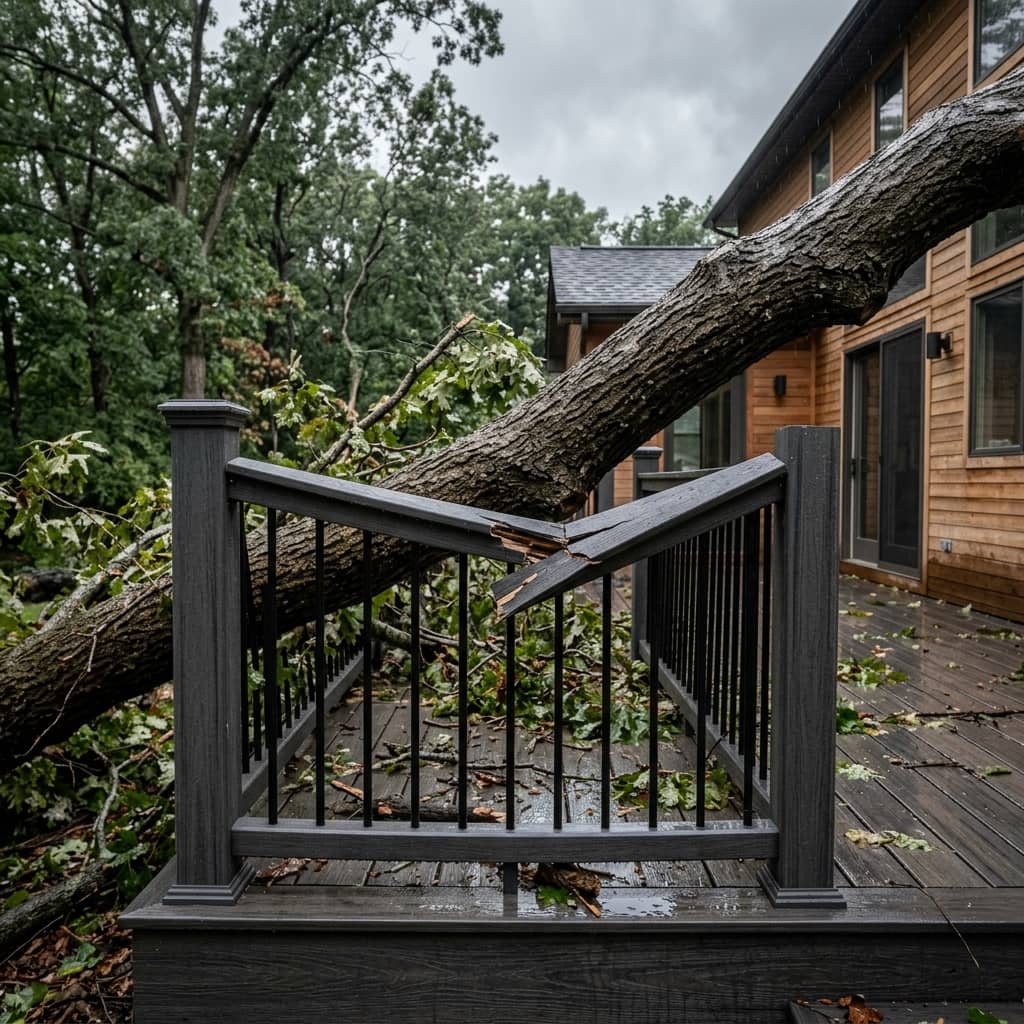
A tree limb cracks your deck during a summer thunderstorm — is that covered? Usually yes. Slow rot at the ledger board? Almost never. Here is exactly how Virginia homeowners insurance treats deck damage, the attached versus detached rule that decides which part of your policy applies, and what to do the moment damage happens.
A tree limb crashes through your back deck after a summer thunderstorm. A neighbor’s car backs into the post supporting your stairs. A heavy ice storm collapses a section of railing. The question every Northern Virginia homeowner asks next is the same: is this covered by my homeowners insurance?
The honest answer is: usually yes — but only for sudden, accidental damage. Slow problems like rot, mold, and structural failure caused by age or neglect are almost never covered, no matter how expensive the repair. The line between covered and not-covered matters, because deck damage in Virginia ranges from a few hundred dollars for a railing fix to $25,000+ for a full replacement.
Here is exactly how Virginia homeowners insurance treats deck damage in 2026, the attached versus detached rule that decides which part of your policy applies, what claims look like, and when to call a professional repair contractor instead.
The Short Answer
For a standard Virginia homeowners policy (HO-3, the most common form):
- Sudden, accidental damage to your deck is usually covered. Storms, wind, hail, fire, fallen trees, vehicle impact, vandalism — all typically covered perils. - Slow, maintenance-related damage is not covered. Rot, mold, insect damage, ledger board failure from poor flashing, water damage from neglect — all excluded under standard policy language. - Flood is never covered by standard homeowners insurance. Flood is a separate NFIP policy.
The specific dollar amount depends on whether the deck is attached or detached, which we cover next.
The Attached vs. Detached Rule
This is the single most important distinction in how your policy handles a deck claim.
Attached Decks (Coverage A — Dwelling)
A deck physically connected to your house — bolted to the home with a ledger board — is treated as part of the house itself. It falls under Coverage A (Dwelling) in your policy, which is typically the largest coverage amount on the entire policy. Your dwelling limit might be $400,000 or $600,000 or higher, and your deck has access to that full limit if needed.
Most custom backyard decks built in Northern Virginia are attached. That is good news for coverage — a $20,000 deck claim is rarely close to dwelling limits, so there is rarely a cap concern.
Detached Decks and Structures (Coverage B — Other Structures)
A fully freestanding deck — for example, a detached pool deck or a separate platform across the yard — is treated as a separate structure. It falls under Coverage B (Other Structures), which is normally capped at 10% of your dwelling limit. A $500,000 dwelling limit means roughly $50,000 of detached structure coverage shared across your fence, your shed, your detached garage, and your freestanding deck.
That 10% can run out quickly if multiple structures are damaged in the same event. Worth knowing before a major storm season.
What Is Typically Covered
Under a standard Virginia HO-3 policy, the following perils are generally covered when they cause deck damage:
- Wind and hail damage. Boards blown off, railings ripped loose, debris impact — all typically covered. Wind damage is the most common deck claim in Northern Virginia. - Falling trees and limbs. A tree from your yard, a neighbor’s yard, or city property that falls and damages the deck is normally covered. The cost of tree removal from the deck itself is also usually included up to a sub-limit (often $500 to $1,000). - Fire damage. From a grill flare-up, an outdoor fireplace, lightning, or a house fire that spreads. - Vehicle impact. A car backing through the deck post, a contractor truck clipping the stairs — all typically covered. - Vandalism and theft. Damaged furniture (if scheduled), spray-painted boards, stolen built-in components. - Weight of snow or ice. A collapsed deck section under heavy snow load is normally covered, though this is also exactly where pre-existing structural weakness becomes the insurer’s argument for denial. See the deck snow load requirements guide for how engineered capacity actually works.
!How snow load travels from accumulation through joists to footings on a deck - Riot or civil commotion. Rare in NoVA but technically a named peril.
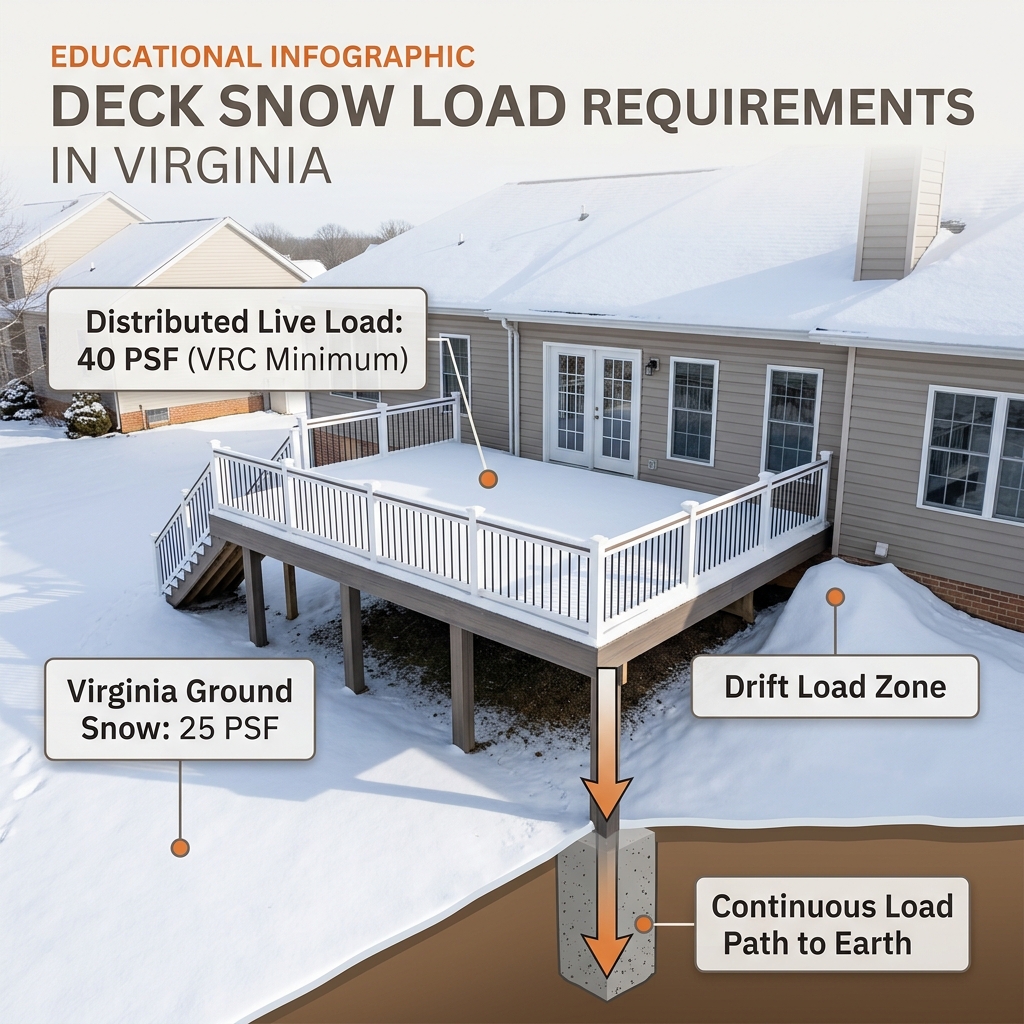
The loose pattern: anything sudden and accidental that you could not have prevented is on the table for coverage.
What Is Typically NOT Covered
This is where insurance claims get denied, and where homeowners get the most unpleasant surprises.
Rot, Mold, and Insect Damage
If the ledger board has been quietly rotting for ten years because it was never properly flashed and one summer the deck pulls away from the house, that is a maintenance failure. Carriers will deny the claim. The fix is on you — and structurally critical. We cover what proper flashing looks like in our ledger board flashing guide.
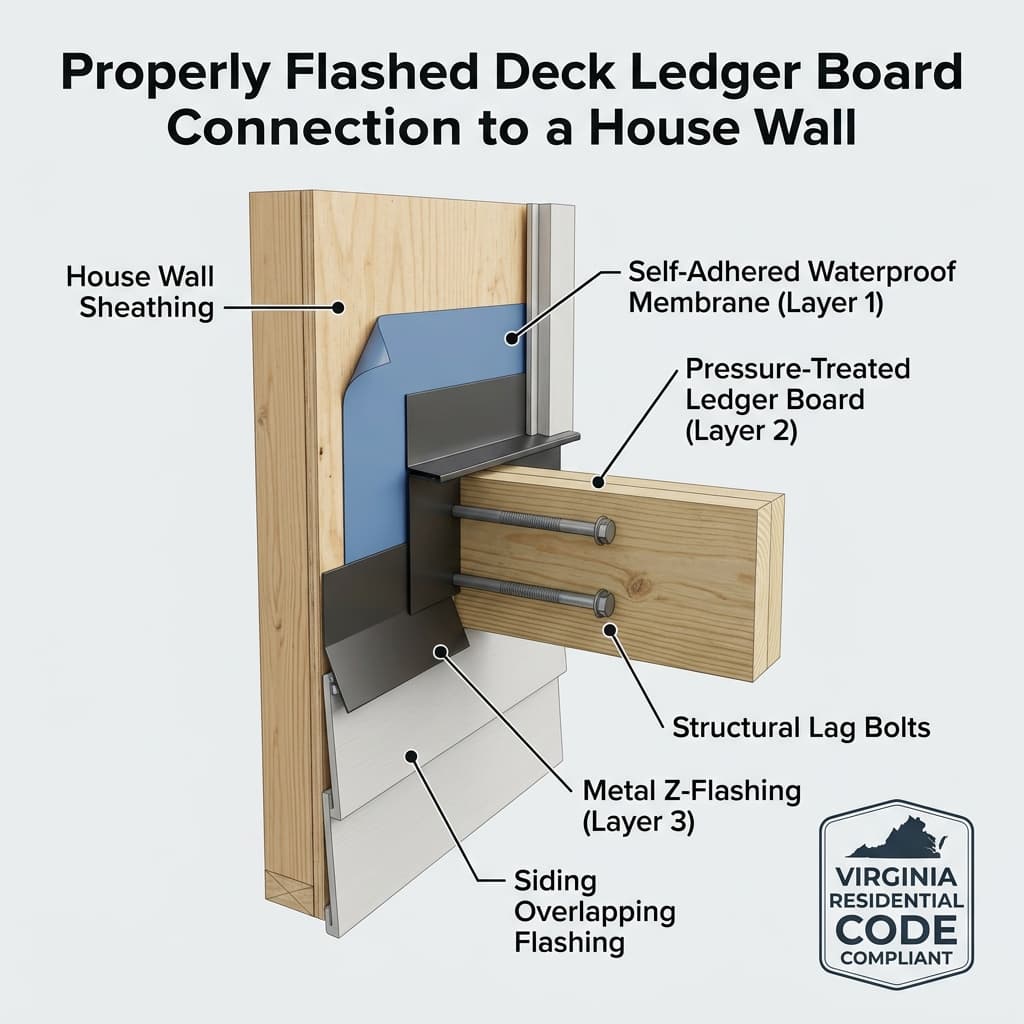
The same applies to joist rot, post rot at ground contact, and termite or carpenter ant damage. These are progressive problems that develop over years, and policies explicitly exclude them.
Wear, Age, and Deterioration
A 20-year-old pressure-treated wood deck that has finally failed has not been damaged in any insurable sense — it has reached the end of its design life. Carriers consider this normal depreciation and will not pay for the replacement.
Neglected Maintenance
If the carrier’s adjuster can show that the damage would not have happened with reasonable upkeep, they will deny the claim. A railing that fails because the lag screws were never tightened, a board that fails because the deck was never cleaned and pressure-washing was deferred for a decade — both can be classified as maintenance failures.
Flood Damage
Standard homeowners policies exclude all flood damage. If your basement walkout deck is damaged by floodwaters, coverage only exists if you also carry a separate flood policy through the National Flood Insurance Program (NFIP) or a private flood insurer.
Earth Movement
Earthquakes, sinkholes, and landslides are excluded under standard policies. Rare in NoVA but not impossible.
How to Read Your Policy Before Damage Happens
Three minutes spent on your declarations page now saves hours of stress after a claim.
1. Check Coverage A and Coverage B limits. Coverage A handles attached decks; Coverage B handles freestanding. Make sure both are appropriate for the value of what is on your property. 2. Note your deductible. Most NoVA policies carry a $1,000 or $2,500 deductible. A $4,000 railing repair on a $2,500 deductible only nets you $1,500 in coverage — and triggers a claim on your record. Many homeowners pay small repairs out of pocket to avoid premium increases. 3. Look for separate wind/hail deductibles. Some Virginia policies carry a higher percentage-based deductible specifically for wind and hail — often 1% or 2% of the dwelling limit, which can mean $4,000-$8,000 out of pocket before coverage kicks in. 4. Confirm replacement cost vs. actual cash value. Replacement cost pays to rebuild the deck like-new. Actual cash value depreciates first, leaving you with substantially less. For decks, replacement cost is strongly preferred. 5. Ask your agent about scheduled outdoor structures. High-value features (built-in outdoor kitchen, custom screened porch, multi-level luxury deck) sometimes warrant a scheduled endorsement so they are insured to actual replacement value rather than buried under dwelling totals.
What to Do the Moment Damage Happens
If a storm rolls through and your deck takes damage, the sequence matters.
1. Make sure nobody is hurt and the structure is stable. Do not stand on a deck that has visibly shifted, sagged, or pulled away from the house. Treat compromised deck framing the way you would treat a damaged staircase — keep people off it until a professional clears it. 2. Document everything. Wide shots of the damage in context, close-ups of every affected board, railing, post, and stair, plus photos of the cause if visible (the fallen tree, the impact point). Time-stamped photos are valuable. 3. Prevent further damage. Tarp exposed areas, board up dangerous openings, remove the obvious hazard if you can do it safely. Insurance companies require homeowners to mitigate ongoing damage — a wet, exposed joist that rots over the next two weeks is your responsibility, not theirs. 4. Call your insurance carrier. Open a claim and get a claim number. Ask whether you need to wait for an adjuster before starting any repairs. 5. Get a professional repair estimate. A licensed contractor’s written estimate carries weight with adjusters. We provide free estimates for storm damage repairs — see our deck repair service and deck repair page for the full process. 6. Schedule a deck safety inspection if any structural element is involved. A storm that damages railings often hides damage to the framing underneath. Our deck safety inspection checklist walks through what we check.
When the Claim Is Denied: The Repair Decision
Sometimes the claim is denied — typically because the damage is classified as wear, rot, or neglect rather than sudden accident. At that point the question becomes: repair, resurface, or replace?
- Localized damage on a healthy deck: repair. Replace the affected boards, joists, or railing sections and move on. - Surface damage but sound framing: resurfacing. The structural skeleton stays, the visible surface gets new composite boards and railings. We cover this option in deck resurfacing versus replacement. - Compromised framing or end-of-life structure: full replacement. A 25-year-old wood deck with widespread rot is no longer a candidate for repair. The honest call is to plan a rebuild.
The insurance question and the repair question are separate. A deck can be uninsurable for its damage and still be a smart repair. Or a deck can be fully covered and still be worth rebuilding rather than patching.
How Loudoun Decks Handles Insurance Repair Work
When storm damage hits an attached deck in Loudoun, Fairfax, or Prince William County, we provide a written estimate that adjusters can work from directly, document the damage with photos that support the claim, and rebuild to current Virginia code so the new work is permitted and inspected. If the damage involves the ledger or the framing, we treat it as a structural job rather than a cosmetic fix.
If a tree, a storm, or an accident has damaged your deck, call 571-655-7207 or visit ldndecks.com/get-estimate for a free assessment. We can usually tell you within an hour whether the damage is likely an insurance event, a repair, or a replacement — so you know what conversation to start with your carrier.
Frequently Asked Questions
Does homeowners insurance cover deck damage in Virginia?
Usually yes — for sudden, accidental damage from covered perils like wind, hail, fire, falling trees, and vehicle impact. It typically does not cover slow problems like rot, mold, neglect, age-related failure, or flood damage. An attached deck draws from Coverage A (Dwelling); a freestanding deck draws from the smaller Coverage B (Other Structures) limit.
Is a fallen tree on my deck covered by insurance?
Yes, in nearly every standard Virginia HO-3 policy. The damage to the deck itself is covered, and the cost of removing the tree from the deck is usually covered up to a sub-limit (often $500 to $1,000). The damage caused by your own tree falling on your own deck is also covered — you do not need a neighbor’s tree to be involved.
Why was my deck rot claim denied?
Because rot is classified as a maintenance failure, not sudden damage. Standard homeowners policies exclude wear, deterioration, mold, and damage caused by long-term water intrusion. The underlying issue — usually a poorly flashed ledger board or insufficient drainage — was the homeowner’s responsibility to maintain, even if the failure was hidden behind cladding.
What is the difference between attached and detached deck coverage?
An attached deck is part of the house and falls under Coverage A (Dwelling), which is typically the largest coverage on the policy. A freestanding (detached) deck falls under Coverage B (Other Structures), which is usually capped at 10% of the dwelling limit and shared with the fence, shed, and detached garage.
Will my insurance go up if I file a deck damage claim?
Possibly. Filing a claim — even a paid one — can affect future premiums and renewal. Many NoVA homeowners pay smaller repairs out of pocket to avoid the claim entirely. As a rule of thumb, if the repair cost is less than your deductible plus a year or two of likely premium increase, paying directly is often cheaper than claiming.
Should I get an inspection before filing an insurance claim?
Yes. A professional deck safety inspection identifies hidden damage that may not be visible from the surface, provides written documentation that supports the claim, and gives the insurance adjuster a credible technical reference point. We provide inspection reports tailored to claim documentation.
Plan Your Northern Virginia Deck Project With Loudoun Decks
Get a free, no-pressure consultation from a licensed Northern Virginia deck builder. Call (571) 655-7207 or visit ldndecks.com/get-estimate.
Get a Free EstimateEverything Your Outdoor
Space Needs
From ground-up deck construction to full outdoor living spaces, every project is custom-designed for your home with permit planning, material guidance, and written workmanship terms.
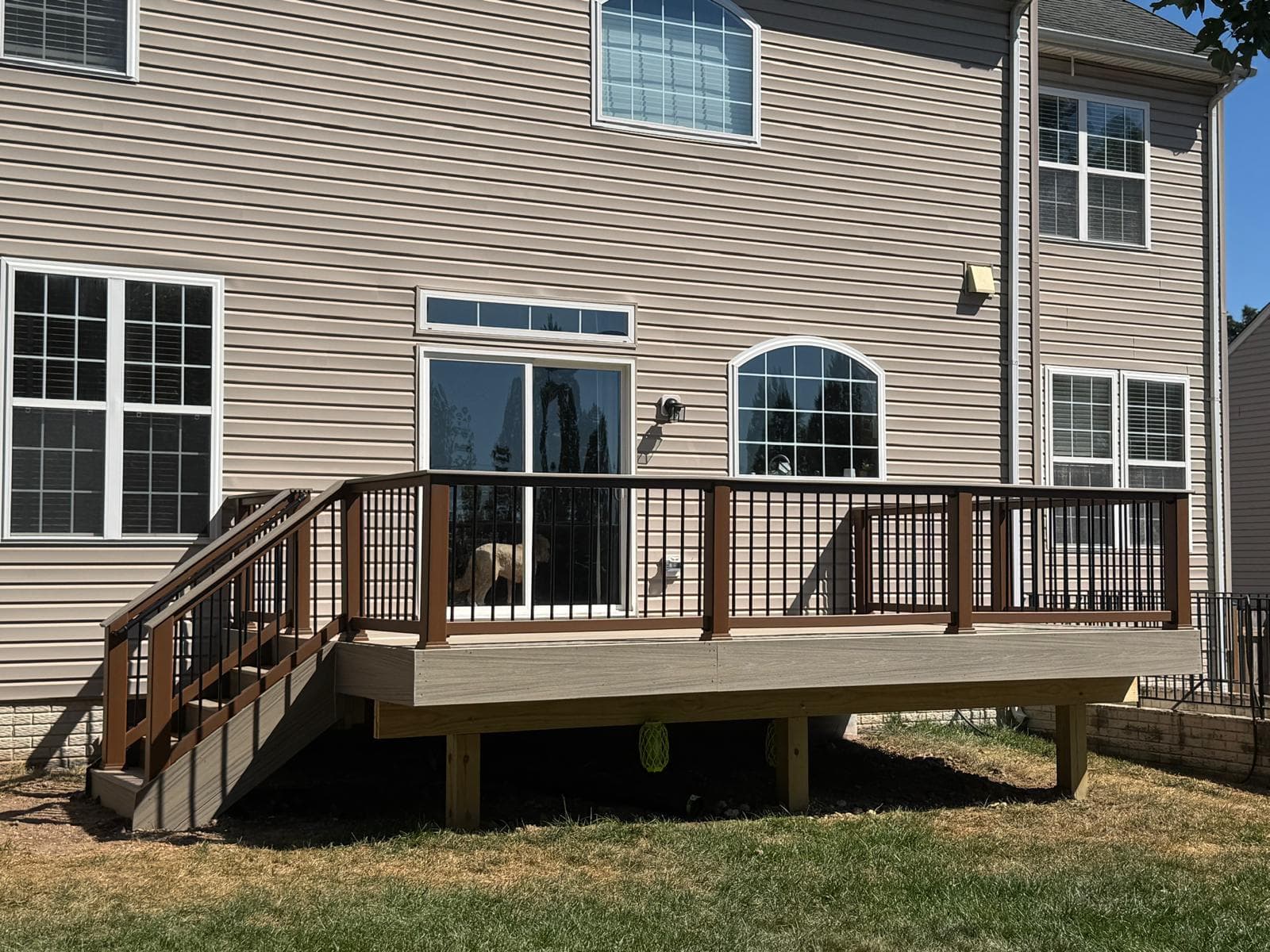
Custom Deck Builder
Transform your backyard with a custom-designed deck using Trex, TimberTech, wood, or PVC materials matched to your budget, HOA rules, and maintenance goals.
Deck Resurfacing
Premium wood-to-composite resurfacing for structurally sound frames. Full surface conversions start from $15k with boards, railings, fascia, and safety review.

Patio Contractor Services
Professional bluestone and paver patio installation. We create durable, beautiful ground-level outdoor living spaces that last a lifetime.
Local Expertise Across Northern Virginia
Loudoun Decks is a trusted deck builder serving Loudoun County, Fairfax County, Prince William County, Arlington, and Stafford.
Loudoun County
- Ashburn, VA
- Leesburg, VA
- Sterling, VA
- Aldie, VA
- South Riding, VA
- Broadlands, VA
- Brambleton, VA
- Purcellville, VA
- Hamilton, VA
- Lovettsville, VA
- Round Hill, VA
- Middleburg, VA
- Dulles, VA
- Arcola, VA
- Belmont, VA
- Cascades, VA
- Countryside, VA
- Lowes Island, VA
- Potomac Falls, VA
- Lansdowne, VA
- One Loudoun, VA
- Stone Ridge, VA
Fairfax County
- Fairfax, VA
- Fairfax Station, VA
- Burke, VA
- Springfield, VA
- West Springfield, VA
- Annandale, VA
- Centreville, VA
- Chantilly, VA
- Clifton, VA
- Herndon, VA
- Reston, VA
- Great Falls, VA
- McLean, VA
- Vienna, VA
- Oakton, VA
- Falls Church, VA
- Tysons, VA
- Dunn Loring, VA
- Merrifield, VA
- Alexandria, VA
- Lorton, VA
- Mount Vernon, VA
Prince William County
- Gainesville, VA
- Haymarket, VA
- Bristow, VA
- Manassas, VA
- Manassas Park, VA
- Woodbridge, VA
- Lake Ridge, VA
- Dumfries, VA
- Occoquan, VA
- Nokesville, VA
- Independent Hill, VA
- Montclair, VA
- Dale City, VA
- Triangle, VA
Arlington County
- Arlington, VA
- Rosslyn, VA
- Ballston, VA
- Clarendon, VA
- Pentagon City, VA
- Crystal City, VA
- Shirlington, VA
Stafford County
- Stafford, VA
- Falmouth, VA
- Garrisonville, VA
- Aquia Harbour, VA
Guides Northern Virginia Homeowners Are Reading
Deck Builder in Northern Virginia
Custom decks, permits, HOA support and local service areas.
Covered Deck Builder
Covered deck planning, outdoor living upgrades and shade structure decisions.
Trex vs TimberTech vs AZEK
Side-by-side brand comparison for Virginia climate.
Composite Deck Cost in Northern Virginia
Material pricing, verified source references, planning examples and what drives the price.
Free Deck Cost Calculator
Get an instant estimate by material, size, and add-ons.
TimberTech & AZEK Decks
Premium PVC and composite deck options for Northern Virginia.