
Railing Cost by Material
Railing is usually the second-biggest line item on a deck project (after decking material). A 300 sqft deck typically needs 60–80 linear feet of railing.
Most popular; HOA-friendly; matches deck color
Modern look; thin profile; durable; common in McLean / Great Falls
View-preserving; some HOAs restrict; high-end aesthetic
Premium; unobstructed view; HOA-restricted in some Loudoun communities
Cheapest; requires annual stain/seal; ages poorly in NoVA climate
Stair Cost by Configuration
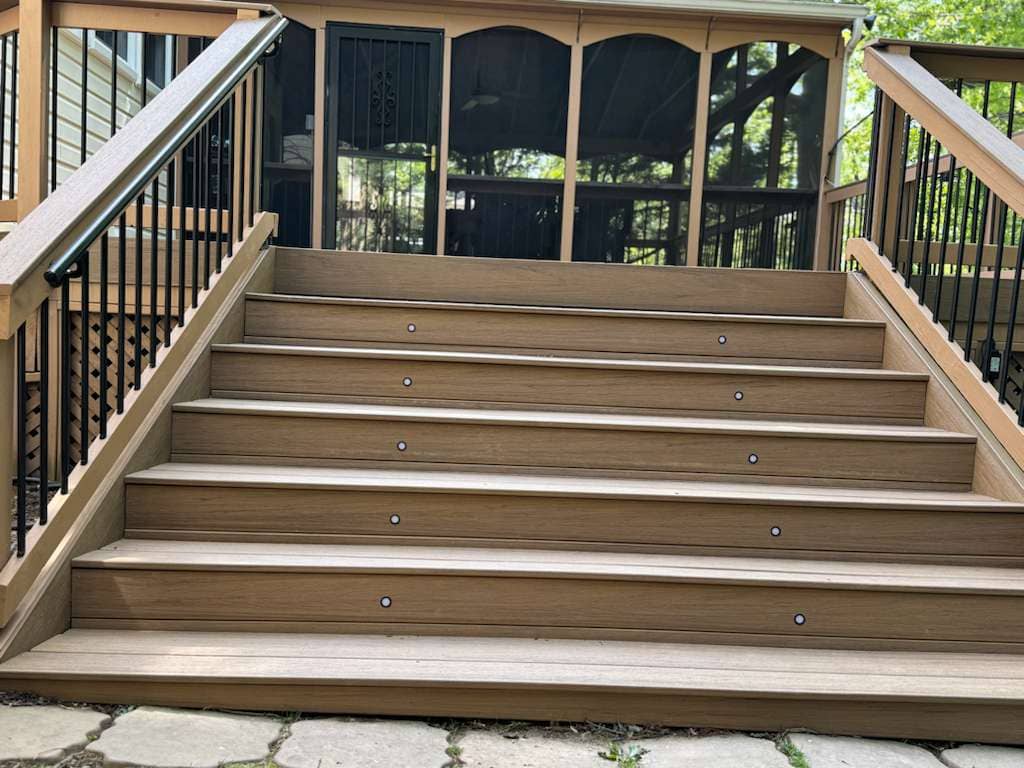
Stair pricing depends on rise (number of risers), tread depth, width, and configuration. Premium configurations like wraparound or cascading stairs add structural complexity and material cost.
Before finalizing a stair allowance, use the Virginia deck stair calculator to estimate step count and total run, then compare the plan against the Virginia deck stair code guide and the deck stair construction diagram. That keeps the budget tied to real rise/run, landing, handrail, and stringer requirements instead of a generic stair line item.
Most common — backyard ground transition
Elevated deck with longer drop to grade
Multi-direction descent; common for side-yard exits
Architectural focal point; doubles as casual seating
Premium feature; common in McLean / Great Falls / Belmont
Lighting Package Pricing
Lighting transforms a deck's nighttime usability. Most Northern Virginia homeowners regret skipping lighting at build time — retrofit cost runs 30–50% higher and the result is rarely as clean as built-in wiring.
Basic safety/aesthetic lighting
Safety lighting for stairs; significant nighttime improvement
Continuous accent lighting around perimeter
Premium ambient lighting in the deck surface
Multi-zone control; color-changing; integrates with home automation
How Add-Ons Move the Monthly Payment
Each add-on category typically adds $2,000–$5,000 to project amount, which translates to roughly $25–$65/month in financing at typical rates over 10 years. A premium package (upgraded railings + full lighting + entertainment stairs) can add $12,000–$25,000, which is $150–$315/month. Build the budget knowing the financing impact, not just the sticker price.
Build-Time vs Retrofit
Three things are dramatically cheaper to install during the initial build:
- Recessed deck lighting — requires opening deck boards if added later
- Riser lights and under-rail LED — wiring runs cleanly during framing
- Picture-frame borders and pattern inlays — must be planned with deck board layout
Two things can wait:
- Smart-control upgrades — wiring is the same; controller swaps in later
- Outdoor heaters and fans on covered decks — usually plug-and-play after rough-in
Related Cost & Material Pages
- Deck Railing Options in Northern Virginia →
- Deck Lighting Ideas in Northern Virginia →
- Deck Payment Estimator →
- Composite Deck Cost in Northern Virginia →
FAQ
How much do composite railings cost per linear foot in Northern Virginia?
Composite railings (Trex Select, TimberTech RadianceRail) run $40–$70 per linear foot installed in Northern Virginia. A 300 sqft deck typically needs 60–80 linear feet of railing, so the railing portion is usually $2,400–$5,600 of the total project. Aluminum runs $50–$90/ft; cable runs $60–$110/ft.
How much do deck stairs cost?
A standard 3–4 riser stair flight runs $1,500–$2,800 in Northern Virginia. A 5–7 riser flight (for elevated decks) runs $2,500–$4,500. L-shape stairs with a landing run $3,500–$6,000. Wide entertainment stairs (6+ ft) run $4,000–$8,000 and become an architectural feature.
How much does deck lighting cost?
Basic post-cap lighting (4 corners) runs $200–$600. A full stair riser-light set runs $400–$1,200. A premium package with under-rail LED, recessed deck lights, and smart control runs $3,000–$5,000+. Lighting is 30–50% cheaper installed during the initial build than retrofitted later.
Which add-on changes the monthly payment the most?
Lighting packages and premium railing upgrades each add $2,000–$5,000 to project amount — about $25–$65/month in financing at typical rates. Wraparound or cascading stairs can add $6,000–$15,000, which moves monthly payment $75–$190. Plan add-ons knowing the financing impact upfront.
Should I add lighting at build time or wait?
Add at build time. Retrofitting lighting after the deck is built requires opening the deck boards or running surface-mounted wiring. Installation cost is 30–50% higher post-build, and the result is rarely as clean. The exception: smart-control systems can be upgraded later because the wiring infrastructure stays the same.
Are HOA-restricted railing styles common in Northern Virginia?
Yes, in some communities. Ashburn Village, Brambleton, and some Belmont sections restrict cable and glass railings to preserve neighborhood consistency. Loudoun's older communities (Lansdowne, parts of Sterling) restrict modern aluminum profiles. We submit material samples with every HOA package and confirm approval before ordering.