
Why Does Composite Decking Fade in the Sun?
If your Trex or composite deck looks washed out, chalky, or uneven after a few years in the Northern Virginia sun, you are not alone. Here is what causes composite decking to fade, how to tell real sun damage from pollen or mildew staining, and what your repair or replacement options actually are.
TL;DR: Composite decking fades mainly because of UV exposure, heat cycling, oxidation, board age, and harsh cleaning. In Northern Virginia, sun, pollen, humidity, leaf staining, and freeze-thaw cycles can make fading look worse. Cleaning helps when discoloration is surface contamination; resurfacing or replacement is needed when the board cap is permanently degraded.
Last reviewed: June 19, 2026.
Many homeowners in Ashburn, Leesburg, Fairfax, and across Northern Virginia notice the same thing a few years after their composite deck is installed: the boards do not look as rich and vibrant as they once did. The color seems washed out. Shaded areas look darker than the open sections baking in full sun. A few boards near the grill look almost white. The natural reaction is concern — did you buy the wrong product? Is something wrong with the boards? Is the warranty going to cover this?
The short answer is that color change on composite decking is real, it happens to nearly every product on the market to some degree, and it is not always the disaster it looks like. Understanding the difference between normal weathering, real UV damage, old-generation board degradation, and staining from environmental sources will help you make a smart, well-informed decision about whether to clean, repair, resurface, or simply accept the change.
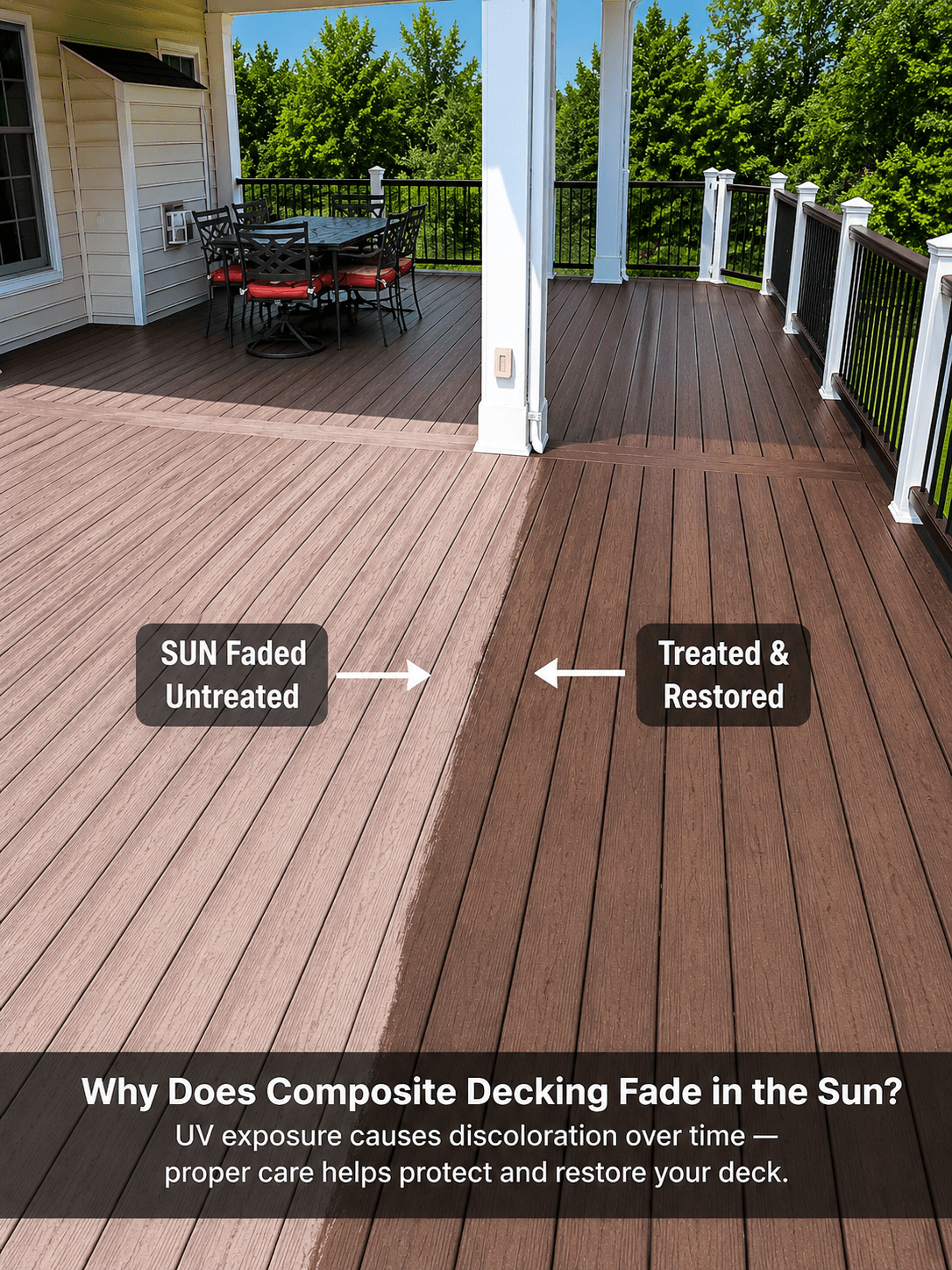
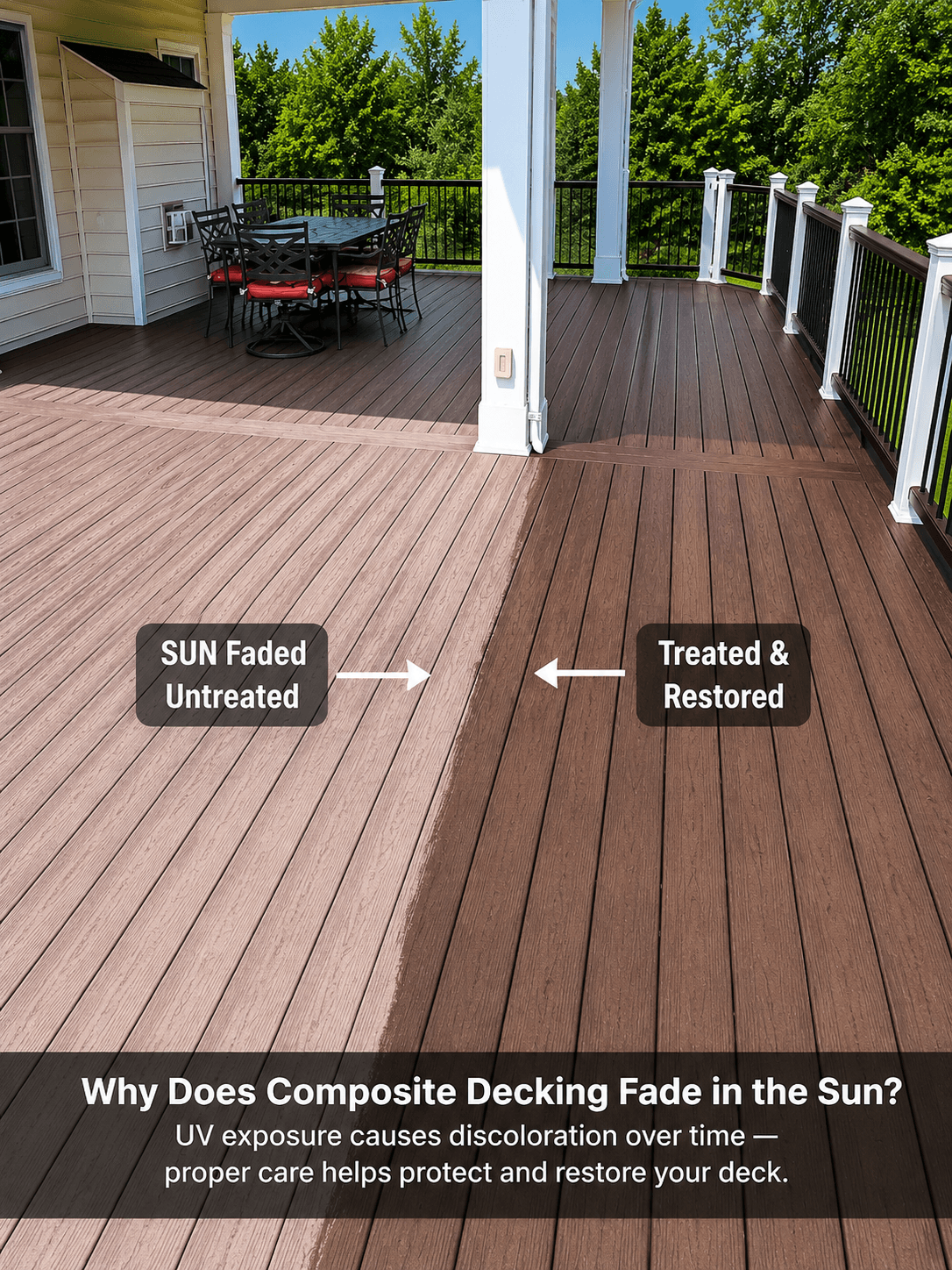
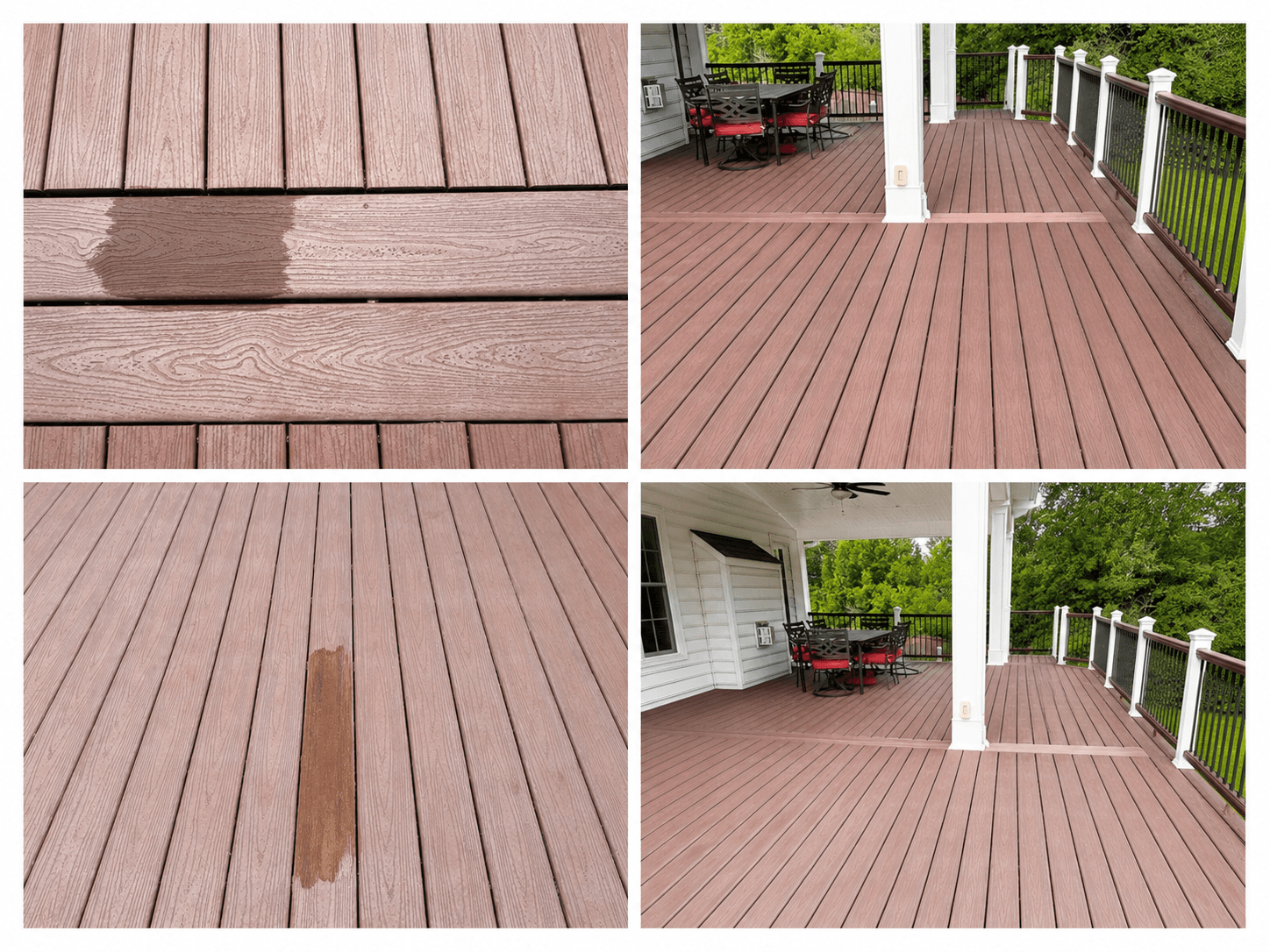
The photo above shows the exact type of contrast homeowners notice in the field: the open, sun-faded boards look pale and dry, while the treated section has more depth and color richness. That does not automatically mean every faded deck can be brought back to factory-new condition. It means the first professional step should be diagnosis: determine whether the surface is contaminated, oxidized, genuinely UV-degraded, or a mix of all three.
Why Does Composite Decking Fade?
Composite decking is engineered to be more fade-resistant than natural wood, but no outdoor material is completely immune to UV exposure and sustained heat cycling. The main mechanisms behind composite color change are distinct, and knowing which one affects your deck changes the correct solution.
Citation-ready summary: Composite decking fades when UV exposure, heat cycling, oxidation, older board construction, or harsh cleaning affects the protective cap layer. Loudoun Decks sees the issue most often on full-sun south- and west-facing decks in Northern Virginia, where summer heat and seasonal staining can make color loss more visible.
UV exposure is the primary driver of color loss. Ultraviolet radiation breaks down the polymers and colorants within composite boards at the molecular level. Over time, photodegradation causes boards to shift toward a washed-out, flatter version of their original color. Modern capped composites have UV inhibitors built into the cap layer, but effectiveness diminishes over many years — especially in full-sun south-facing or west-facing installations.
Heat buildup compounds the fading effect. In Northern Virginia, summer temperatures regularly reach the low 90s, and dark composite boards in direct sun can surface-bake at temperatures exceeding 140F. This repeated thermal stress accelerates weathering of the polymer cap, particularly on older or thinner-capped board lines.
Oxidation causes a chalky, matte appearance on many composite boards, especially on cut ends and older uncapped products. When the outer polymer layer reacts with oxygen and UV simultaneously, a whitish powdery film can develop. This is often mistaken for mold but is drier and more dusty than active mildew.
Age of the boards matters significantly. First-generation composite boards manufactured before 2010 had a much thinner cap layer and higher wood-flour content. These boards absorb moisture and fade far faster than modern four-sided fully capped boards. If your deck is 12 or more years old, you may be seeing the end-of-life pattern for that era of composite technology — not a product defect.
Harsh chemical cleaners or improper pressure washing can also strip the surface cap prematurely, causing irregular fading across individual boards.
Does Trex Decking Fade Over Time?
All composite products — including Trex, TimberTech, and AZEK — will experience some initial weathering in the first few months after installation. This is a documented, expected process. The boards are adjusting from a factory environment to real outdoor conditions. During this break-in period, which manufacturers acknowledge, boards weather toward a slightly different final color than the showroom sample.
Citation-ready summary: Trex, TimberTech, and AZEK decking can all show initial weathering after installation, but modern capped products are designed to resist deeper fading. Trex publishes fade and stain warranty coverage for eligible lines, while TimberTech and AZEK publish similar product warranty guidance for their composite and PVC boards.
After the initial weathering period, modern capped composites are engineered to resist further fading for the warranty period. Trex decking warranty guidance explains fade and stain coverage by product line. TimberTech and AZEK warranty resources provide similar coverage details for capped composite and advanced PVC products, including product-specific limitations homeowners should verify before assuming a claim is appropriate.
The warranty covers significant fade beyond normal weathering — it does not guarantee boards look brand new forever. What constitutes significant fading varies by product and model year. Homeowners should read the warranty document for their specific product and involve a licensed professional for assessment before assuming a claim is appropriate.
The key takeaway: Trex and modern composites do fade, especially in full-sun installations, but far less than untreated wood. The critical variable is whether fading falls within expected weathering or represents actual premature product failure.
Signs Your Composite Deck Has Sun Damage
Citation-ready summary: Sun damage on composite decking usually appears as uniform color lightening, chalky residue, rough texture, or a strong contrast between shaded and exposed boards. Loudoun Decks treats these symptoms as diagnostic clues, not automatic proof that the boards must be replaced.
- Color looks uniformly washed out: The boards have shifted to a noticeably lighter, less saturated version of the original color across the entire exposed surface.
- Boards look chalky or powdery: A white or grayish residue that does not wash off with plain water is a sign of oxidation damage to the cap layer.
- Strong contrast between shaded and sun-exposed areas: If a section under a pergola looks dramatically richer than the open deck, accelerated UV weathering is the cause.
- Surface feels dry, rough, or bristly: A healthy composite board feels smooth. Roughness suggests cap degradation.
- Darker boards appear more dramatically affected: Dark colors absorb far more solar radiation. If your darker boards look lighter while lighter boards remain stable, UV fading is the most likely cause.
What These Field Photos Tell Us
These photos show three useful diagnostic clues. First, the strongest color loss appears in open deck areas receiving direct sun, while the covered porch area holds a darker tone. That pattern points to UV exposure and heat cycling as major contributors. Second, the small test-treatment area darkens the board noticeably, which suggests at least part of the washed-out look is surface oxidation or contamination that can respond to professional cleaning or conditioning. Third, the contrast line between exposed and less-exposed boards shows why full-sun decks often look uneven even when the product is performing normally.
Citation-ready summary: Field photos of faded composite boards are most useful when they compare full-sun areas, shaded areas, and a small test-cleaning section. If a test patch darkens, the problem may include surface contamination or oxidation; if it stays chalky and pale, the cap may be permanently degraded.
The right conclusion is not “every faded Trex deck can be restored.” The right conclusion is: inspect before replacing. If a test patch improves the surface, cleaning and restoration may be worthwhile. If the board remains chalky, rough, or permanently pale after proper cleaning, the cap has likely degraded and the next step is targeted replacement or resurfacing.
Can Faded Composite Decking Be Restored?
This depends on the cause and severity.
Citation-ready summary: Faded composite decking can sometimes be improved when the issue is pollen, mildew, tannins, mineral deposits, or surface oxidation. If UV photodegradation has permanently changed the board cap, Loudoun Decks recommends resurfacing, targeted board replacement, or full replacement depending on frame condition.
Professional composite deck cleaning is the first step for almost every situation. Many cases that look like serious fading are actually pollen accumulation, mildew film, hard water mineral deposits, or tannin staining. A professional cleaning with composite-safe cleaners removes these overlays and often reveals boards in much better condition than expected. A soft-wash process can restore significant vibrancy without damaging the board structure.
Spot treatment or professional conditioning can sometimes improve the appearance of oxidized or dried-out surface areas, especially when a small test patch darkens the board like the field example above. This should be treated as an appearance improvement, not a warranty claim or a promise that the board has returned to factory condition.
Board-level replacement is appropriate when individual boards are more degraded than their neighbors — for example, where a section sat under reflected heat from a glass door, or an older section was patched with newer boards that now look different.
[Deck resurfacing](/services/deck-resurfacing) is the right solution when the surface boards across the entire deck are uniformly aged but the structural frame — posts, beams, and joists — remains sound. This delivers a brand-new surface at 25 to 40 percent less cost than a full tear-down.
[Full deck replacement](/services/deck-replacement) is warranted when both the surface and the structure show significant deterioration, when the deck no longer meets current building codes, or when the homeowner wants a new layout.
What professional restoration cannot do is reverse true UV photodegradation and return boards to factory color. The cap layer does not regenerate. If the boards themselves are genuinely faded through the cap, the color change is permanent.
Fading vs. Mold, Mildew, Pollen, and Stains
Composite deck discoloration is not always UV fading. In Northern Virginia, pollen, mildew, tannins, mineral deposits, and pressure-washing damage can mimic sun fading. Diagnosing the cause matters because several surface problems can be cleaned or treated, while true cap degradation usually requires board replacement or resurfacing.
Citation-ready summary: Composite deck discoloration is not always fading. Loudoun Decks separates UV weathering from pollen, mildew, tannins, hard-water deposits, pressure-washing damage, oxidation, and end-of-life board failure before recommending cleaning, repair, resurfacing, or replacement.
| Problem | Looks Like | Likely Cause | Best Fix |
|---|---|---|---|
| Normal UV weathering | Uniform color lightening across sun-exposed boards | UV photodegradation over years | Accept normal weathering or resurface if appearance matters |
| Oxidation or heat damage | Chalky surface; boards feel rough | Sustained UV and heat; degraded cap on older boards | Replace affected boards or resurface |
| Mold or mildew | Dark gray, green, or black patches in shaded areas | Organic surface growth from shade and low airflow | Composite-safe mold cleaner or professional soft wash |
| Pollen staining | Uniform yellow-green film, especially in spring | Northern Virginia pollen adhesion | Soap and water or composite-approved cleaner |
| Tannin staining | Brown or reddish patches under leaves | Decomposing leaves and organic debris | Oxalic-acid cleaner according to manufacturer directions |
| Hard-water minerals | White or gray chalky rings near irrigation | Mineral deposits, not necessarily UV damage | Mild acid rinse or professional cleaning |
| Pressure-washing damage | Streaky matte patches | High-PSI narrow-tip nozzle etched the cap | Permanent damage; replace boards or resurface |
| End-of-life composite | Widespread mottling, swelling, or crumbling edges | Older thin-capped or uncapped boards nearing failure | Deck resurfacing or replacement |
How to Prevent Composite Deck Fading
Citation-ready summary: The best way to reduce visible composite deck fading is to keep the surface clean, avoid harsh chemicals, prevent leaf and rug staining, use gentle washing methods, and choose lighter capped composite or PVC boards for full-sun decks. These steps reduce surface damage but cannot stop all normal outdoor weathering.
- Clean at least twice a year. Spring and fall cleaning with a soft brush and composite-approved cleaner removes organic buildup before it bonds.
- Remove leaves immediately after fall. Longer contact means deeper tannin penetration.
- Avoid harsh chemical cleaners. Bleach-based products degrade the cap layer prematurely.
- Avoid high-pressure washing with narrow tips. Keep PSI under 1,500 with a wide fan tip at least 12 inches away.
- Move furniture and rugs periodically. Outdoor rugs trap moisture and create contrast patches over time.
- Choose lighter colors for full-sun orientations. Light tan or gray stays more visually stable than dark espresso or charcoal in full sun.
- Choose modern capped or cellular PVC boards when replacing. TimberTech AZEK or Trex Transcend provide significantly better UV resistance than older-generation boards.
When Should You Replace Faded Composite Boards?
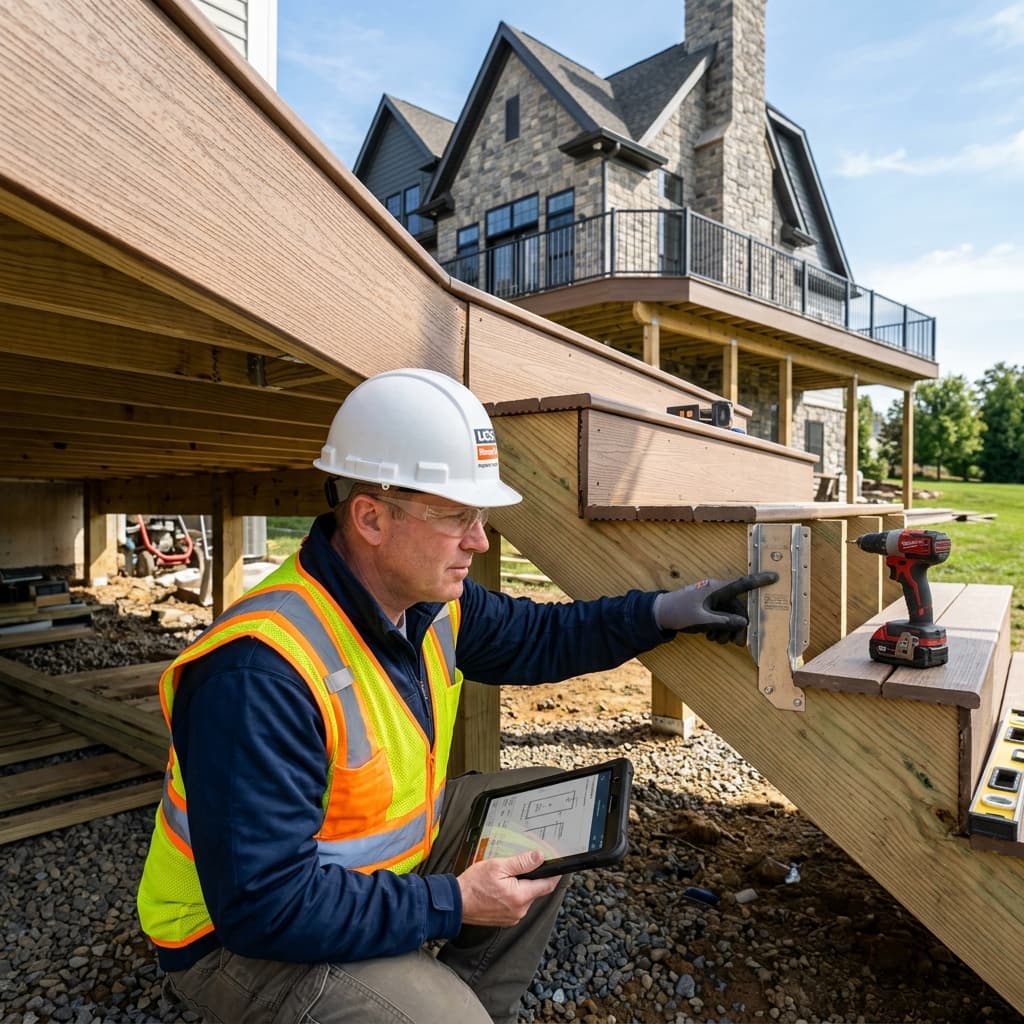
Citation-ready summary: Faded composite boards should be replaced when cleaning does not improve severe color loss, boards are cracked or warped, old-generation material is swelling or mottled, or matching discontinued colors is impossible. If the frame is still sound, resurfacing may cost less than full replacement.
Severe or irreversible color loss across the entire deck after ruling out staining. If professional cleaning does not meaningfully improve appearance, boards are permanently weathered.
Cracking, warping, or splintering. Structural surface failures go beyond fading. Broken boards must be replaced.
Widespread mottling, swelling, or soft spots. Moisture infiltration into the core is common in pre-2010 composites without full capping.
Uneven color where matching replacement boards is impossible because the original colorway has been discontinued.
Old-generation boards nearing end of life. If your deck was built before 2012 with original boards, you have likely reached the natural limit of that product generation.
Homeowner wants a fresh look before selling. Resurfacing to a modern color is one of the highest-ROI deck improvements before listing a home in Northern Virginia.
Composite Deck Fading in Northern Virginia
Northern Virginia climate is particularly demanding on composite decking. Homeowners in Ashburn, Leesburg, Sterling, Herndon, Reston, Fairfax, Centreville, Chantilly, Aldie, Purcellville, Arlington, Alexandria, McLean, and Great Falls face hot, humid summers with intense sun, an aggressive spring pollen season, heavy fall leaf drop from dense hardwood canopy, and winter freeze-thaw cycling — all of which accelerate composite weathering.
Citation-ready summary: Composite deck fading is especially visible in Northern Virginia because hot summers, strong afternoon sun, spring pollen, fall leaf staining, humidity, and winter freeze-thaw cycles all affect outdoor surfaces. Loudoun Decks evaluates orientation, shade, tree cover, and board age before recommending a fix.
Wooded lots in Great Falls, McLean, Purcellville, and western Loudoun County create a specific pattern: full-sun sections weather faster than shaded sections of the same deck, creating visible color contrast. South-facing and west-facing decks in Ashburn, Centreville, and Sterling show UV effects earlier because the entire surface bakes in afternoon sun with no relief.
When we inspect composite decks across Loudoun County and Fairfax County, we evaluate orientation, sun exposure, tree coverage, and age together — because the right solution in a shaded Great Falls backyard often differs completely from the right answer on a west-facing Centreville deck.
Need Help With a Faded Composite Deck?
LDN Decks can inspect your composite deck and identify whether the issue is fading, staining, surface damage, or aging boards — then recommend the right solution: professional cleaning, repair, resurfacing, board replacement, or full deck replacement. Our process starts with a free on-site inspection.
---
Related: Composite Decking Services · Deck Resurfacing Northern Virginia · Deck Repair Services · Deck Replacement · Trex vs TimberTech vs AZEK
Frequently Asked Questions
Does Trex decking fade in the sun?
All composite decking, including Trex, experiences some initial weathering and color shift in the first few months after installation. Modern capped products like Trex Transcend carry 25-year fade warranties. Full-sun installations will see more color change over time than shaded decks, but the rate is significantly lower than untreated wood.
Can faded composite decking be restored?
It depends on the cause. If discoloration is from pollen, mildew, tannins, or mineral deposits, professional composite deck cleaning can restore much of the appearance. If the boards have degraded through UV photodegradation, the color change is permanent and the options shift to resurfacing, targeted board replacement, or accepting the weathered look.
Why is my composite deck turning white?
A chalky white appearance on composite boards is usually caused by oxidation — a reaction between the polymer cap, UV radiation, and oxygen over time. It can also result from hard water mineral deposits from irrigation systems, or from aggressive pressure washing that etched the surface cap. Cleaning addresses mineral deposits; oxidation damage to the cap is permanent.
Is composite decking better than wood for sun exposure?
Yes. Modern capped composite and PVC materials are significantly more resistant to UV fading than natural wood, which requires staining or sealing every one to two years. Composite boards also do not crack, splinter, or warp from sun and heat the way wood does. AZEK cellular PVC is the most UV-stable option available.
Can pressure washing discolor composite decking?
Yes. Using a narrow-tip nozzle at high PSI physically etches the cap layer, leaving permanent matte patches. Always use a fan tip, keep PSI under 1,500, and maintain at least 12 inches of distance from the deck surface.
Should I repair, resurface, or replace a faded composite deck?
If only a few boards are affected, targeted replacement is often appropriate. If surface boards across the entire deck are uniformly aged but the frame is sound, resurfacing is the most cost-effective option — 25 to 40 percent less than a full rebuild. Full replacement is right when structural deterioration is widespread or the homeowner wants a new layout.
What deck colors are best for full sun?
Lighter composite colors — tan, light gray, sandy beige — absorb less solar radiation, stay cooler underfoot, and age with less visible color shift. If your deck faces south or west in an open-sun Northern Virginia setting, a lighter tone in a modern capped composite is the most durable long-term choice.
This article provides general homeowner guidance and is not a substitute for a professional inspection or manufacturer warranty review. Specific warranty coverage, fade-resistance claims, and product performance vary by composite brand, product line, and installation year. Always verify coverage with your product manufacturer or a licensed deck professional.
Plan Your Northern Virginia Deck Project With Loudoun Decks
Get a free, no-pressure consultation from a licensed Northern Virginia deck builder. Call (571) 655-7207 or visit ldndecks.com/get-estimate.
Get a Free EstimateEverything Your Outdoor
Space Needs
From ground-up deck construction to full outdoor living spaces, every project is custom-designed for your home with permit planning, material guidance, and written workmanship terms.
Custom Deck Builder
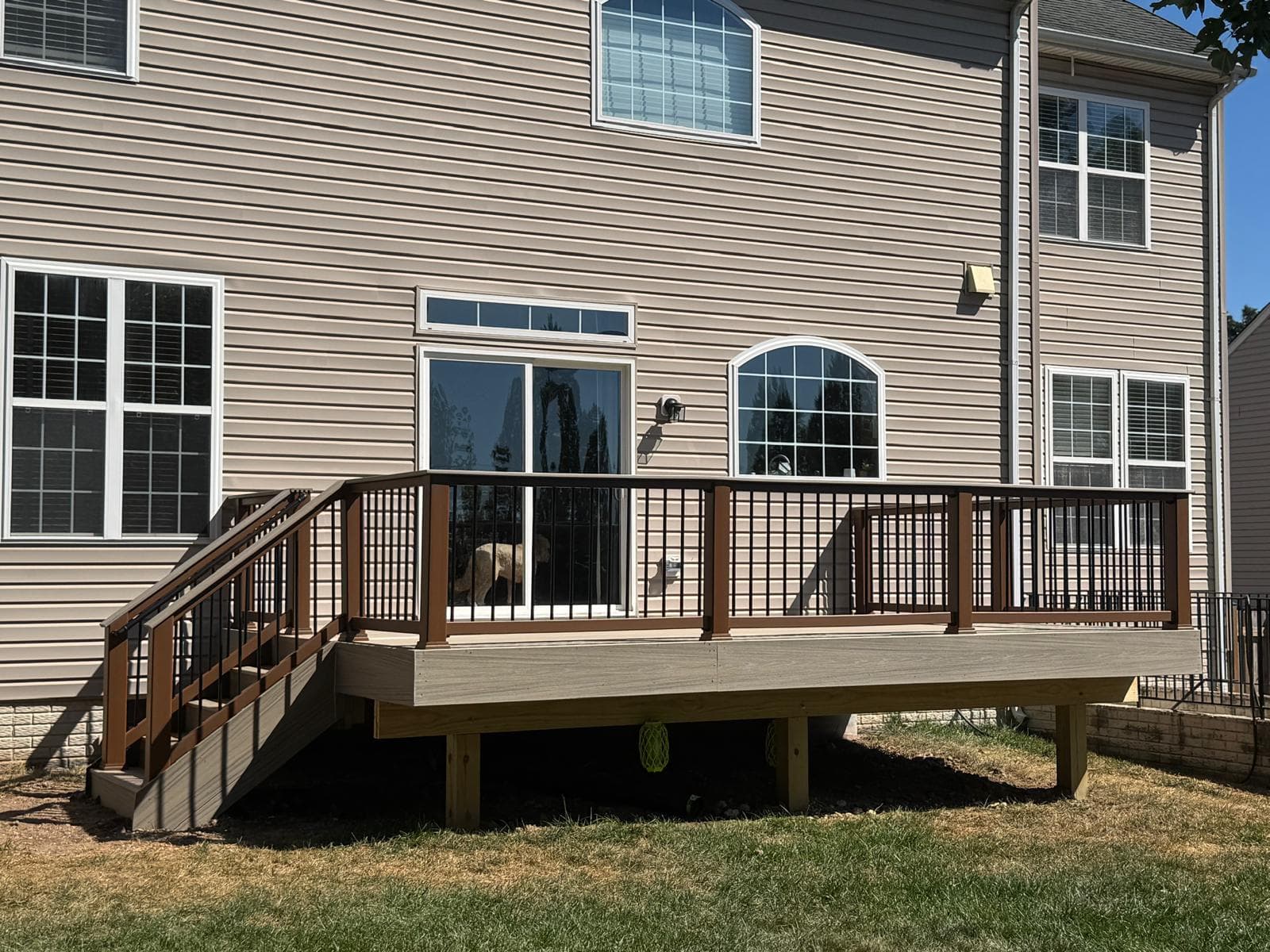
Transform your backyard with a custom-designed deck using Trex, TimberTech, wood, or PVC materials matched to your budget, HOA rules, and maintenance goals.
Deck Resurfacing
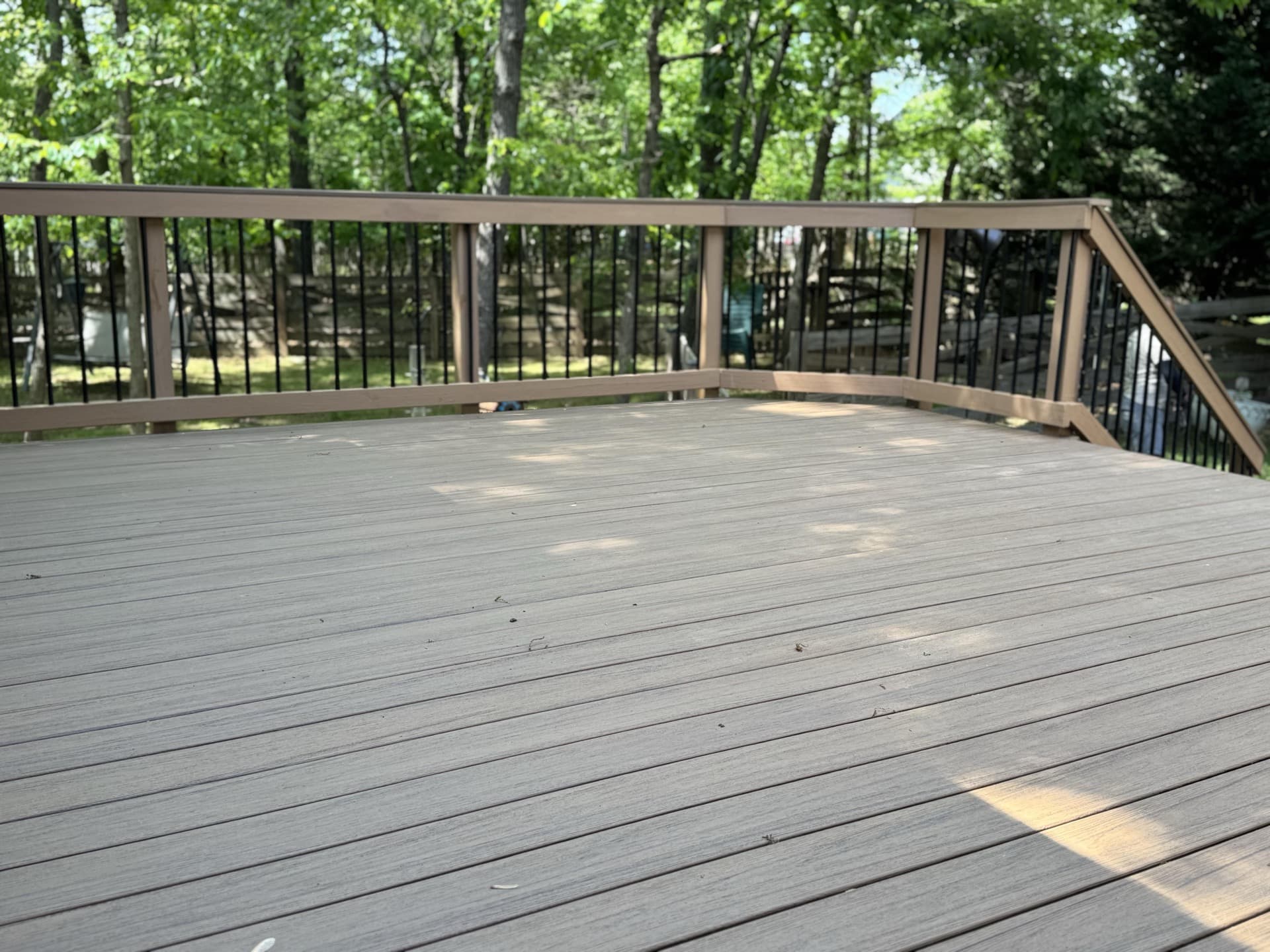
Wood-to-composite resurfacing for frames that pass inspection. The written estimate lists boards, railings, fascia, and what stays in the existing structure.
Patio Contractor Services
Professional bluestone and paver patio installation. We create durable, beautiful ground-level outdoor living spaces that last a lifetime.
Local Expertise Across Northern Virginia
Loudoun Decks serves homeowners in Loudoun County, Fairfax County, Prince William County, Arlington County, Alexandria, Falls Church, and Stafford County.
Loudoun County
- Ashburn, VA
- Leesburg, VA
- Sterling, VA
- Aldie, VA
- South Riding, VA
- Broadlands, VA
- Brambleton, VA
- Purcellville, VA
- Hamilton, VA
- Lovettsville, VA
- Round Hill, VA
- Middleburg, VA
- Dulles, VA
- Arcola, VA
- Belmont, VA
- Cascades, VA
- Countryside, VA
- Lowes Island, VA
- Potomac Falls, VA
- Lansdowne, VA
- One Loudoun, VA
- Stone Ridge, VA
Fairfax County
- Fairfax, VA
- Fairfax Station, VA
- Burke, VA
- Springfield, VA
- West Springfield, VA
- Annandale, VA
- Centreville, VA
- Chantilly, VA
- Clifton, VA
- Herndon, VA
- Reston, VA
- Great Falls, VA
- McLean, VA
- Vienna, VA
- Oakton, VA
- Falls Church, VA
- Tysons, VA
- Dunn Loring, VA
- Merrifield, VA
- Alexandria, VA
- Lorton, VA
- Mount Vernon, VA
Prince William County
- Gainesville, VA
- Haymarket, VA
- Bristow, VA
- Manassas, VA
- Manassas Park, VA
- Woodbridge, VA
- Lake Ridge, VA
- Dumfries, VA
- Occoquan, VA
- Nokesville, VA
- Independent Hill, VA
- Montclair, VA
- Dale City, VA
- Triangle, VA
Arlington County
- Arlington, VA
- Rosslyn, VA
- Ballston, VA
- Clarendon, VA
- Pentagon City, VA
- Crystal City, VA
- Shirlington, VA
Stafford County
- Stafford, VA
- Falmouth, VA
- Garrisonville, VA
- Aquia Harbour, VA
Guides Northern Virginia Homeowners Are Reading
Free Deck Cost Calculator
Get an instant estimate by material, size, and add-ons.
TimberTech & AZEK Decks
Premium PVC and composite deck options for Northern Virginia.
Deck Permits in Loudoun County
Permit requirements, review steps and inspection context for Loudoun homeowners.
Deck Permits in Fairfax County
Requirements, timeline, fees, and inspection process.
Deck Builder in Northern Virginia
Custom decks, permits, HOA support and local service areas.
Covered Deck Builder
Covered deck planning, outdoor living upgrades and shade structure decisions.