


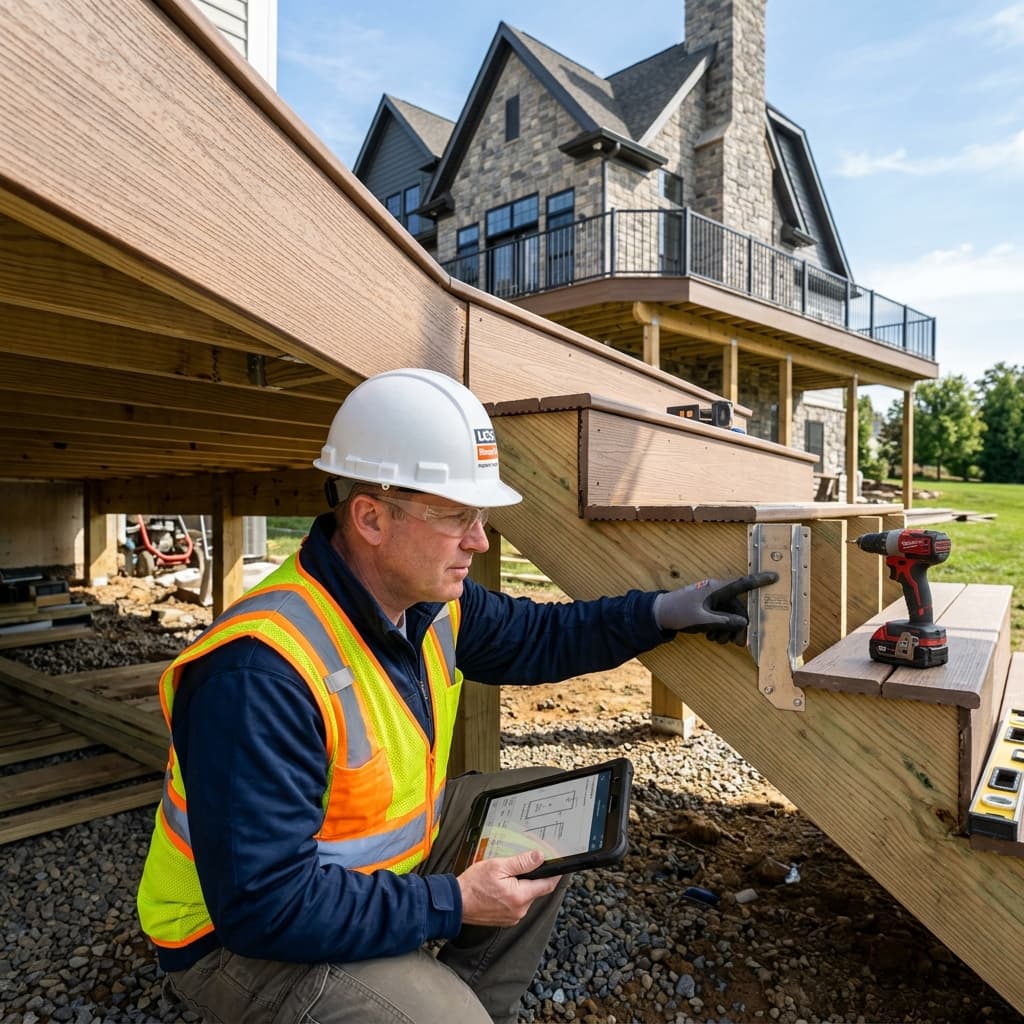
A ledger board is the horizontal framing member that connects an attached deck to the house. When it is flashed and fastened correctly, loads transfer into the house framing while water is directed back out. When it is done poorly, water gets trapped against the ledger, band joist, sheathing, and siding. That is how a deck that looks fine from above can rot at the connection that matters most.
This is a homeowner-facing guide, not an engineered drawing. Your approved plan set, current Virginia code cycle, manufacturer instructions, and county inspector comments control the final requirement.
What Correct Ledger Flashing Has To Do
Flashing is not decoration. It has to route water over the face of the ledger instead of behind it, work with the weather barrier behind the siding, and remain compatible with pressure-treated lumber and metal connectors. The best inspection question is simple: if rain hits the wall above the deck, where does the water go?
- The siding is cut back or removed at the ledger so the ledger can connect to structural framing.
- Continuous flashing laps with the wall water-resistive barrier and projects over the ledger.
- Fasteners are approved for the load and installed in the right staggered pattern.
- Hangers, screws, bolts, washers, and flashing are corrosion-resistant and compatible.
- No water is intentionally trapped between the ledger and the house.
Ledger Inspection Cheat Sheet
| Detail | What Inspectors Expect | Common Failure |
|---|---|---|
| Flashing | Continuous flashing above the ledger when attached to wood-framed construction. | Missing, short, lapped backward, or buried behind siding. |
| Siding removal | Siding removed at the ledger before installation. | Ledger fastened over siding or trim. |
| Attachment surface | Ledger connected to approved structural framing or approved masonry/foundation condition. | Attachment through brick veneer, stone veneer, chimney, bay, or unsupported overhang. |
| Fasteners | Approved lag screws, through-bolts, anchors, or listed wood screws at the required spacing. | Generic deck screws, wrong spacing, no washers, corroded hardware. |
| Lateral support | Tension ties or approved lateral support method when required by the plan set. | No lateral load path back into the house framing. |
Simple Ledger Flashing Diagram
This simplified diagram shows the water path. It is not a substitute for county typical details or engineered drawings.
House wall / sheathing
---------------------------
| weather barrier laps over flashing
|      _________
|_____/         \____  <- continuous Z-flashing directs water out
|  2x ledger board   |
|  approved fasteners|  <- lag screws / bolts / listed screws per plan
|____________________|
       joist hanger
       deck joist ->
Where Ledger Attachments Are Prohibited
Fairfax County typical deck details identify conditions where a standard ledger attachment is not allowed. In those cases, the answer is usually a freestanding deck, a foundation/masonry attachment detail that actually applies, or project-specific engineering.
- Brick veneer or stone veneer.
- Masonry chimneys.
- Open web floor trusses.
- Bay windows, cantilevered projections, or unsupported overhangs.
- Any condition where the ledger cannot connect to an approved structural member.
Warning Signs Homeowners Can See
Siding trapped behind ledger
The ledger is sitting over vinyl, fiber-cement, or wood siding instead of tight to structural framing.
No visible top flashing
Water can run behind the ledger instead of over its face.
Rust stains around fasteners
Corrosion can reduce connection strength and indicates chronic water exposure.
Soft wood at the house line
Probe damage often means water has been held against the ledger or band joist.
Brick or stone veneer attachment
Veneer is not the structural framing needed to carry a deck ledger load.
Gap between house and deck
Movement can signal failing fasteners, rot, or incorrect attachment.
How This Ties Into Permits And Resale
Ledger flashing affects both safety and paperwork. Loudoun County notes that decks using typical details must be built in strict conformance with the detail and application dimensions. Fairfax County states that approved plans must be on site for inspection and lists the footing inspection stage as including the ledger attachment. If the ledger detail is wrong, the project can fail before decking even goes down.
For permit planning, pair this guide with the Loudoun County deck permit guide and the Fairfax County deck permit guide. For an existing deck, start with the deck safety inspection checklist before deciding between repair, resurfacing, or replacement.
Repair, Replace, Or Freestanding?
The right fix depends on how much damage exists at the ledger and house framing. Minor flashing problems can sometimes be corrected during a repair or resurfacing project. Soft ledger wood, damaged sheathing, corroded fasteners, or prohibited attachment surfaces can push the project toward structural repair, engineering, or a freestanding redesign.
- Repair: localized flashing correction, approved fastener upgrade, or isolated wood replacement.
- Resurface carefully: only if the ledger, joists, posts, and hangers pass a structural inspection.
- Replace: when rot, attachment, or code issues make the existing frame a bad foundation for new composite boards.
- Freestanding: when the house condition cannot accept a code-compliant ledger attachment.
Official Sources Used
- Fairfax County Typical Deck Details for continuous flashing, siding removal, ledger fasteners, prohibited attachments, and inspection notes.
- Loudoun County Decks permit page for typical deck detail use, required plans, inspections, and common rejection reasons.
FAQ
Is caulk enough for deck ledger flashing?
No. Caulk can be part of a detail, but it is not a substitute for properly lapped continuous flashing and a correct weather-barrier connection.
Can I inspect ledger flashing without removing boards?
You can spot warning signs, but a full diagnosis may require removing the first deck board, trim, or siding to see the actual flashing and fastener condition.
Does resurfacing trigger a ledger check?
It should. Installing new composite boards over an old frame without checking the ledger can hide the highest-risk connection for another decade.
Who should evaluate ledger rot?
Use a qualified deck builder, structural repair contractor, or inspector who understands local deck details, fastener schedules, and water-management failures.
Worried about ledger rot or flashing?
Loudoun Decks checks ledger flashing, fastener spacing, joist hangers, water stains, soft framing, and permit risk before recommending repair, resurfacing, replacement, or a freestanding design.
Call (571) 655-7207